On this page
If you say green, you have to show it.
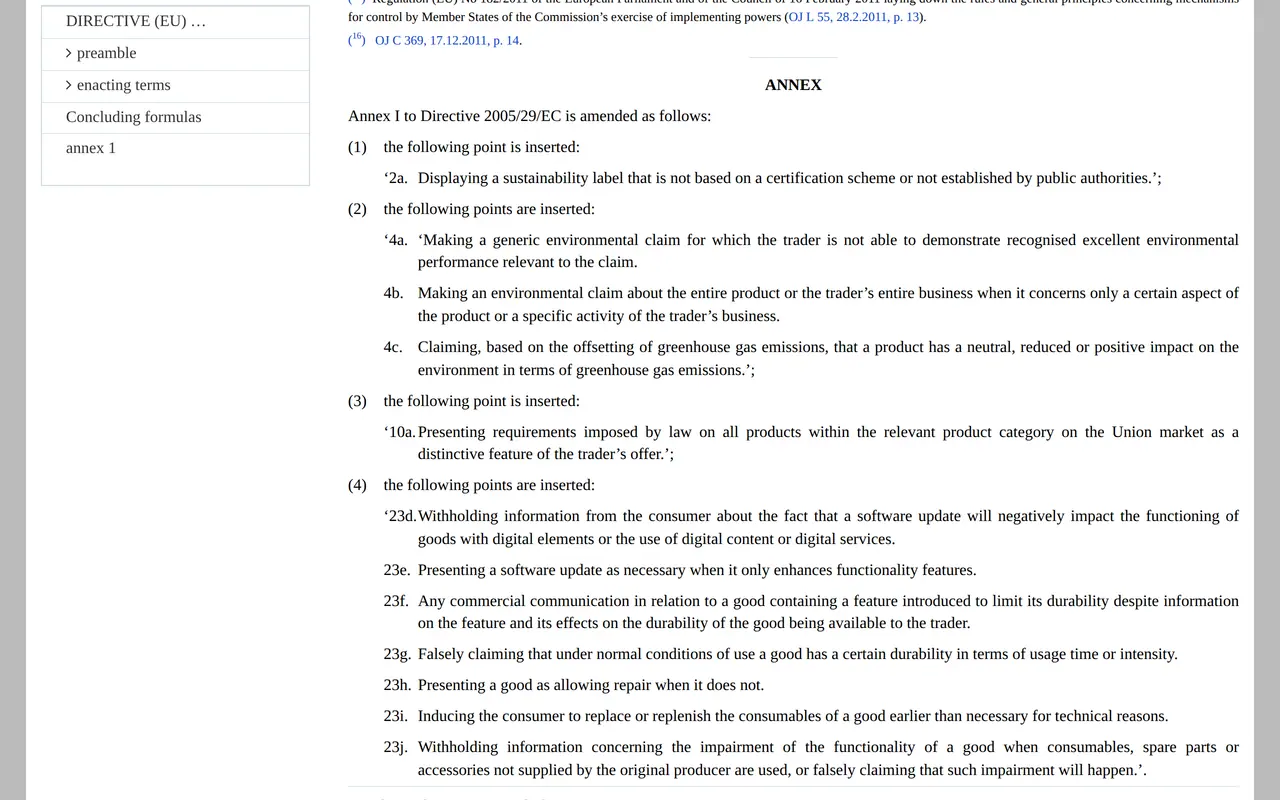
The EU ban on generic green claims applies since 27 September 2026. Directive (EU) 2024/825 bans environmental claims such as "green" or "environmentally friendly" without recognised excellent environmental performance, sustainability labels that rest on no certification scheme, and the promise that a product is climate neutral because you offset emissions elsewhere. Member states had to write it into national law by 27 March 2026, and the rules are the same in every one of them.
It covers everything you tell consumers: your site, your shop, your packaging, your ads and your social media. Specific claims you can prove remain allowed. It applies to every business selling to consumers in the EU, wherever it is based, so a brand in Oslo or London selling into France is as bound as a shop in Lyon.
- Generic claimCommon before"Eco", "green", "environmentally friendly" on its ownSince 27 September 2026Banned without recognised excellent environmental performance
- Own sustainability labelCommon beforeA home-made green logo on your productSince 27 September 2026Only with a certification scheme or from a public authority
- Claim about the whole productCommon before"Sustainable" when only the packaging improvedSince 27 September 2026Banned when it concerns only a part
- Climate neutral through offsettingCommon before"CO2 neutral" thanks to bought creditsSince 27 September 2026Banned
- Specific claim with proofCommon before"70 percent recycled plastic in the bottle"Since 27 September 2026Allowed, if you can prove it
What you say about your product must be provable, and cover the whole product or say which part.
When a green claim is still allowed
A generic claim is allowed only if you can show recognised excellent environmental performance relevant to that claim. The directive spells out what counts: the EU Ecolabel, a national or regional type I ecolabel under EN ISO 14024 that a member state officially recognises, or top environmental performance under other EU law. A paragraph of your own about "conscious choices" does not count.
The directive lists examples of generic wording: environmentally friendly, eco-friendly, green, nature's friend, ecological, climate friendly, carbon friendly, energy efficient, biodegradable and biobased. If you say clearly, in the same place, what exactly you mean, the claim is no longer generic. "Packaging made from 80 percent recycled cardboard" is fine, as long as it is true and you can prove it.
Grace periods differ by country
The directive itself has no transition period: the bans apply from 27 September 2026. Some national laws soften the start for stock already on the shelf. Belgium, for one, stops its inspectors from acting for six months on goods produced, packaged or placed on the market before that date, until 27 March 2027. Services get no such grace, and a competitor can still go to court in the meantime. Never assume one country's leniency applies in the next: check the law of each market you sell to.
What else the directive bans
The directive reaches beyond green words. It adds practices to the list that is banned in all circumstances, and two to the misleading practices that are judged case by case.
| No longer allowed | An example |
|---|---|
| Presenting a legal requirement as your selling point | "Free of banned refrigerants" on a fridge, when every fridge on the EU market must be |
| A future environmental claim without a plan | "Net zero by 2030" without a public plan with measurable targets that an independent expert checks regularly |
| Advertising irrelevant benefits | Promoting a benefit that does not follow from your product or the way you work |
| Hiding a built-in shorter life | Advertising a device with a part designed to limit its lifespan, while you know about it |
| False durability or repairability | "Lasts ten years" or "repairable" when it is not true |
| Calling updates necessary | Presenting a software update as needed when it only adds features |
| Replacing consumables too early | Pushing customers to replace filters or ink sooner than technically needed |
If you sell devices or goods with software, read the last four rows twice. They touch your product pages and your after-sales emails, not just your packaging.
Check your copy in four steps
- Find the wordsSearch site, shop, packaging and ads for eco, green, sustainable, climate neutral, natural and conscious.
- Ask for the proofFor each claim: which document, measurement or recognised ecolabel backs it?
- Make it specificReplace the vague claim with what you can show, with a figure and which part of the product it covers.
- Keep the proofStore the source per claim, so you can show it when a customer, a competitor or a regulator asks.
Rewritten, per sector
| Sector | Vague claim | Specific claim you can prove |
|---|---|---|
| Construction | "Sustainable renovation" | "We insulate your roof to the value your grant requires and install a heat pump" |
| Restaurant | "Green restaurant" | "Vegetables from three farms within 30 km, their names are on the menu" |
| Fashion brand | "Eco collection" | "Shirts in organic cotton with a recognised ecolabel, the rest of the range not" |
| Logistics | "Climate neutral delivery" | "Twelve of our trucks run on HVO, consumption per trip is in your report" |
| Holiday rental | "Green stay" | "Solar panels on the roof and a charger for your car" |
These are examples: fill them in with what you can prove.
A company that translates one master text
If your product pages are translated from one master text, fix the master once and every language follows. A claim banned in one EU market is banned in all of them, so a German, French and Dutch version need the same proof. Running several languages? See how we build a multilingual website.
A builder or installer
A builder promising "sustainable renovation" does better writing what it actually does: insulating to a set value, installing a heat pump, reusing materials. It is more honest and it sells better, because a buyer can decide on it. More in marketing for construction companies and websites for contractors.
An online shop
Product titles with "eco" or "natural" carry the most risk, especially when copied from a supplier. Go through your range and ask suppliers for the proof. A claim with a figure also helps search, because it answers what people look for; our SEO checklist covers product pages and ecommerce SEO goes further.
On social media and in ads
The rule covers every commercial practice towards consumers, so a post, a reel or an ad too. A campaign with "green" in the headline and no proof on the landing page is exactly what the EU wants gone. Write in your social media and your Facebook and Instagram ads what you concretely do, and let the landing page show the proof. "Insulated to a U-value of 0.24" tells a buyer more than "sustainably built", and Google and AI assistants would rather quote a page with a figure than a slogan. Two other EU rules reached shops this year: the withdrawal button and accessibility one year on.