On this page
Six quiet weeks, then another shake.
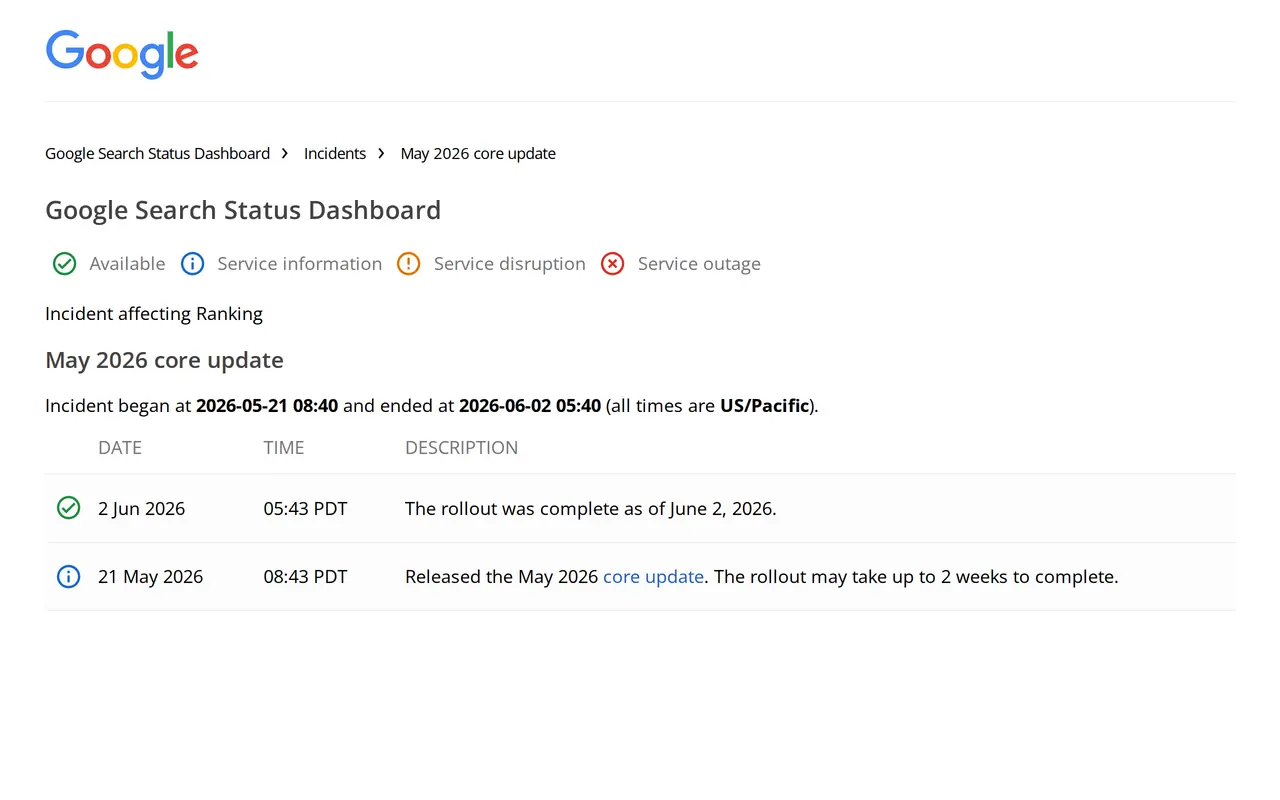
Google's May 2026 core update ran for eleven days and 21 hours and began 43 days after the March update finished. Sites that lost in April got a fresh chance quickly; sites that won could lose it just as fast. Short, but not a record: in late 2024 two core updates followed each other after barely a week.
It has been quiet since May. On 22 October 2026 Google had gone 142 days without a new core update, with three spam updates in between. That is close to the longest gap since 2024. Below: what the short and the long gap say about recovery, what Google wrote about AI that same week, and why you should set a baseline now.
Days between the end of one core update and the start of the next
- March 2024 to August 2024118 days
- August 2024 to November 202469 days
- November 2024 to December 20247 days
- December 2024 to March 202585 days
- March 2025 to June 202595 days
- June 2025 to December 2025147 days
- December 2025 to March 202688 days
- March 2026 to May 202643 days
- Since May 2026, on 22 October142 days, still running
Broad core updates only, without spam or Discover updates. Counted from the completion day to the start day on the status dashboard.
What 43 days meant for sites that fell in April
Google advises waiting a full week after a core update ends before you measure. After the March update, a fair comparison was possible from 15 April. That left 36 days before May to see which pages fell, understand why and improve them. Tight, but doable for a services site with ten pages that matter.
Whether those improvements counted in May is not certain. Google writes that some changes take effect within days, but that it can take months for its systems to see that a site as a whole has improved. Teams that fixed a handful of pages in April and wrote down what they changed could read in June what worked. Teams that rewrote everything in a panic could not.
A change log that answers after the next update
The difference between those two is a log. One line per change, with the date, so that after an update you can pair every movement with a cause. For a Dutch SaaS selling into Germany and the UK it looks like this:
| Date | Page | What you changed | Why |
|---|---|---|---|
| 16 April | Pricing page, German version | Added plan prices in EUR and a VAT note | Fell from position 3 to 11 in Germany, rival shows prices |
| 22 April | Integration guide | Rewrote with screenshots of the current product | Old screenshots, fewer clicks |
| 29 April | All feature pages | Titles rewritten around the buyer's question | Low click rate at good positions |
| 9 June | Pricing page, German version | Nothing changed, only measured: position and clicks next to those of 16 April | First measuring week after the May update |
The log takes ten minutes a week. It also makes your next SEO audit faster, because nobody has to guess what changed when.
What the AI guide of 15 May says, and what the market sells
- A separate discipline
- What some agencies sellAI optimisation as a new field with its own tricks, called AEO or GEO
- What Google writesThe usual SEO basics remain the basics, also for AI Overviews and AI Mode
- Special files
- What some agencies sellAn AI text file or extra markup that would earn AI answers
- What Google writesNo new machine-readable files, AI text files or special schema markup needed
- Content
- What some agencies sellLots of short answers, one page per question
- What Google writesUnique, non-commodity content with real experience and your own images
- Measurement
- What some agencies sellAI visibility rankings from third-party tools
- What Google writesSearch Console, with AI impressions per page since 31 August
If your SEO is in order, you do not start over for AI. If it is not, AI tricks win you nothing.
The guide that appeared a week before the update
On 15 May Google published a guide on optimising for generative AI in Search. It covers four things: why unique content that cannot be found elsewhere matters, how to provide local, shopping, image and video content, first guidance on AI agents, and why established SEO practice stays the foundation. The documentation on AI features is even more direct: there are no additional requirements to appear in AI Overviews or AI Mode, and no special schema markup to add.
For a local business that means a complete Google Business Profile and service pages that state price, area and process; see local SEO. For a webshop: your own product photos, real specifications and an explanation per category, as in ecommerce SEO. How classic SEO differs from writing for AI answers is in SEO vs GEO.
I/O in the same week
Two days before the update, on 19 May, AI Mode got Gemini 3.5 Flash as its default model at Google I/O, and you can now ask a follow-up from an AI Overview straight into AI Mode. Google reported more than a billion monthly users for AI Mode. What that means for your visibility is in Google AI Mode after I/O 2026. Since late August you can measure it yourself, in the Search Console AI report.
142 quiet days: set your baseline now
Google does not announce a core update in advance. If you want to read the next one, fix a comparison week now: positions, clicks and AI impressions of your twenty most important pages, per market, with the date. Then you compare against a week you chose, not against whatever you happen to remember.