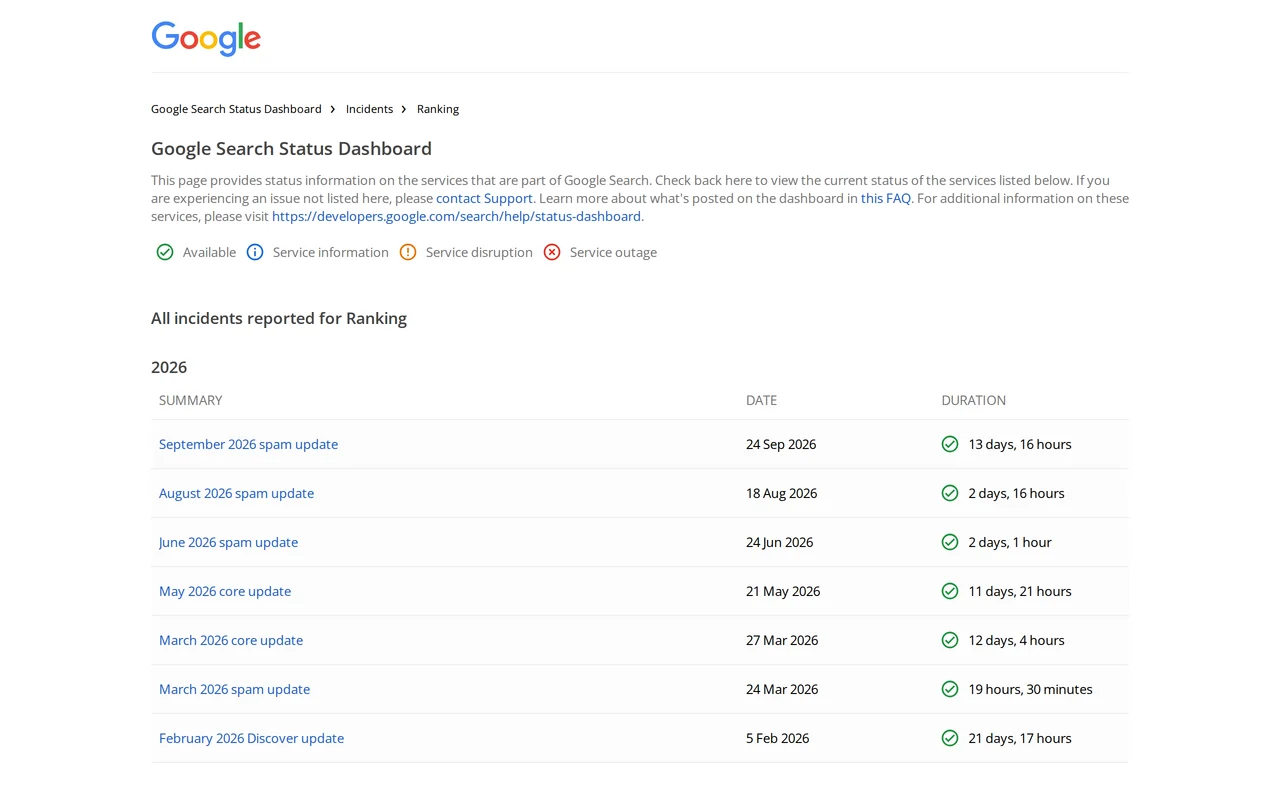
Google released two core updates in 2026 so far, on 27 March and 21 May, plus four spam updates and one update for Discover. The March core update took twelve days, the May one eleven. No core update has started since 2 June; the September spam update ran until 8 October.
This timeline puts every confirmed Google algorithm update of 2026 in one place, with the start and end as Google reports them on its Search Status Dashboard, what Google said, and how to read your own numbers. Other sites announce updates based on swings in their own tracking; this list sticks to what Google confirmed. A new line goes in with every update.
Every Google update of 2026
| Update | Start | End | Duration | What it is |
|---|---|---|---|---|
| December 2025 core update | 11 December 2025 | 29 December 2025 | 18 days | Broad reweighing of all pages |
| February Discover update | 5 February | 27 February | 21 days | Discover only, not search results |
| March spam update | 24 March | 25 March | 19 hours | Sites that break the spam policies |
| March core update | 27 March | 8 April | 12 days | Broad reweighing |
| May core update | 21 May | 2 June | 11 days | Broad reweighing |
| June spam update | 24 June | 26 June | 2 days | Spam policies |
| August spam update | 18 August | 21 August | 2 days | Spam policies |
| September spam update | 24 September | 8 October | 13 days | Spam policies, global, all languages |
The details per update are in our news pieces on the March 2026 core update, the May 2026 core update and the September 2026 spam update.
December 2025 core update18 days
February Discover update21 days, Discover only
March spam update19 hours
March core update12 days
May core update11 days
June spam update2 days
August spam update2 days
September spam update13 days
- Back button hijacking rule
- Site reputation: no longer in the EEA
No new update started after 8 October 2026. Smaller unannounced changes are not on the status dashboard.
What the two core updates had in common
Google announced both with the same sentence: the rollout may take up to two weeks. It took twelve and eleven days. Between the end of the March update and the start of the May one sat 43 days, short by Google's standards. A site that lost in April got a new chance quickly, and one that gained could lose it just as fast.
On recovery Google says the same every time: improvements can help, but it can take days to months, and often only shows at a later core update. What Google does say clearly is what it rewards: original information, a complete description of the topic, insight beyond the obvious, and no rewrites of other sources. That is the core of E-E-A-T. How to write an article that meets it is in how to write a blog post for SEO.
The spam updates, and two new rules in between
The March, June and August spam updates each finished within three days. September's ran thirteen days and sixteen hours, by far the longest of the year. Between those rounds, two rules changed that matter for ordinary business sites.
| Rule | Since | What it means for your site |
|---|---|---|
| Back button hijacking | Announced 13 April, enforced from 15 June | A script that redirects the browser's back button is a violation; check scripts from ad platforms too |
| Site reputation abuse | Since 30 August, manual actions no longer apply in the EEA | Searchers in Europe no longer see the effect; outside the EEA they do |
The second change is one of several where Google now treats the European Economic Area differently, alongside the changes that followed the Digital Markets Act; the DMA fine on Google explains the background. If you sell in Europe and elsewhere, check rankings per market, not as one global number.
Core update or spam update: read the drop differently
- Aimed at
- Core updateNo site in particular: Google reweighs all pages
- Spam updateSites that break the spam policies
- In 2026
- Core updateMarch and May
- Spam updateMarch, June, August, September
- If you drop
- Core updateSomeone else now answers the query better
- Spam updateSomething on your site breaks a rule
- What to do
- Core updateImprove the page for the searcher, then wait
- Spam updateFind and remove the violation
- Recovery
- Core updateOften only at a later core update
- Spam updateCan take months; bought links stay worthless
Reading your own data after an update
You see an update in Google Search Console: impressions and positions per page and per query. How to use Google Search Console walks through the reports. Google advises waiting a full week after the rollout is complete and comparing that week with a week before it started. Not yesterday, and not only the total: a drop on a page that never brought clicks is no problem; a drop on your main service page is.
Since September 2026 Search Console also reports on AI features; what the AI performance report shows, and what it does not, is covered separately. A drop after an update can also mean fewer clicks because Google answers at the top; AI Mode after Google I/O 2026 made that more common. Whether you can keep your content out of AI Overviews is in opting out of Google AI Overviews.
Rule out three other causes before you blame the update:
- A technical fault on your own siteA page set to noindex by mistake, a migration with wrong redirects, a slow server. The SEO checker and the technical SEO guide find them; a move goes smoother with this website migration approach.
- SeasonA query about the January sales drops in March whatever Google does. Compare with the same week last year.
- A competitor who got betterA core update often just shows that someone else answers the question better now.
Questions site owners ask after an update
How many Google core updates were there in 2026?
Two by 25 October 2026: the March 2026 core update (27 March to 8 April) and the May 2026 core update (21 May to 2 June). There were also four spam updates and one Discover update.
Is there a Google update right now?
Not as of 25 October 2026: the last rollout, the September spam update, finished on 8 October. Google lists every confirmed ranking update on its Search Status Dashboard.
Do Google updates hit sites in Europe differently?
Core and spam updates apply worldwide and in all languages. One rule differs: since 30 August 2026, manual actions for site reputation abuse no longer affect searchers in the EEA.
How long should I wait before judging an update?
Google advises a full week after the rollout is complete, then comparing that week with a week before it started.
Sites in several countries and languages
Core and spam updates roll out worldwide and in all languages, but their effect is rarely the same in every market. A site with an English, a Dutch and a French version can win in one language and lose in another during the same update, because the competition per language differs. Check Search Console per country and per language folder, not only the total, and compare each with its own week before the start.
Make sure Google knows which version is meant for whom. Language versions linked with hreflang help Google show the right page in the right country; without it, your Dutch page can compete with your English page for the same searcher. The February Discover update is a separate case: it only affected the feed in the Google app, not search results, so a drop in Discover traffic in February had nothing to do with your rankings.
One more European detail: an update can look different from Brussels than from London. Search result features that changed under the Digital Markets Act, and the site reputation rule above, mean a ranking you check from the UK is not always what a buyer in the EU sees. Use a VPN or Search Console's country filter before you draw conclusions.
What we saw ourselves
The site we built for Business Centrum grew sharply in the weeks around the September spam update: from 220 impressions a day in mid-September to 10,200 a day five weeks later, and from 13 to 1,593 non-brand search terms on page 1. The rise began around 28 September, during the rollout. We do not credit the update: in the same weeks we fixed the technical basis and published hundreds of pages that answer the questions of their clients. What it does show: a site with original, useful answers can grow while Google clears out spam. The method is in keyword research and in our SEO trends for 2027.
What may come after October
Google does not announce core updates in advance. Since March 2024, gaps between the end of one core update and the start of the next ranged from 7 to 147 days; by 25 October 2026 Google had gone 145 days without one, close to the longest pause in that run. A new update before the end of the year is quite possible, but unannounced. As soon as it appears on the dashboard, it goes into this timeline. If you wonder whether all this is still worth the effort: is SEO dead, and how long SEO takes.
How VBS steers your site through an update
After each update we check your numbers per page and per query the way Google recommends: a full week after the rollout, against a week before. If a page dropped, we find out why and rewrite it around what the searcher needs, or we tell you honestly to leave it. That is part of our SEO work, with the same method that grew Business Centrum's site. We work from Ghent, Belgium, for companies across Europe. Send us your Search Console export or book a call.