The three biggest SEO trends for 2027 are already under way: AI answers you can measure in Search Console since the end of August 2026, a Google that rewards original information and filters out template work at scale, and EU rules that make search results in Europe differ from the rest of the world.
Most trend lists come from the US and miss the third shift entirely. This one is written from Ghent, Belgium, for companies that sell in Europe. It predicts nothing that is not already visible: every point rests on what Google announced, on an EU decision, or on what we measure on the sites we build.
Shift 1: AI answers become measurable
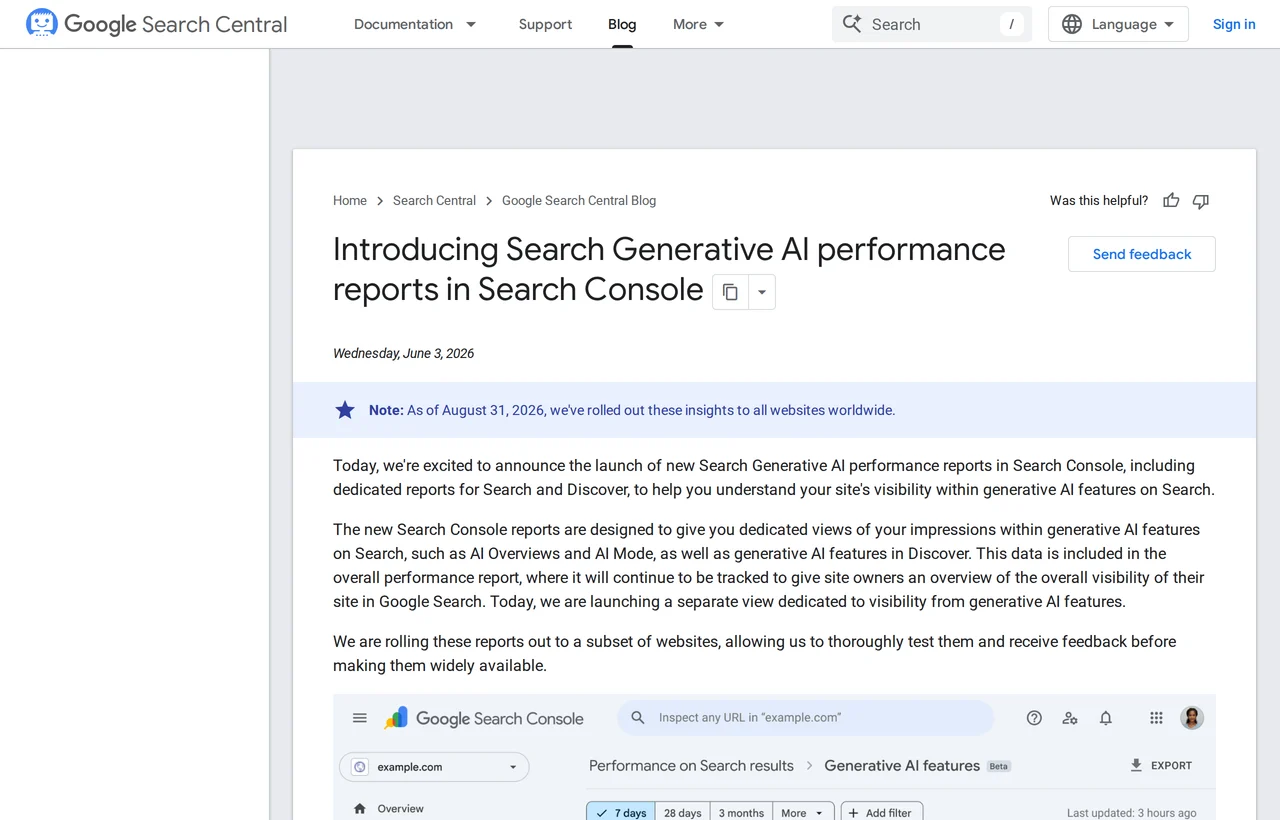
For two years AI in Google was something you could see but not measure. That changed in 2026. AI Mode is live across most of Europe and its languages, AI Overviews sit above many informational searches, and since 31 August 2026 Search Console gives every site a separate generative AI report: how often your pages appear in AI Overviews and AI Mode, per page, country and device. What the AI performance report shows and what it leaves out is covered separately.
For 2027 that means rankings and clicks are no longer the whole picture. A page can lose clicks and still be seen more, because it is cited in an answer. Anyone who only watches clicks draws the wrong conclusion.
| What you measure | Where | What it tells you |
|---|---|---|
| Rankings and clicks | Search Console, performance report | How you do in classic results |
| Impressions in AI features | Search Console, generative AI report | How often Google uses your page in an AI answer |
| Visitors from AI assistants | Your own analytics, by source | Who arrives via ChatGPT, Gemini or Copilot |
| Enquiries and calls | Your analytics and inbox | The only number that means revenue |
AI Mode splits a question into sub-questions and searches for each, which Google calls query fan-out; questions in AI Mode are nearly three times longer than classic searches. A page that fully answers a real question stands a better chance than one aimed at a loose keyword. How to find those questions is in keyword research. Since Google I/O 2026, users can follow up from an AI Overview straight into AI Mode, which strengthens the effect. Keeping your content out of AI answers is possible only in limited ways; see opting out of Google AI Overviews.
- What you measureSEO up to 2025Rankings and clicksSEO in 2027Also impressions in AI Overviews and AI Mode
- What Google rewardsSEO up to 2025A well-optimised pageSEO in 2027Original information found nowhere else
- Many pages at onceSEO up to 2025Templates per city or serviceSEO in 2027Only if each page has something of its own
- EuropeSEO up to 2025Same results as elsewhereSEO in 2027Own rules and results under the DMA
- Other searchersSEO up to 2025Google and little elseSEO in 2027ChatGPT, Gemini and Copilot read along
- The basicsSEO up to 2025Fast, indexable, right titlesSEO in 2027Still the condition for everything above
Each row is worked out in the article, with the source or measurement behind it.
Shift 2: original information wins, templates lose
In May 2026 Google published a guide on optimising for generative AI, and its core is not technical: unique content that is not common knowledge. The Google updates of 2026 carried the same message, and the spam updates targeted what Google calls scaled content abuse: many pages with little value, however they are made, with or without AI.
That hits a popular tactic: a hundred pages per city or service from one template, each with a different name. In 2027 it only works if every page has something of its own: local facts, its own worked example, its own answer. What Google means by experience and expertise is explained under E-E-A-T.
What we saw at Business Centrum
We tested this shift first-hand. For Business Centrum, a payroll and HR office in Ghent, we built pages from mid-September that each answer a question its clients ask, with figures from the official source and the date they were checked. In five weeks impressions in Google rose from 220 to 10,200 a day, and non-brand search terms on page 1 from 13 to 1,593. The first visitors via Google Gemini arrived.
Two things made the difference. Every page carried information found nowhere else in that form, such as pay scales per joint committee straight from the Belgian federal database. And the site makes life easy for AI assistants: a page of key figures, an llms.txt and a structured data file. That is no AI trick; it is the clarity Google rewards anyway. Schema markup does the same job for search engines.
Shift 3: Europe gets its own search results
The third trend is the least discussed and, for anyone selling in the EU, the most important. Under the Digital Markets Act, Google treats the European Economic Area differently. In July 2026 the Commission fined Google for favouring its own services and decided that from January 2027 Google must share anonymised search data with other search engines, including AI chatbots that search. Google appealed. Since 30 August, manual actions for site reputation abuse no longer apply to searchers in the EEA.
| Feature | In the EU | Elsewhere |
|---|---|---|
| AI Mode and AI Overviews | Available, in most EU languages | Available |
| Ads inside AI Overviews | Not yet | In English in twelve countries |
| Search data shared with rival engines | Planned from January 2027, under appeal | No |
| Ads in ChatGPT | Since 24 August 2026 | In 89 countries by October 2026 |
For a company selling in Europe, a US trend list is often early or simply wrong for your market. And the number of places where buyers search keeps growing: ChatGPT shows ads across Europe and has become a search engine for many. How to get named there is in how to get found in ChatGPT, and how that differs from classic SEO in SEO vs GEO.
Five things to do before 2027 starts
- Take a baseline in the AI reportOpen the generative AI report in Search Console and note where your pages appear in AI answers, per country.
- List the ten questions buyers askCheck whether your site answers each fully, with something no other page says.
- Cut the filler pagesRewrite or remove pages that exist only to hold a search term.
- Check results per marketLook at what Google shows in each EU country you sell in, not what a US list predicts.
- Get named elsewhereTwo or three places outside your own site where your buyers look: a trade body, a comparison, a local article.
What it means for your type of company
The three shifts do not weigh the same for everyone.
- A B2B service company(agency, consultancy, software) gets most from the second shift. Buyers ask long, specific questions, and AI Mode answers them by combining sources. A page that explains your pricing model, your process or a real comparison is the page that gets cited. Thin service pages lose.
- An online shopfeels the first shift hardest. Product questions increasingly get an answer before the click, so measure impressions in AI features next to clicks, and make sure product data is structured and complete. In the EU, where ads inside AI Overviews do not run yet, organic visibility in those answers is still the main way in.
- A local businessdepends on the basics more than ever: a complete Google Business Profile, reviews, and pages that mention the places you serve with something real to say about each. A hundred near-identical city pages are exactly what the spam updates target.
- A company selling across bordersshould treat each market as its own search landscape, with its own competitors, its own language and, inside the EU, its own rules.
Mentions on other people's lists
AI assistants name companies they come across in several places: your own site, but also lists, comparisons and other people's articles. A company that exists only on its own site is named less than one listed by a trade body or covered in a local article. That is not a new rule; it is what backlinks always did, made visible by AI. A list where you put yourself first does not help; search engines and assistants recognise that format.
What stays: the technical basis
Each of the three shifts assumes that Google and AI crawlers can read your site. A slow site, pages missing from the index, a robots.txt that blocks AI crawlers without you knowing: then no trend helps. Whether OpenAI's, Google's and other crawlers may read your site shows in the AI crawler checker; what has to be in order is in the technical SEO guide. Selling in several countries? Each language version needs hreflang, or your pages compete with each other.
For what changes beyond search, read our AI trends for 2027. If you doubt whether any of it still pays: is SEO dead.
How VBS gets you ready for 2027
We build sites and pages that answer a question better than what ranks today, with original information and a technical basis that Google and AI assistants read without effort. We measure what counts: rankings, impressions in AI features, and the enquiries that follow, per market. It is the approach that made Business Centrum's site seen 46 times as often in five weeks. Read about our SEO and found in ChatGPT work. We work from Ghent, Belgium, for companies across Europe. Book a call.