On this page
Twelve days of reshuffling, and the question after.
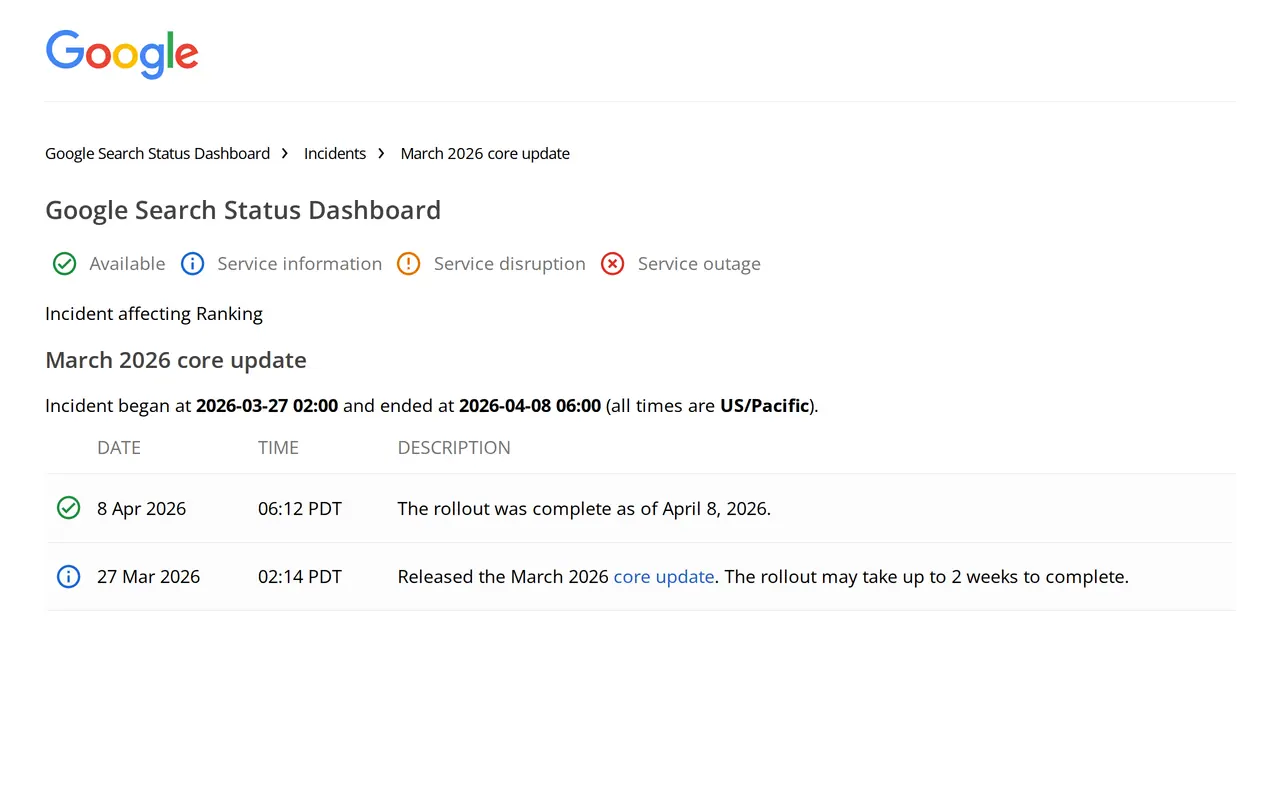
Google's March 2026 core update was the first broad ranking update of the year. Google said the rollout could take up to two weeks; it took twelve days and four hours. Three days earlier a spam update ran and finished in under a day. If you lost or gained traffic in late March or early April, you want to know which of the two it was, and whether to act.
A core update is not aimed at any particular site. Google reweighs how it assesses pages, and other pages rise for the same query. Below: how Google itself says to check it, where sites selling into several markets misread the data, and which reflexes to avoid.
Two updates, four days apart
The March spam update started on a Tuesday evening and was done by the next afternoon. The core update began three days later. Every update of the year is on one timeline in Google algorithm updates 2026. A spam update targets sites that break the spam policies: hidden text, bought links, pages at scale without value. A core update reweighs every page. They call for different responses, so you need to tell them apart.
The shape of the drop tells you. A spam update tends to hit a whole site or a whole folder, sharply, from one day to the next. A core update shifts things gradually, page by page, across the rollout. A cliff on 25 March points to the spam policies first. A slope between late March and early April is the core update. A drop on every page at once, brand name included, is usually neither: it is technical, such as a site migration gone wrong, a leftover noindex or a robots.txt that blocks too much.
Google's own method, step by step
Google describes how to read a core update. Wait at least a full week after the rollout ends. Then compare a week after the update with a week before it started, on the same weekdays.
- In Search Console, open Performance and compare a week from 15 April with the week before 27 March.
- Review your top pages and queries. Google draws the line itself: from position 2 to 4 is a small drop, leave it alone. From 4 to 29 is a large drop, and it calls for a deeper assessment.
- Look at search types separately: Web, Images, Video and News. A drop in Images needs a different fix than a drop in Web.
- Add a filter per country. The update is global and in every language, but your competitors differ by market. A Dutch SaaS can rise in the Netherlands and fall in Germany in the same week.
- Check Security and Manual actions. A core update never sends a notice. If there is one, it is something else.
One trap in that measuring week: Easter Sunday fell on 5 April, mid-rollout, and Easter Monday is a public holiday in most of Europe. Business searches dip around it without any update involved. Compare the week of 20 to 26 April as well, and set the same weeks of 2025 next to it.
Rollout duration, in days
- December 2025 core update18 days
- February 2026 Discover update22 days
- March 2026 spam update< 1 day
- March 2026 core update12 days
- May 2026 core update12 days
- June 2026 spam update2 days
- August 2026 spam update3 days
- September 2026 spam update14 days
Rounded to whole days. Read a drop only after the rollout ends, and compare the same weekdays.
Which drop fits which cause
| What you see | Likely cause | What you do |
|---|---|---|
| Sharp cliff on 24 or 25 March, whole site or folder | Spam update | Check the site against the spam policies; recovery takes months |
| Gradual slide between 27 March and 8 April, some pages | Core update | Compare those pages with what ranks above you now |
| One or two positions lost on your top pages | Core update, small shift | Change nothing on what performs well |
| Dozens of positions lost, across the site | Core update, large shift | The self-assessment below, honestly, on the whole site |
| Every page at once, brand name too | Technical: indexing, robots.txt, a migration | Run the SEO checker and read technical SEO |
| Fewer impressions, positions unchanged | Lower demand, the Easter week | Nothing: compare with the same weeks of 2025 |
The self-assessment Google suggests
If you fell hard, Google does not hand you a list of errors but a set of questions. Ask them of the pages that lost most, and get someone outside your company to read along. Does the page bring original information, its own figures or research? Does it cover the subject completely? Does it go beyond the obvious? Does it mostly rewrite what other sites already say? Was it mass-produced, by many writers or across many sites? Does it contain errors anyone could check quickly?
Answer those honestly and you usually see why a competitor now ranks above you: a price you do not show, an example from practice, a named author. That is what Google means by experience, expertise and trust. For a German webshop it is often hundreds of category pages that say almost the same thing; see duplicate content and ecommerce SEO. For a company in several markets it is often one language that slipped: a multilingual website is several sites in Google's eyes, each with its own competitors, and thin translations lose first.
Recovery can take days, or wait for the next update
Google writes that some improvements take effect within days, but that it can take months for its systems to see that a site as a whole has improved. Smaller core updates, which Google does not announce, can also lift an improved page. If nothing moves after a few months, you wait for the next broad core update. That one started on 21 May.
Reflexes that break more than they fix
- Rewriting every pageGoogle advises against touching pages that perform well. Without data you throw those away too.
- Deleting whole sectionsA last resort for Google, only for content that cannot be saved.
- Buying linksThat is not what a core update is about, and it is a reason for the next spam update.
- Measuring during the rolloutPositions move daily while the update runs. Google says: wait a full week after it ends.
Where to start when you do need to act
Start with an SEO audit that says which pages fell and why, not with a rewrite. If your site no longer appears at all, the website not showing on Google check is the first stop. Fix the pages that really lost ground with the twenty checks of the SEO checklist, and log every change with a date. Plan for time: how long results take is in how long does SEO take. What the next update did for sites that lost in April is in our piece on the May 2026 core update.