Taxi and private hire
Taxi website design that takes airport bookings while you drive
A passenger books a 4am run to the airport, sees the fare before confirming and gets the confirmation straight away, while every driver on shift is out on a job.
Pre-booked journeys start on a phone screen
Most private hire work is booked ahead: the early flight, the hospital appointment, the school run, the late train home. The passenger searches, compares two or three operators and books with whoever gives a fare and a confirmation first. A site that shows a phone number and a photo of a saloon loses that booking to the operator whose form takes ninety seconds.
This page covers what a taxi or private hire site needs to win bookings, what your operator licence asks of the booking flow, what it costs and how we start. For the dispatch and driver app behind the site, read our page on software for taxi companies.
Booking form fields that save a call back
Every question the form leaves out becomes a phone call later. A good form asks for what the driver needs and nothing more.
| Field | Why the passenger fills it in | What it saves you |
|---|---|---|
| Pickup and drop-off | Address lookup that works on a small screen | Wrong addresses and calls to check the street |
| Date, time and flight number | The driver tracks the flight for the return leg | Waiting at arrivals for a delayed plane |
| Passengers and luggage | Four people with four cases need an estate or an MPV | Sending a saloon that cannot take the bags |
| Child seat or wheelchair | The right vehicle turns up | A refused job at the door |
| Fixed fare shown before confirming | No surprise at the end of the ride | Arguments about the price |
| Account booking for hotels and firms | Reception books without ringing, billed monthly | Hours on the phone with regular customers |
A form on your own site is not a marketplace: the passenger books with you, you set the fare and no commission comes off each job. How such a module is put together is on booking system for your website. A simpler start works too: each request arrives by email and you confirm it yourself.
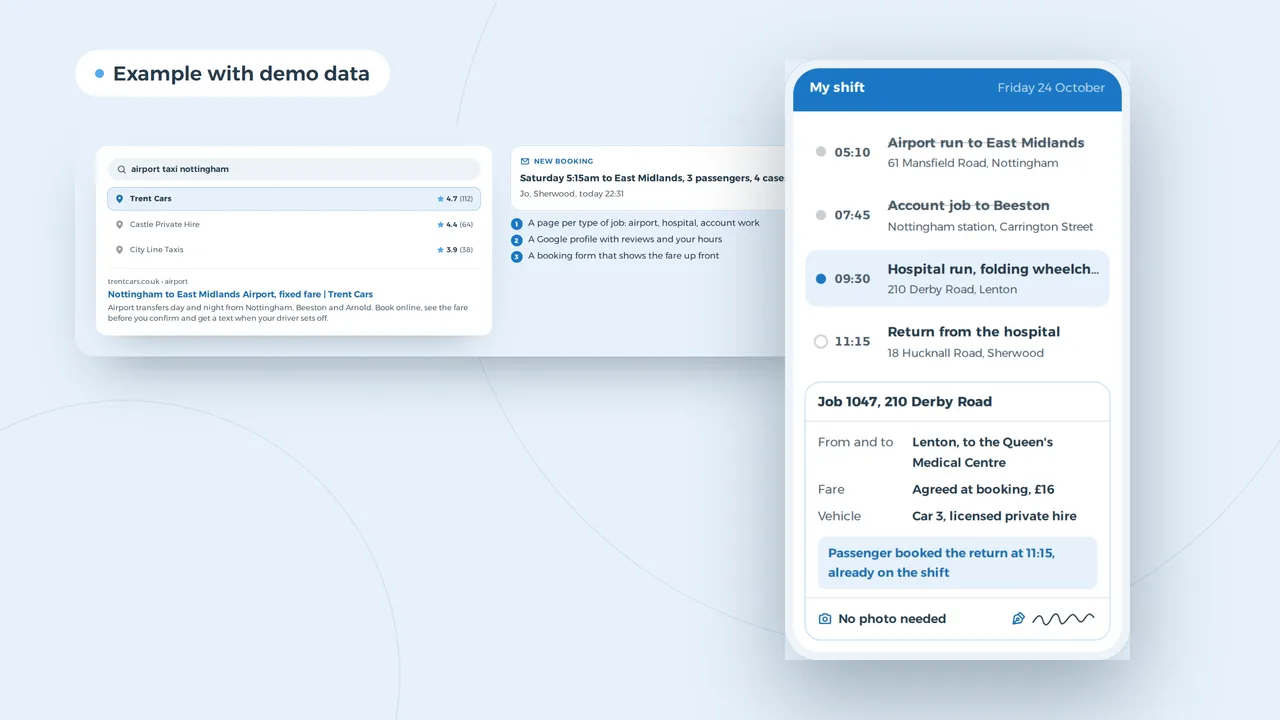
A late search for an airport transfer
New booking
Saturday 5:15am to East Midlands, 3 passengers, 4 cases
Jo, Sherwood, today 22:31
- A page per type of job: airport, hospital, account work
- A Google profile with reviews and your hours
- A booking form that shows the fare up front
The firms and reviews above are fictional.
Airport pages, town pages and your Google profile
Almost every taxi search is tied to a place: taxi in your town, taxi to Heathrow, taxi to Manchester Airport, taxi to the station. Ranking for those searches takes a page per destination and per town you cover, each with the fare, the journey time and what fits in the car. One page called Our Services does not win them.
Start with your Google Business Profile. If you run from home and do not want that address public, a profile with a service area works: see a business profile without an address. Reviews carry a lot of weight for a taxi, because a passenger would rather get in with the operator who has eighty good reviews than with a name they do not know. Getting more Google reviews covers how to ask, and the review link generator gives you a direct link to send after each job.
With structured data Google reads your service area and fares the way you mean them. The wider approach to ranking in your area is on local SEO, with practical steps in local SEO tips.
Licensing rules your booking flow must respect
A private hire operator in England and Wales works under a licence from the council. What the site promises has to match what you record and what your drivers do.
| Rule | Source | What it means for the site |
|---|---|---|
| Operator licence from the council, for up to five years | Local Government (Miscellaneous Provisions) Act 1976, s.55 | Show your licensing council and licence number; hotels and firms check it |
| Every booking recorded before the journey starts | s.56 | An online booking creates that record with the right fields, without retyping |
| Booking records kept for at least six months | Statutory taxi and private hire vehicle standards | The site and your system keep the history, not an inbox that gets cleared |
| A register of staff who take bookings or dispatch, with basic DBS checks | Statutory standards | Office staff who handle web bookings belong on that register |
| Passing a booking to another licensed operator is allowed | s.55A | When you are full, the job can still go out under the rules |
The full route to a licence is in start a taxi business in the UK. The company details that belong on every page are covered in company number on your website. A booking form handles personal data, so read a GDPR-compliant website and whether you need a privacy policy.
Record keeping starts at the form
Your operator licence asks you to record every booking before the journey and to keep those records for at least six months. A web booking that lands in your system with the pickup, time, passenger and fare already filled in is a record nobody has to type up afterwards.
The web booking on the driver's phone
- Every job is logged before it startsThe booking sits in the system with time, pickup and passenger before the driver sets off, which is what the operator record needs.
- The return job is already thereThe passenger asks for it in the car, the driver adds it to the shift and dispatch sees it.
- The shift record fills itselfStart and end of the shift, the car and the jobs come together. Nobody copies them out at night.
How a driver app for a private hire firm could work. Addresses and jobs are invented; you choose what a job records.
Dispatch and driver app behind the form
The site is the front door. Behind it, someone decides which car takes the job. With two cars the owner does that in their head. With twelve cars and night shifts it takes a dispatch board that spots a car booked twice, and an app where the driver sees the jobs for the shift.
| Size | Website | What sits behind it |
|---|---|---|
| Owner-driver | Fixed fares and a form that goes to your email | Nothing extra: you confirm each job |
| Three to five cars | Form with date, time and return leg, email confirmation | A shared calendar or a simple dispatch board |
| Twenty to fifty drivers | Accounts for hotels and firms, jobs on invoice | Dispatch board, driver app and the booking record |
| Larger, with its own control room | Sites per town or region | A link with the system your control room already runs |
What goes into that board and app is on the taxi companies page. If you already run booking software, the site pulls from it through an API integration, so nobody keys a job in twice. A separate driver app is its own project: see app development. If your cars also carry parcels in quiet hours, look at courier companies.
Recruiting drivers for the night shift
A taxi firm grows only as fast as it finds drivers. A careers page on your own site does more than a job ad that vanishes after thirty days. Say which shifts you run, whether there is night work, which cars drivers use and what a driver needs before the first shift, so someone without the paperwork learns what to sort out first.
Keep the application short: name, mobile number, the area they know and the languages they speak. That is enough for a first conversation. How a careers page helps people stay as well as apply is under employer branding.
Languages and speed at the terminal
Airport passengers are often tourists, students or people travelling for work. An operator near a big airport gets requests in Polish, Spanish or Arabic as well as English. A site with its own page per language is found in each of them; how that works is on multilingual website development.
Speed matters just as much. Someone looking for a car outside a terminal has a phone, a weak signal and little patience. A page that loads slowly loses them before they see a fare. Check your current site with the website speed test and read improve website speed for what you can fix yourself. Google measures that experience through Core Web Vitals.
Missed fares, worked out
Those amounts are assumptions. Your own figures come from the missed calls on your phone and your average fare. A first estimate for the build itself comes from the website cost calculator, and the wider price ranges are in website cost in the UK.
Four stages to a booking site
- A conversationYou tell us which jobs you run, where your passengers come from and how bookings come in today. We look at your current site and your Google profile together.
- A fixed priceYou get a proposal that says what is in and what is not, with one fixed price for the whole project.
- Your fares and destinationsWe build the destination and town pages, the form and the confirmation. You supply the fares and the rules of your shifts.
- Live and foundThe site goes live with your business profile and reviews linked, and you see which pages bring in bookings.
Price and first conversation
A website with VBS starts from 1,500 euro. A site with destination and town pages, several languages and a booking form takes more work than a single page; what it comes to for your firm you hear after the first conversation, as a fixed price per project. How we work is on website design, and how long a build usually takes is answered in how long a website takes.
Advertising can sit on top for busy periods such as the summer holidays: see Google Ads.
We have no taxi firm as a client yet; we did build a site in four languages for Business Centrum, with French, English and Turkish next to Dutch.
Operators ask us this
Can passengers pay online when they book?
Yes, if you want that. Card payment at booking cuts no-shows on airport runs; many operators keep payment in the car for local jobs. You choose per type of journey.
Does a web booking count as the booking record under s.56?
The form can capture the details the record needs before the journey. Whether your record is complete is set by your council's conditions, so we build the fields from those conditions.
Do I need a separate app for passengers?
Rarely. A fast mobile site with a short form covers most bookings. An app pays off once regular customers book several times a month.
Can the site show fares that change by time of day?
Yes. Night and bank holiday fares can sit next to the day fare, as long as the passenger sees the fare before confirming.
We already use a dispatch system. Does the site replace it?
No. The site sends bookings into the system you use, if it offers a way to receive them. Otherwise bookings arrive by email until a link is built.
Website design
How VBS helps you with this
We build your site from design to copy, imagery and code, in one team, so that Google and your buyers find it and get in touch.
- Design and copy built on your buyers' questions
- Fast, multilingual when you need it, at a fixed price
- Forms, cookieless analytics and hosting on AWS
How we approach it is on our page about Website design.
Bookings through your own site?
Send us your current site, the destinations you drive most and how bookings come in today. After a conversation you get a proposal with a fixed price.
Rather get in touch right away?