Industries: taxi companies
Taxi dispatch software for bookings, drivers and the records your council asks for
A driver app with every job of the shift and a fixed price agreed up front, a board that knows who drives which car, and bookings that come in through your own website. Built around how your office actually dispatches.
Private hire offices run on two phones and a radio
Taxi dispatch software starts with a night shift that ends at four and a day shift with an East Midlands Airport run at five. In between, a hotel emails for three cars tomorrow, a hospital asks for a regular run for a patient on dialysis, and a business account wants to know why last month's statement is missing two jobs.
In a lot of private hire firms that runs through the owner's phone, a booking book in the office and a group chat with the drivers. Bookings are written down after the call, if at all, and who had car 3 on Tuesday night is only known to whoever was working. Jobs slip through and two shifts end up on the same car.
Taxi booking software built for you puts jobs, cars and drivers in one place: an app for each driver, a board for the week, and booking on your own site that drops the job straight onto the board. Below, need by need, is what we build, which licensing rules belong in your system and how much system fits the size of your fleet.
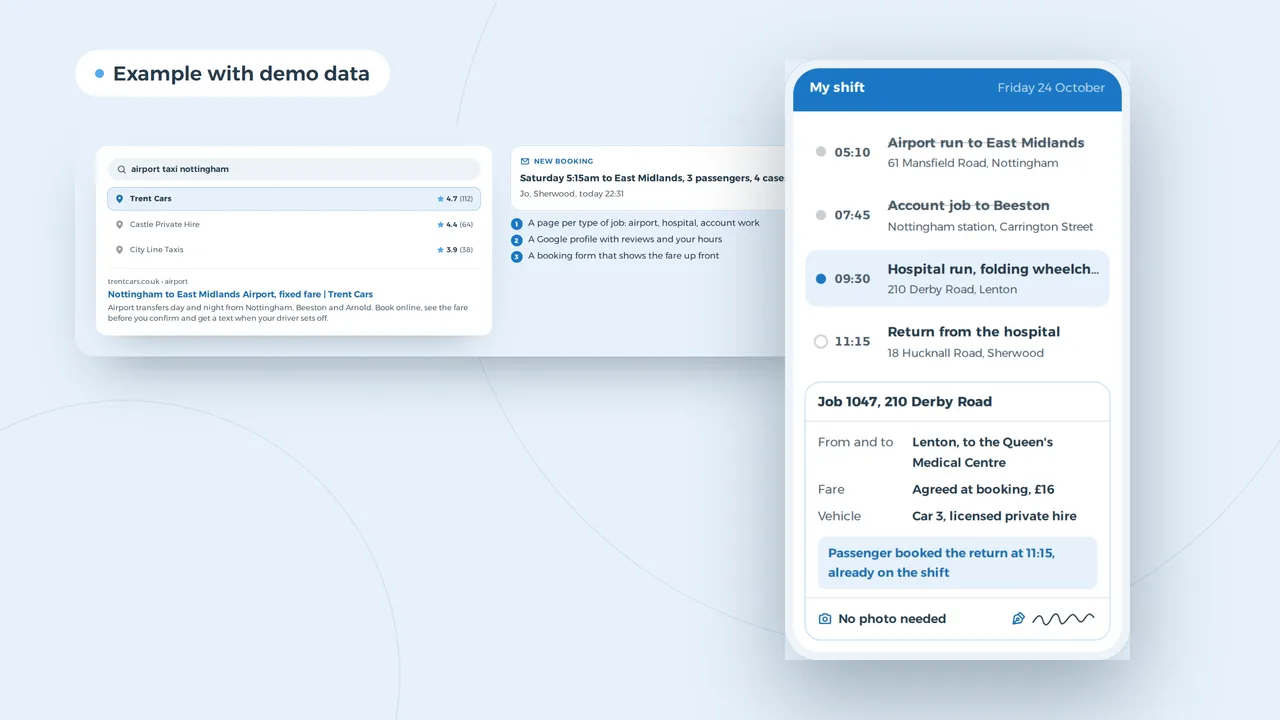
Job sheet with the agreed fare on the driver's phone
- Every job is logged before it startsThe booking sits in the system with time, pickup and passenger before the driver sets off, which is what the operator record needs.
- The return job is already thereThe passenger asks for it in the car, the driver adds it to the shift and dispatch sees it.
- The shift record fills itselfStart and end of the shift, the car and the jobs come together. Nobody copies them out at night.
How a driver app for a private hire firm could work. Addresses and jobs are invented; you choose what a job records.
Airport runs, school contracts and a busy Saturday night
A taxi firm rarely loses money on the journey itself. It loses it on the phone nobody answers, the booking nobody wrote down and the car that sits idle because the rota lived in a book.
| Moment | How it often goes | With your own taxi dispatch software |
|---|---|---|
| A customer wants a car | Ringing until somebody picks up | Booking on your site or by phone, the job lands on the board at once |
| A regular school or hospital run | A list in the booking book | A recurring job with the same driver and times |
| The shift starts | Keys and car from memory | The driver sees their car, their jobs and who had the car before |
| After the job | A paper receipt, if asked | A receipt by email or text, with the fare and the time |
| End of the shift | Writing up the jobs afterwards | Every job already recorded with time, pick-up and destination |
| Business accounts | Adding up jobs per customer at month end | A statement per account with every job on it |
An airport run, a school contract and a job from the rank are three different things. The first has a fixed price and a flight number, the second a regular customer who pays monthly, the third a meter. So we build the job as the unit with a type, not as a line in a diary. Cars, with MOTs, insurance and servicing, belong in fleet management software.
Travellers searching for an airport taxi tonight
New booking
Saturday 5:15am to East Midlands, 3 passengers, 4 cases
Jo, Sherwood, today 22:31
- A page per type of job: airport, hospital, account work
- A Google profile with reviews and your hours
- A booking form that shows the fare up front
The firms and reviews above are fictional.
Someone who needs a car searches "airport taxi Nottingham" or "taxi near me" and rings or books with the first name that looks right. Booking on your own website brings that job in without paying commission to a platform: pick-up, destination, time, passengers and luggage, a fare agreed up front, and the job is on the board.
We build the site with a page for each kind of work you want: airport transfers, hospital runs, business accounts, weddings and nights out. What a taxi site needs is set out on taxi website design; a site with a booking form starts from 1,500 euro, see website design. The booking itself is a booking system for your website. Being found in the towns you cover is local SEO, with practical steps in local SEO tips. Taxis live on reviews; a Google review link sent after the job gets more of them written, and the rest is in get more Google reviews.
Car 3 booked twice on Tuesday night
Car booked twice
On Tuesday night Imran and Darren are both on car 3. One car, two shifts.
Car 5 is idle on Tuesday and its licence plate is valid. The board puts Imran in it.
Fixed: Imran to car 5
A sample dispatch board with drivers who do not exist. You decide which rules it checks.
A board for a taxi firm plans two things at once: who drives, and in which car. A driver cannot be in two cars, and a car cannot go out with two drivers. The board spots a clash before the shift starts and suggests a free car. It also tracks who has done two nights in a row and which car is due its test.
That rota connects to hours and contracts. For employed staff there is staff scheduling software and a time tracking app that adds up the shifts. A driver app is built as a custom app; a rough budget is in app development cost. If you are weighing this against an off-the-shelf dispatch system, build vs buy software sets out the trade-off.
Operator licence, booking records and DBS checks
Private hire in England and Wales runs on a council licence and duties per booking, per driver and per member of staff. These are the rules that most often belong in your system.
| What | What the rule asks | What the software does |
|---|---|---|
| The operator licence | Granted by the council for up to 5 years, under section 55 of the Local Government (Miscellaneous Provisions) Act 1976 | The expiry date with a reminder well ahead |
| Every booking | Recorded before the journey starts, under section 56 | A job cannot go to a driver until it is saved with its details |
| Keeping records | Statutory standards expect booking records kept for at least 6 months | Records stored and searchable for as long as you set, at least 6 months |
| Office staff | A register of staff who take bookings or dispatch, each with a basic DBS check | The register with check dates, and a flag when one is due |
| Passing on a booking | Subcontracting to another licensed operator is allowed under section 55A, added by the Deregulation Act 2015 | Subcontracted jobs marked with the operator who took them |
| Employing staff | Employers' liability insurance of at least £5 million | A reminder before the policy runs out |
Councils add their own conditions on top, so check yours before we build; the software follows what your licence says. Because the records hold names, addresses and journeys, how long you keep them and who sees them matters; UK GDPR vs EU GDPR covers the basics. VAT already runs through Making Tax Digital, and B2B e-invoicing over Peppol becomes mandatory from 1 April 2029; see e-invoicing in the UK. The software applies for nothing and reports nothing on your behalf.
Hotel email with three pick-ups becomes three bookings
A sample of what we build. AI reads the email and proposes; a person assigns the cars and decides.
AI does not take the phone off your dispatcher. It removes the retyping: an email from a hotel, a message from a travel agent or a list from a school becomes a set of jobs with time, address and passengers, ready to confirm. The dispatcher picks the cars and presses confirm; the customer gets the confirmation with the fare. On your website an AI chatbot can answer questions at night about airport fares or a wheelchair-accessible car, and propose a booking that a person checks before it is saved. More in AI in transport and AI customer service.
Night drivers with a private hire licence wanted
The applicants in this sample are not real. You pick what the form asks.
For a lot of taxi firms, finding drivers is harder than finding passengers. An applicant wants to know whether they drive days or nights, in which car and how pay works. So we build the vacancy on your own site with a few questions that count: do they hold a private hire licence already, how long they have had a full licence, which shifts suit them, which languages they speak. Applicants without a licence see what the council asks before they apply. You see everyone in a list with their status. How you stand out as an employer is employer branding, and AI for HR speeds up the first replies.
Cars on the fleet: from one to fifty
An owner-driver with one car does not need an ERP. An office with forty cars needs more than a booking book. What we would put in place depends on headcount.
| Size | What you need | What you do not need (yet) |
|---|---|---|
| Owner-driver | A website with a booking form, a Google profile, jobs on the phone with an email receipt | A dispatch board, roles and permissions, an ERP |
| Team of 5 | The board for drivers and cars, the driver app, booking records kept the way your licence asks | A passenger app in the app stores |
| Firm of 20 to 50 | Business accounts with monthly statements, school and hospital contracts, licence and DBS dates, a link to your accounts package | A large package built for goods transport |
| Larger company | A portal where hotels and businesses book themselves, figures per account and per car, subcontracted jobs on the board | A second system next to the first |
Once a few business accounts book regularly, a client portal where they book and find their statements pays off. The monthly invoices themselves can go out through Peppol invoicing software ahead of 2029.
Missed bookings counted for an eight-car firm
| Task per week | Booking book and group chat | Your own taxi dispatch software |
|---|---|---|
| Retyping jobs from emails and calls | 6 hours | 1.5 hours |
| Checking the booking records | 4 hours | 1 hour |
| Monthly statements for accounts | 3 hours | 0.5 hours |
| Total | 13 hours | 3 hours |
That is 10 hours a week, 500 hours over 50 weeks. At £25: 500 x 25 = £12,500 a year. Add the bookings nobody took at night. Suppose 4 more jobs a week come in through the site because nobody has to answer the phone: 4 x 20 x 50 = £4,000 in fares. Together £16,500 a year in this example. Plug in your own figures and the result moves. What custom software costs in general is in custom software development cost.
Hackney ranks, subcontractors and starting out
Three questions come up with taxi firms. Does it work for hackney carriage work from the rank as well as private hire? Yes: rank jobs get their own type, with the meter fare entered by the driver, while pre-booked work keeps the full booking record. Can subcontracted operators see jobs you pass on? Yes, with their own role that shows only those jobs, and each one is marked with the operator who took it. Can you start small? Yes. If you are new, read start a taxi business in the UK first, then begin with a website and a job list on the phone.
We also build for couriers on courier companies, and for heavier vehicles on transport software.
Dispatchers and drivers: getting started
- A conversation about your shiftsHow do jobs come in, who hands them out, what does the driver fill in, when do statements go out? We go through an ordinary week, nights included.
- A fixed price per projectTogether we pick where you lose the most and set a fixed price for that piece. A website with a booking form starts from 1,500 euro; software is priced after the conversation.
- One shift runs on itA few drivers and the dispatcher use the first version on a real shift. What does not fit, we change before everyone joins. Code and data stay yours.
No taxi firm is on our client list yet; what does run every day since July 2026 is the clash-checking board and three-language driver app at DA Logistics, with about thirty drivers and 34 vehicles.
Custom software
How VBS helps you with this
We build the platform your business runs on every day: your spreadsheets, emails and paperwork in one system that does what you do.
- Your workflow mapped first, then a fixed price
- Screens for the office, the client and the road
- Hosting, backups and security managed by us on AWS
How we approach it is on our page about Custom software.
Jobs and cars on one board?
Tell us how a day and a night at your firm run. We will show you where we would start.
Rather get in touch right away?