On this page
What are the legal requirements for an online store selling to consumers in the EU? Your full identity with address, phone number and email, the total price including VAT and delivery before the order button, a 14-day right of withdrawal with a model form and, since June 2026, a withdrawal button, and a two-year legal guarantee. On top of that came rules on accessibility, product safety and green claims since 2025, plus VAT through the One Stop Shop once you sell across borders.
This guide is for a store based anywhere, the UK, the US, Switzerland or another EU country, that sells to customers in Belgium and the rest of the EU. It lists every rule with its date and what you change on your site, and links to the news piece with the detail where one exists. For advice on your own terms or a dispute, talk to a lawyer in the customer's market; this guide covers the technical side: what has to be on screen.
Why EU rules apply to a store outside the EU
EU consumer law follows the customer. Once you direct your store at EU consumers, with a shipping option to Belgium, prices in euro or a site in Dutch, French or German, their consumer protection applies to the sale and cannot be signed away in your terms. Choosing English law in your conditions does not remove a Belgian buyer's 14 days to withdraw. The same goes for the geo-blocking rules: you may choose not to ship to a country, but you may not block or reroute a visitor from it without their consent.
What every online store must show before the order
| What | Where on your site | Source |
|---|---|---|
| Company name, registration number, VAT number | Footer of every page and a legal page | E-Commerce Directive, Consumer Rights Directive Art. 6 |
| Geographical address, phone number, email | Footer and contact page | Consumer Rights Directive Art. 6, as amended in 2022 |
| Total price with VAT, plus delivery costs | Product page, at the latest before the order button | Consumer Rights Directive Art. 6 |
| Payment methods and delivery time | Product page and checkout | Consumer Rights Directive Art. 6 |
| Right of withdrawal, deadline, who pays returns, model form | Terms and confirmation email | Consumer Rights Directive Art. 6 and Annex I |
| Two-year legal guarantee | Terms | Sale of Goods Directive |
| Order button worded "order with obligation to pay" or equally clear | The last button of the checkout | Consumer Rights Directive Art. 8 |
Does an online store need a phone number? Yes: since the 2022 changes to the Consumer Rights Directive the phone number is on the list next to address and email. The law does not set opening hours, but a number nobody answers fails the purpose of quick contact. A post box does not count as an address.
Withdrawal: 14 days, and the button of June 2026
A consumer has 14 days from delivery to cancel a distance purchase without giving a reason. You refund the price and the standard delivery cost within 14 days of the cancellation, and may wait until the goods are back or you have proof of return shipping. Forget to inform the customer of this right and the period grows by twelve months.
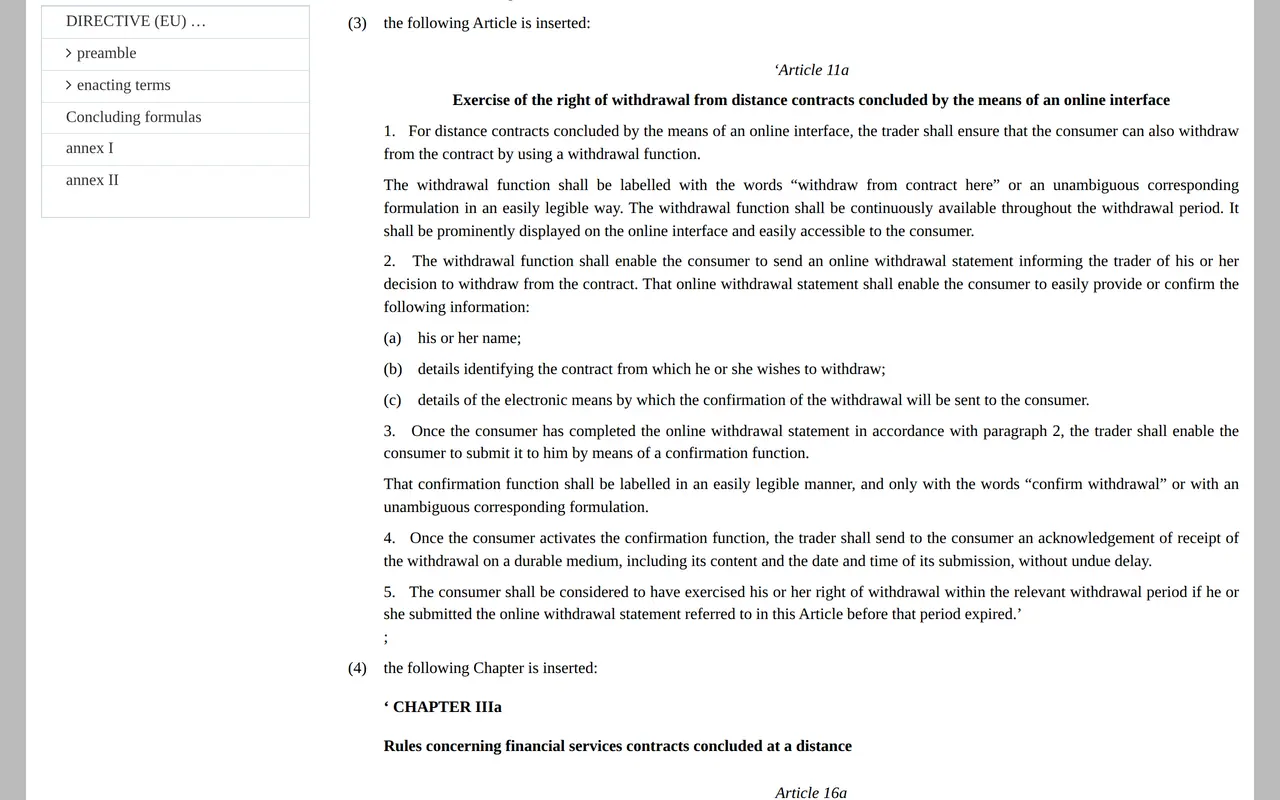
New since 19 June 2026: every store selling through a website or app shows a withdrawal function, labelled "withdraw from contract here" or equally clear, visible during the whole withdrawal period, with a second step "confirm withdrawal" and an acknowledgement on a durable medium. Belgium wrote it into Article VI.61/2 of its Economic Law Code, in force since 14 August 2026; other member states have their own transposition. What it looks like and what has to happen behind it is in the EU withdrawal button.
Rules added since 2025, and what you change on your site
- 13 Dec 2024Product safety (GPSR)Manufacturer, EU responsible person and warnings on every product page
- 28 Jun 2025Accessibility (EAA)Checkout and menu work with keyboard and screen reader
- 20 Jul 2025ODR platform closedRemove the link to the platform
- 1 Jan 2026Peppol e-invoicing in Belgium (B2B)Invoices to Belgian businesses through Peppol, not as PDF
- 19 Jun 2026Withdrawal buttonTwo-step button with email confirmation
- 1 Jul 2026EUR 3 customs dutyRework landed cost of small parcels from outside the EU
- 27 Sep 2026Vague green claims bannedDrop or prove eco, green and climate neutral
- 27 Mar 2027Green claims grace endsOld stock without generic claims too
- 28 Jun 2030Belgian accessibility for micro firmsShops under 10 staff accessible too in Belgium
Seven of the nine apply already. A store that was compliant at the end of 2024 has had to change in at least four places since.
Accessibility since 28 June 2025
Your store must work for people with disabilities: with a screen reader, without a mouse, zoomed in. Following the harmonised standard EN 301 549, which maps to WCAG at level AA, gives a presumption of conformity. The directive exempts micro-enterprises providing services, with fewer than 10 staff and at most 2 million euro turnover or balance sheet; Belgium chose to bring them in from 28 June 2030. The guide European Accessibility Act covers the rules, and the accessibility law one year on what enforcers found.
Product safety since 13 December 2024
The General Product Safety Regulation asks for every listing: the manufacturer's name and address, for a manufacturer outside the EU the name and address of a responsible person inside the EU, a picture or description that identifies the product, and warnings or safety information in the customer's language. A UK or US brand selling direct into the EU needs that EU responsible person before it ships; without one, the product may not be offered.
Vague green claims banned since 27 September 2026
Words like "eco-friendly", "green" or "climate neutral through offsetting" are no longer allowed without recognised excellent environmental performance, and neither is a home-made sustainability label without certification. What is still allowed is in the EU ban on generic green claims. Goods placed on the market before that date have until 27 March 2027.
Customs duty on small parcels since 1 July 2026
Parcels up to 150 euro shipped from outside the EU now pay a flat customs duty of 3 euro per type of item. For a UK or US store shipping single orders into the EU that is a new cost per parcel, on top of import VAT through IOSS. The detail is in the EU 3 euro customs duty.
VAT when you sell across EU borders
| Situation | VAT rule | What you set up |
|---|---|---|
| EU seller, cross-border consumer sales under 10,000 euro a year in total | Your home country's VAT | Nothing extra |
| EU seller above 10,000 euro | VAT of the customer's country | One Stop Shop return each quarter |
| Non-EU seller, parcels up to 150 euro | Import VAT charged at checkout | Import One Stop Shop (IOSS), often through an intermediary |
| Non-EU seller, parcels above 150 euro | Import VAT and customs at the border | The customer or courier pays, which hurts conversion |
Prices for EU consumers show VAT included. Selling to Belgian businesses as well? Belgian VAT-registered companies must receive structured e-invoices through Peppol since 1 January 2026; a seller without a Belgian establishment is not bound by that duty but its Belgian customers may ask for it. See e-invoicing in Belgium. VAT rates and your OSS position are a question for your accountant.
Discounts, Black Friday and dark patterns
A struck-through price must be the lowest you charged in the 30 days before the discount. In Belgium a blackout period before the sales also stops announced reductions on clothing, shoes and leather goods, from 2 December 2026 to 1 January 2027. Black Friday 2026 in Europe lists the rules per country. Misleading screens such as fake countdowns or pre-ticked insurance are banned anyway; ten examples with their rule are under dark patterns.
Cookies, privacy and marketing email
Analytics and marketing cookies wait for consent, with reject as easy as accept; whether you need a banner is in do I need a cookie banner. Your privacy policy explains what you keep and why, see do I need a privacy policy. The link to the EU's ODR dispute platform can go: the platform closed on 20 July 2025 and the duty went with it.
What goes where, from product page to confirmation
- 01Product page
- Price including VAT
- Delivery costs and time
- Manufacturer and EU responsible person
- Warnings in the buyer's language
- No generic green claim
- 02Checkout
- Total price before the button
- No pre-ticked extras
- Payment methods
- Button: order with obligation to pay
- Link to terms and withdrawal
- 03Confirmation and account
- Contract on a durable medium
- 14-day withdrawal and model form
- Button: withdraw from contract here
- Who pays for returns
- Two-year legal guarantee
The footer of every page carries company name, registration and VAT number, address, phone number and email.
Your store checked for EU customers
- Footer: company name, registration and VAT number, address, phone number and email.
- Product page: price with VAT, delivery costs, delivery time, manufacturer, EU responsible person and warnings.
- Checkout: total price before the button, no pre-ticked extras, a button that says the customer pays.
- Withdrawal: 14 days explained, model form, who pays returns, and the withdrawal button visible for the whole period.
- Discounts: every struck-through price is the lowest of the last 30 days.
- Copy: no generic green claims without recognised proof.
- Accessibility: the checkout works with a keyboard and a screen reader.
- No link to the ODR platform any more.
Short questions on selling into the EU
Does the right of withdrawal apply to business customers?
No, only to consumers. Identity details, product safety information and, in Belgium, Peppol invoicing do apply to business sales.
Can I choose my own country's law in my terms?
You can choose it, but it cannot take away the protection of the consumer's own country. The stricter rule for the consumer wins.
Do I need a website in the customer's language?
EU law asks that information is clear and comprehensible; some countries require their language for certain information. Selling into Belgium and Germany in English alone loses customers before it causes legal trouble.
What if I sell through Amazon or another marketplace?
You are still the seller and carry the same duties. The marketplace runs part of the screen, you supply the right details.