Industries: event companies
Events management software built around your own run sheet
500
An events company works with ten versions of everything: the quote, the site plan, the run sheet, the list of who is on the bar on Saturday. We build the system that keeps one version and puts it on every phone, from the first enquiry to the last invoice.
Every event is a small project with a date that never moves
Events management software has to work in a trade where the date is fixed. A staff party, a wedding, a festival or a product launch: there is a client who adds options, a licence that has to be in place, suppliers who want to deliver at eight and a crew of casual staff who need to be on site at six on Saturday.
Most companies run that on a mix of spreadsheets, a shared drive, WhatsApp groups and an accounts package. It holds until three events land on the same weekend. The packaged platforms are built for ticketed conferences and registrations; a company that builds marquee parties and corporate days needs something closer to its own way of working.
Below is what we would build, for a solo planner up to a company with its own kit and a pool of casual staff, the rules that belong in it, and how we start.
The weeks before an event, where the hours go
The event itself usually runs well; that is what you are good at. The hours go in the weeks before, between versions, phone calls and lists nobody trusts any more.
| Moment | How it often goes | With your own system |
|---|---|---|
| The enquiry | An email of three lines and five rounds of back and forth | A form that asks for the date, guest numbers, type and budget up front |
| The quote | A Word file per version, options in the margin | One quote with options the client ticks and signs |
| The run sheet | A PDF that goes round and is out of date by Wednesday | One run sheet on every phone, with each person's own tasks |
| The crew | A WhatsApp message to thirty people and a long wait | Shifts per role, people sign up, the reserves are ready |
| Suppliers | Confirmations in five inboxes | Every delivery with a time, a place and a tick on arrival |
| The final invoice | Hunting for hours and extras after the weekend | Deposit, options and hours are already in the file |
We do not rebuild ticketing or the bar till. Those exist and work. We connect to them, so tickets and drink tokens sold land on the right event. How such a link works is on API integration services.
A build day on the phone, with the marquee arriving now
- The run sheet is on every phoneEveryone on site sees their own tasks, the time and the site plan. A change reaches everyone at once.
- Every delivery ticked offWhat arrived, when and in what state, with photos. If something is missing, the event manager sees it before the guests do.
- Works in a field with no signalWhat you note goes up as soon as there is a connection again.
An example of what we can build, with a made-up venue. You choose which fields a delivery has.
A run sheet that says the same thing on every phone
The run sheet is the heart of an event, and usually its weakest point. It is a document called version 7, in which the soundcheck is still at four while the band arrives at half past. Whoever printed it at nine last night does not have the change made at ten.
In the app, the run sheet is a list of moments with a time, a place and the person responsible. The event manager changes it once and everyone sees it. Each member of the crew opens their own day: where to be, when, with whom and what to bring. Suppliers tick off their delivery with a photo, so the event manager sees what is missing before the guests do.
On a site with no signal, the app keeps working with what is already on the phone. What an app involves, and when a web app is enough, is on app development and web application development.
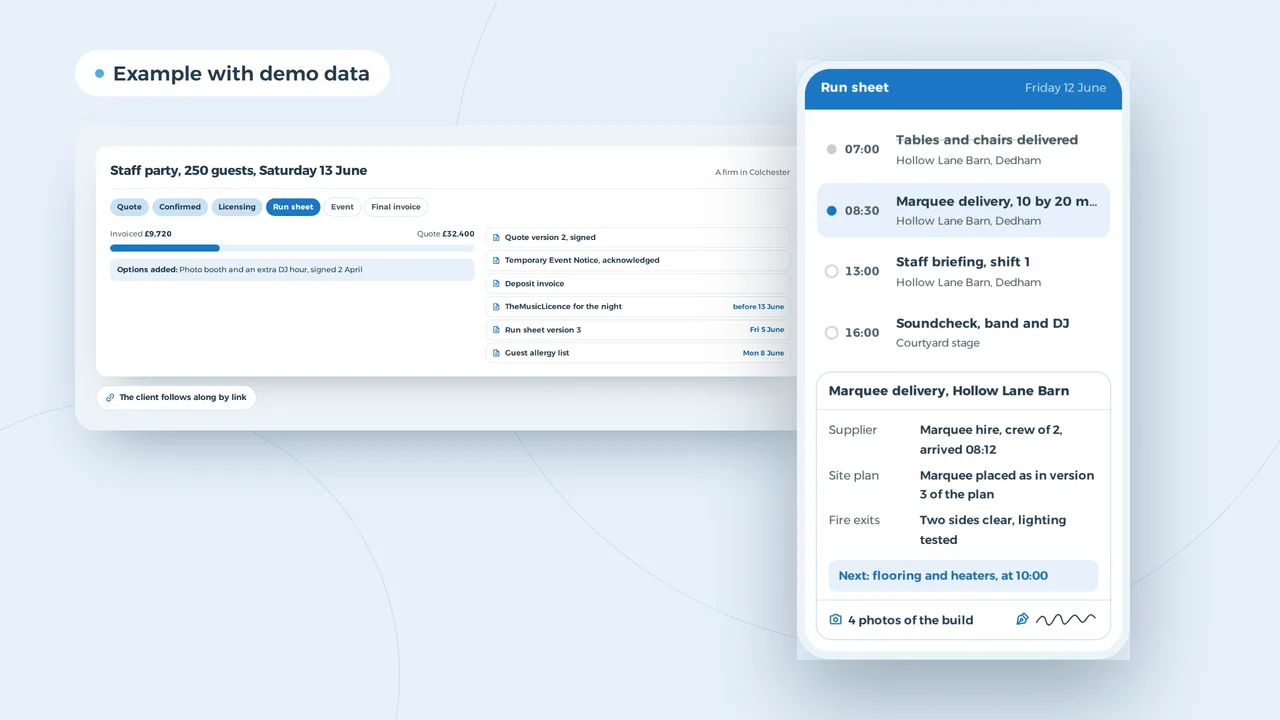
A staff party for 250 guests as one file
The client follows along by link
An example of what we can build, with a made-up event. You choose the stages and the documents.
Quotes with options the client ticks themselves
An event is rarely sold in one go. The client asks for a price for 200 guests, then wants a photo booth, drops the dessert table and adds an hour of DJ. Every change is a new version, and three weeks later nobody knows which one was signed.
In a system of your own, a quote is a list of lines with options. The client opens a link, ticks options on or off, sees the total change and signs online. The file keeps what was signed, what was added and what has been invoiced. The deposit and the final invoice follow from those lines.
- A returning client, like a firm that holds a summer party every year, starts from last year's quote.
- A venue you use often comes with its site plan, capacity and regular suppliers.
- Options you sell often are ready with a price and what they ask of crew and kit.
Following up clients and their earlier events is the job of a custom CRM. The client follows along in a small client portal, with the quote, the run sheet and the invoices in one place. A first draft of the quote can come from AI, as on AI quote generator.
A three-day summer party with a gap on the bar on Saturday
The board spots a problem
On Saturday at 6pm there are 6 people on the bar. The run sheet asks for 8 for 600 guests.
Two people on the reserve list are free on Saturday evening. The board sends them the shift with the time, the post and the parking, and adds them to the rota once they confirm.
Sorted: Ask the reserves
An example of what we can build, with a made-up event. You decide which event deadline the board keeps an eye on.
Building a crew without thirty messages
An event for 600 guests needs a crew you do not employ all year: bar staff, front of house, cloakroom, build and break-down. You call, send messages and keep a list of who said yes. Two days before the party someone drops out and it starts again.
The board sets out the shifts per event, per role and per hour. Crew see the shifts in the app and sign up. The board keeps count: how many people per shift, who is still in reserve, who has not done their right-to-work check yet. When someone drops out, the request goes first to the reserves who are free that day.
How a rota of your own works in general is on staff scheduling software. If you are not sure a spreadsheet is no longer enough, read Excel or scheduling software.
Finding bar and front of house staff for the season
An example of what we can build, with made-up names. You choose what you ask.
A pool of casual staff you already know
The best crew is a crew that has worked with you before. A pool of casual staff you know means fewer calls and less training. You build that pool with a vacancy on your own site with three questions instead of twenty: who you are, which roles you can do, which weekends you are free.
What you say about the work, the atmosphere behind the bar, the pay, whether there is transport to a site outside town, is employer branding for a crew that starts again every season.
Two rules sit in the planning. You must check that someone has the right to work in the UK before you employ them. And once you employ staff, employers' liability insurance with at least £5 million of cover is a legal requirement, and you can be fined £2,500 for every day you are not properly insured. The system keeps the check and the start date with each new starter.
A client email becomes a draft quote with options
An example of what we can build, with a made-up client. The AI prices from your own list, you decide what goes out.
Enquiries you check instead of work out
An enquiry rarely arrives tidy. It is an email with a date, a rough number of guests, a mood and a budget that is not stated. Working out the first quote takes an hour, even when the client does not book in the end.
AI can turn that email into a draft quote with your own lines and prices: the venue that fits the guest numbers, the options that are often chosen for that kind of party, and the questions that are still open. You read, change and send. What AI can do elsewhere in the trade is on AI in hospitality.
Guest lists with allergies or dietary needs are personal data, and an allergy says something about a person's health. Only the people who need such a list see it, it is deleted after the event, and a supplier who processes it signs a data processing agreement.
A search for a corporate event company in Essex that becomes an enquiry
New enquiry
Staff party, 180 people, June, bowl food and a DJ
Kate, HR in Colchester, today 10:32
- A page per kind of event and per area
- Photos and a floor plan of real set-ups
- An enquiry with options: guests, date, food, music
Example with made-up companies and reviews.
Website design for events that brings in enquiries
Someone looking for an events company searches for what they want to hold: a staff party, a wedding, a product launch, a family day. They want to see that you have done it before, what it looked like and roughly what it takes. A site with one "What we do" page does not reach those searches.
What works better is events website design with a page per type of event, photos of real events, an enquiry form that asks for the date, guest numbers, area and budget, and a Google Business Profile with recent photos. Ask for reviews the week after the event, while the client is still pleased; how to do that is in get more Google reviews.
For a one-off event with tickets, a landing page is often enough. A website from VBS starts from 1,500 euros, and for showing up in your own county there is local SEO.
How much events management software a business of your size needs
A planner who does three weddings a year does not need a board for sixty crew. A company with its own kit and twenty events in summer needs more than a shared drive. Per size of company, it looks like this:
| Size | What you need | What you do not need (yet) |
|---|---|---|
| Solo planner | A site with an enquiry form, quotes with options, a run sheet shared by link | A crew board, kit management |
| Company with five permanent staff | A file per event, a run sheet on every phone, shifts people sign up for | A client app, reports per department |
| Company with a pool of 50 or more | A board with reserves and right-to-work checks, a link to ticketing or the bar till, a client portal | An ERP, or a package you use half of |
| Company with its own kit or venues | A platform with kit, venues and files together, availability per date | A separate system per department |
What decides the cost of a build like this is in custom software development cost, and you can put in your own numbers with the software development cost calculator. A caterer who mostly feeds other people's events works differently; that is on software for caterers, and a hotel with a function room on software for hotels.
The rules on licensing, music and crew
An event touches licensing, music rights and employment law. These are the rules that most often belong in the software. The licensing rules below apply in England and Wales.
| Situation | What the rule asks | What the software does |
|---|---|---|
| Selling alcohol or putting on entertainment at an unlicensed venue | A Temporary Event Notice for fewer than 500 people at any one time, staff included, for at most 168 hours, with a £21 fee | Guest and crew numbers in the file, with a warning near the limit |
| When to give the notice | At least 10 clear working days before for a standard notice; a late notice 5 to 9 working days before | A deadline per file, counted in working days |
| How many notices | 5 a year per person, or 50 with a personal licence; 15 a year per venue, 21 days in all | A count per person and per venue across your files |
| Music, live or recorded | A licence such as TheMusicLicence from PPL PRS, with a temporary licence for one-off events | A reminder before the event, and the licence in the file |
| Casual crew | A right-to-work check before you employ someone | The check is stored with the person and blocks the first shift until done |
| Employing staff | Employers' liability insurance with at least £5 million of cover | The policy and its renewal date in the system |
The software does not apply for a licence and decides nothing about a contract. It makes sure the deadline is visible before it passes. How to handle guest data properly on your site is in a GDPR compliant website.
A staff party for 250 guests, counted in minutes
| Task per event | Now | With your own system |
|---|---|---|
| Quote in three versions | 90 minutes | 30 minutes |
| Updating and sending the run sheet | 180 minutes | 60 minutes |
| Building and confirming the crew | 150 minutes | 45 minutes |
| Confirming suppliers | 90 minutes | 40 minutes |
| Final invoice with extras | 120 minutes | 30 minutes |
| Total | 630 minutes | 205 minutes |
That is 425 minutes per event, just over seven hours. At 40 events a year it comes to about 283 hours.
Starting with the next event in your diary
- A call about your seasonHow enquiries come in, how you write quotes, how the crew is put together and which software or ticketing is already running.
- A fixed price per projectWe pick the part that costs the most time, often the run sheet or the crew, and give a fixed price for it. No hourly billing.
- First on one real eventThe first version runs on one real event, with the event manager and part of the crew. What does not work on site we change before the whole season.
We have not built for an events company yet. For Plus One Fieldmarketing, which puts student staff on campaigns, we did build a one-pager with a separate path for applicants and for clients, and vacancies with a button to apply straight away. To talk it through for your company, read how we handle custom software or get in touch.
Questions event companies ask us
- Does your software replace my ticketing or bar till?
- Usually not. Ticketing and tills exist and work. We connect to them, so tickets and drink tokens sold land on the right event and the final invoice adds up.
- Does the run sheet work on a site with no signal?
- Yes. What is on the phone stays readable without a connection, and what you tick off or note goes up as soon as there is signal again.
- Can the client choose options in the quote themselves?
- Yes. The client opens a link, ticks options on or off, sees the total and signs online. The file keeps which version was signed.
- Is this different from Eventbrite or a conference platform?
- Yes. Those are built to sell tickets and register delegates. We build for the work behind an event you deliver for a client: the quote, the run sheet, the crew and the suppliers. Where you sell tickets, we connect to the platform you use.
- What does events management software from VBS cost?
- After a call you get a fixed price per project, for the part you want first. A website starts from 1,500 euros. What makes software dearer or cheaper is in our guide to custom software development cost.
Custom software
How VBS helps you with this
We build the platform your business runs on every day: your spreadsheets, emails and paperwork in one system that does what you do.
- Your workflow mapped first, then a fixed price
- Screens for the office, the client and the road
- Hosting, backups and security managed by us on AWS
How we approach it is on our page about Custom software.
One run sheet instead of ten versions?
Tell us what your next event looks like and where it goes wrong now. We will show you where we would start.
Rather get in touch right away?