Industries: caterers
Catering software for UK caterers, built around your own menu and your busiest weekends
A caterer sells an event that happens months later, to people who never see the kitchen. We build the enquiry form that asks the right questions, the quote that comes from your own prices, and the system that carries dietary needs, temperatures and hire stock from the kitchen to the venue and back.
Catering runs on numbers that keep moving until Thursday
Most catering software in the UK is sold as one package for every kind of food business: a contract caterer feeding a hospital, a wedding caterer in a barn and a deli doing boxed lunches get the same screens. We work the other way round. We look at how your week runs and build the part that costs you the most hours, around the menu and prices you already have.
For a caterer that usually means the same handful of jobs. Quoting per head with children's menus, dietary needs and hire added. Knowing which table has the coeliac guest before Friday's prep, not on Saturday morning. Logging temperatures when the van leaves and when food goes out. Counting plates and glasses back in. Finding enough people for June.
Below is what we would build for each of those, the rules a UK caterer has to carry, how much system fits your size, and what it is worth in hours. Everything uses made-up names and demo data, because we do not have a caterer as a client yet.
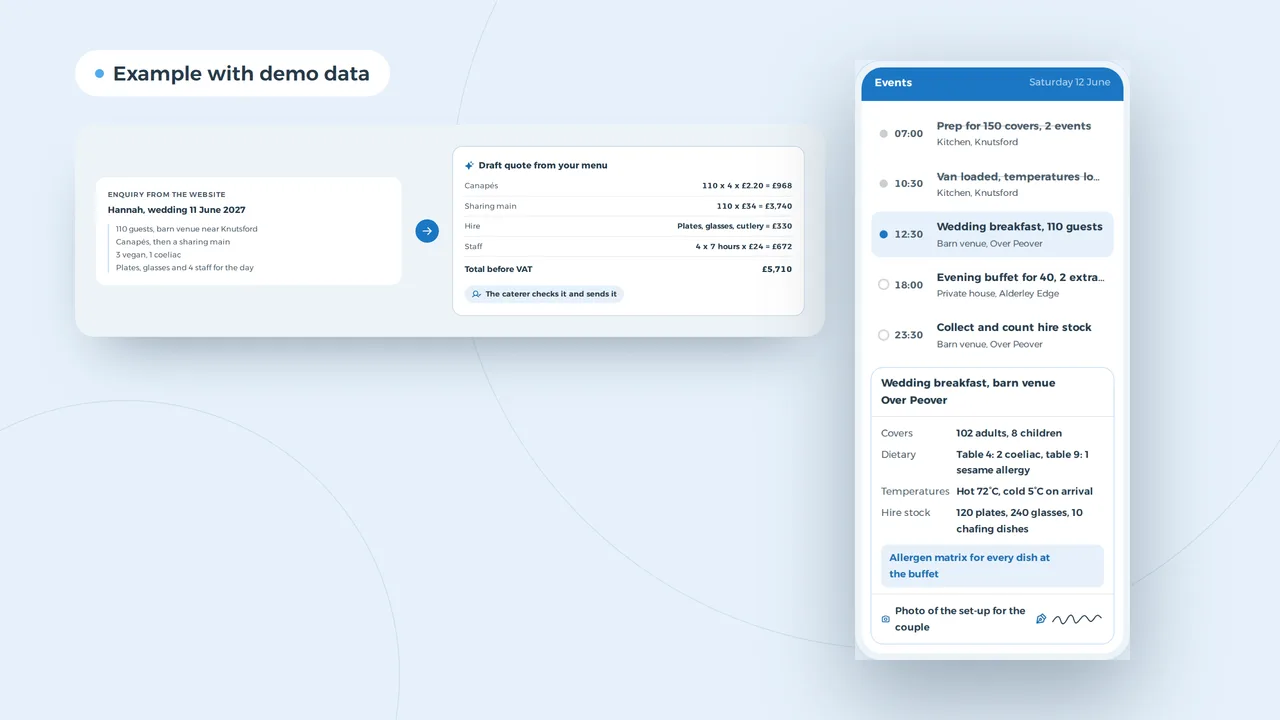
The wedding breakfast on the phone, with dietary needs by table
- Dietary needs by table, not by nameThe couple sends needs per table through the form. The kitchen sees which plates change, without a list of guests and their health details.
- Temperatures at loading and serviceYou log the probe reading when the van leaves and when food goes out. It lands in your Safer Food, Better Business diary without a paper sheet.
- Hire stock counted backWhat leaves is on the list. What comes back, you tick off. Breakages and shortfalls go straight onto the invoice.
An example of what we can build, with made-up events and clients. You choose which fields an event has.
Where the week leaks for a caterer
A caterer rarely loses time at the stove. It leaks before and after. On Sunday evening four enquiries arrive by email, Instagram and the contact form, each with different details: one gives a date and guest numbers, another just asks "how much is a buffet?". On Monday you ring back to ask about children, the venue and allergies. On Tuesday you work out three menu options for 110 guests in a spreadsheet, with and without hire.
The week of the event brings the rest. On Thursday the couple email to say two more guests are vegan and table 9 has a sesame allergy. The kitchen needs that for Friday's prep. The van leaves with hot and cold food, and whoever probes it writes the reading on a sheet that stays in the cab. After the event you count the glasses, find twelve missing and cannot say whether they stayed at the barn or at the house in Alderley Edge.
From May to September, with weddings every weekend, that happens three times on one Saturday. You also need extra staff, found through a group chat. Each leak is small. Together they cost the owner every Sunday evening and part of the margin.
A Sunday-night enquiry becomes a draft quote
An example of what we can build, with made-up prices. The AI works from your menu and your rates, you decide what goes out.
Catering quote software that works from your own menu
The first job is the quote. Caterers price per head, per menu, with a children's option, supplements for dietary needs, and hire and staff on top. None of that is hard, but you do it dozens of times a week and start from scratch each time.
Catering quote software from us starts with the enquiry form. It asks for the date, the occasion, adults and children, the venue, whether you supply crockery and staff, and dietary needs per table. From those answers the system builds a draft quote from your own menu and price list. AI helps where an enquiry arrives in plain words, such as "a hog roast for about 80 at a farm near Macclesfield", and turns it into lines you check. How that works is on our page about an AI quote generator. If you still quote in Word, our quote template is a fair place to start.
The AI does not invent prices and does not send anything. It works from what is on your menu, and you read every quote before it goes. A quote that is ready on Monday morning rather than Wednesday wins more often against the caterer who answers later.
How to get more catering clients from search
People look for a caterer by occasion and place: wedding caterers Cheshire, corporate lunch delivery Manchester, funeral catering Knutsford, private chef Wilmslow. A site with a page per occasion answers those searches far better than one page that says "we cater for all occasions". Each page shows the menus for that occasion, a price per head or a starting price, the minimum guest numbers and the allergens per dish. How we build that is on our page about catering website design.
Your Google profile matters as much, because the map sits above the ordinary results. A complete profile with your service area and real photos from recent events helps; the guide create a Google Business Profile walks through it. Asking for a review after every event works better than chasing them all at once, as the guide on how to get more Google reviews explains. For caterers who work within an hour of the kitchen, local SEO is the work that pays back most.
Venues and wedding planners are the other source. A page per venue you work with, with the menus that suit it and a short note on access and timings, gives a planner something to send a couple. It also tends to rank for the venue's name plus "catering".
Wedding caterers in Cheshire, searched on a phone, turns into an enquiry
New enquiry
Wedding 11 June 2027, 110 guests, barn venue, 3 vegan
Hannah, Wilmslow, today 21:14
- A page per occasion: weddings, corporate, wakes, private dining
- The allergen matrix on every menu page and the hygiene rating in view
- An enquiry form that asks for guest numbers and dietary needs per table
Example with made-up caterers and reviews.
Counting flutes for three events on one Saturday
Saturday 19 June: 3 events, 310 covers
You have 260 flutes and need 310. Suggestion: hire 60 from your supplier and assign them to the right events.
An example of what we can build, with made-up numbers. You choose which kit and which limits you track.
Hire stock that goes out and has to come back
Plates, glasses, cutlery, chafing dishes, poseur tables and linen are stock for a caterer, but an odd kind: they leave, spend a night at a venue and do not always all come home. Some of it you own, some you hire in from a supplier for the busy weekends.
A system for that works like inventory management software, with locations instead of shelves: the store, the event that is running, the event you still have to collect from. When the van leaves, the list shows what went. When it comes back you scan the crates and tick off. Breakages and shortfalls go straight onto that event's invoice, not into a pile you sort out in October.
The system also looks ahead. If you have three events on Saturday 19 June with 310 covers between them and own 260 flutes, you see it on Monday rather than Friday night, hire in what is missing and the hired flutes go to the right event.
Natasha's Law and the boxed lunch
Natasha's Law covers food packed on your premises before a customer orders it and sold from those same premises, such as a sandwich in the chiller of your deli. It needs the name of the food and a full ingredients list with the allergens emphasised. Boxed lunches made to order and delivered to an office are distance selling: the allergen information has to be available before the order is confirmed and again when the food arrives.
Extra hands for the summer weekends
A caterer runs on a small core and a wider ring of people who help at weekends: students, chefs who work elsewhere in the week, front of house who know the venues. From May to September you need all of them, in January hardly anyone. Start looking in April and June is already short.
We build two things. A careers page on your own site where someone applies in three taps: name, kitchen or front of house, and which weekends. And a rota where each person sees their events a month ahead, with the address, the call time and what to bring. When a spreadsheet stops being enough is covered in Excel scheduling or planning software, and what a rota system looks like is on our page about staff scheduling software.
Hours go from the phone to whoever runs payroll. Your payroll provider still files with HMRC; we make sure the hours reach them correct and on time.
Weekend staff for the kitchen and front of house
An example of what we can build, with made-up names. You choose what you ask.
Catering software in the UK and the rules it carries
A caterer moves food from a kitchen to someone else's venue and serves it there. The rules that come with that belong in the system, so nobody has to remember them on a busy Saturday. This is for England, Wales and Northern Ireland; Scotland has its own scheme for hygiene ratings.
| Rule | What it asks | What the system does |
|---|---|---|
| Food business registration | Register with your local authority at least 28 days before you start trading. It is free and covers caterers working from home | Your registration and inspection details kept with your documents |
| Allergens in non-prepacked food | Information on the 14 allergens must be available. FSA best practice since March 2025: have it in writing and invite a conversation | Allergens per dish from one source: menu page, quote and the matrix at the buffet |
| Natasha's Law | Food prepacked for direct sale needs a full ingredients list with allergens emphasised | Labels printed from the same recipe data |
| Distance selling | Allergen information before the order is confirmed and on delivery | Allergens on the order page and on the delivery note |
| Food hygiene rating | Display of the sticker is required in Wales and Northern Ireland, voluntary in England. Scotland runs FHIS | Your rating shown on the site where it helps |
| Hot and cold holding | Hot food at 63°C or above, cold food at 8°C or below, with limited exceptions | Probe readings at loading and on arrival, with time and name |
| UK GDPR | A guest's allergy or diet linked to their name is special category data | Dietary needs by table, not by name |
How to register is in the guide register a food business, and what PPDS labels need is in Natasha's Law explained. What UK GDPR means for the forms on your site is in UK GDPR vs EU GDPR.
How much system a catering business of your size needs
A caterer working alone or with a partner does not need an ERP. A contract caterer with fifty staff and two production kitchens needs more than a spreadsheet. This is where we would start at each size.
| Size | How enquiries arrive now | Where we start | What can wait |
|---|---|---|---|
| Sole trader, alone or with a partner | Phone, email and Instagram mixed together | A site with a page per occasion, menus with allergens and an enquiry form | Software for rotas and hire stock |
| A team of five | A shared inbox and a spreadsheet per season | Draft quotes from your menu, dietary needs by table, hire stock per event | A link to your accounts package |
| 20 to 50 staff | Several people quoting, a whiteboard in the kitchen | Production planning per day, temperature logs on the phone, staff rotas | A client portal for corporate accounts |
| Larger, with a production kitchen | An ordering package and an ERP | Custom work beside your package, for what it does not do, with integrations | A full system of your own |
The rule is the same at every size: start with what costs the most hours. For a small caterer that is nearly always the quote. For a large one it is the handover between sales, kitchen and logistics. A first estimate of what custom work costs comes from the software development cost calculator, and the guide to custom software development cost explains what moves the price.
One file for a wedding of 110 guests
The couple sees the menu, the stages and what is still open through a secure link. Dietary needs go per table, without names.
An example of what we can build, with a made-up couple and amounts.
Six hours of quoting a week, priced up
What is it worth in hours? A worked example with assumptions you swap for your own figures.
Hire stock comes on top. Glasses and plates that never come back and never reach an invoice are a cost nobody measures. A count per event makes it visible. And a quote that goes out on Monday rather than Wednesday is harder to put a number on, but every caterer knows the first to answer often gets the booking.
A site with pages per occasion, menus and an enquiry form starts from EUR 1,500, as on our website design page. Software for quotes, rotas and hire stock gets a fixed price per project after a conversation; see custom software.
Starting from one ordinary event
- A conversation about one eventWe follow an event from enquiry to final invoice: how the enquiry arrives, who quotes, how the kitchen knows what to make, what happens to the hire stock. That shows where the hours go.
- A fixed price for the first pieceWe pick what costs the most time, usually the quote or the site, and give a fixed price for it. A website starts from EUR 1,500; software gets a price after the conversation.
- A season of real eventsYou use the first version on real events. What does not fit, we change before the next piece. The code and the data are yours.
If you also let rooms or run events yourself, our pages for hotels and event companies cover that side, and what AI already does in the trade is in AI in hospitality. We do not have a caterer as a client yet; we did build a booking form with an availability calendar for Villa Lidia, and for Business Centrum a hospitality sector page and a page on hospitality payroll. To talk about your own week, get in touch.
Caterers often ask
- Do I need to register as a caterer in the UK?
- Yes. Any food business, including a caterer working from a home kitchen, registers with its local authority at least 28 days before it starts trading. Registration is free.
- Does Natasha's Law apply to catering?
- Only to food you pack on your own premises before it is ordered and sell from there. Plated or buffet food at an event is non-prepacked, and boxed lunches made to order and delivered fall under distance selling. Allergen information is required in every case, just in a different form.
- What does catering software from VBS cost?
- Software gets a fixed price per project after a conversation, for the piece you want first. A website with pages per occasion and an enquiry form starts from EUR 1,500.
- Does the AI write and send quotes on its own?
- No. It drafts from your own menu and prices and turns a plain-words enquiry into lines. You check every quote and decide what goes out. It does not invent prices.
- How do I collect dietary needs without collecting health data?
- Ask per table or as a count, not per named guest. Two coeliac at table 4 is enough for the kitchen. Anyone who wants to give more detail can talk it through with you directly.
- Will it work with my accounts package?
- Usually. Quotes and invoices can go to packages such as Xero or QuickBooks where they offer a connection. Which link is possible depends on your package; we check that in the first conversation.
Custom software
How VBS helps you with this
We build the platform your business runs on every day: your spreadsheets, emails and paperwork in one system that does what you do.
- Your workflow mapped first, then a fixed price
- Screens for the office, the client and the road
- Hosting, backups and security managed by us on AWS
How we approach it is on our page about Custom software.
Fewer Sunday evenings spent quoting?
Tell us how one event runs for you, from enquiry to the last crate back in the store. We will show you where we would start.
Rather get in touch right away?