Industries: bakeries
Bakery software for UK bakeries, built around the night bake and the counter
Your till stays your till. We build what sits beside it: online orders with a collection slot, celebration cakes, a bake sheet that adds itself up and allergens on every product, labels included.
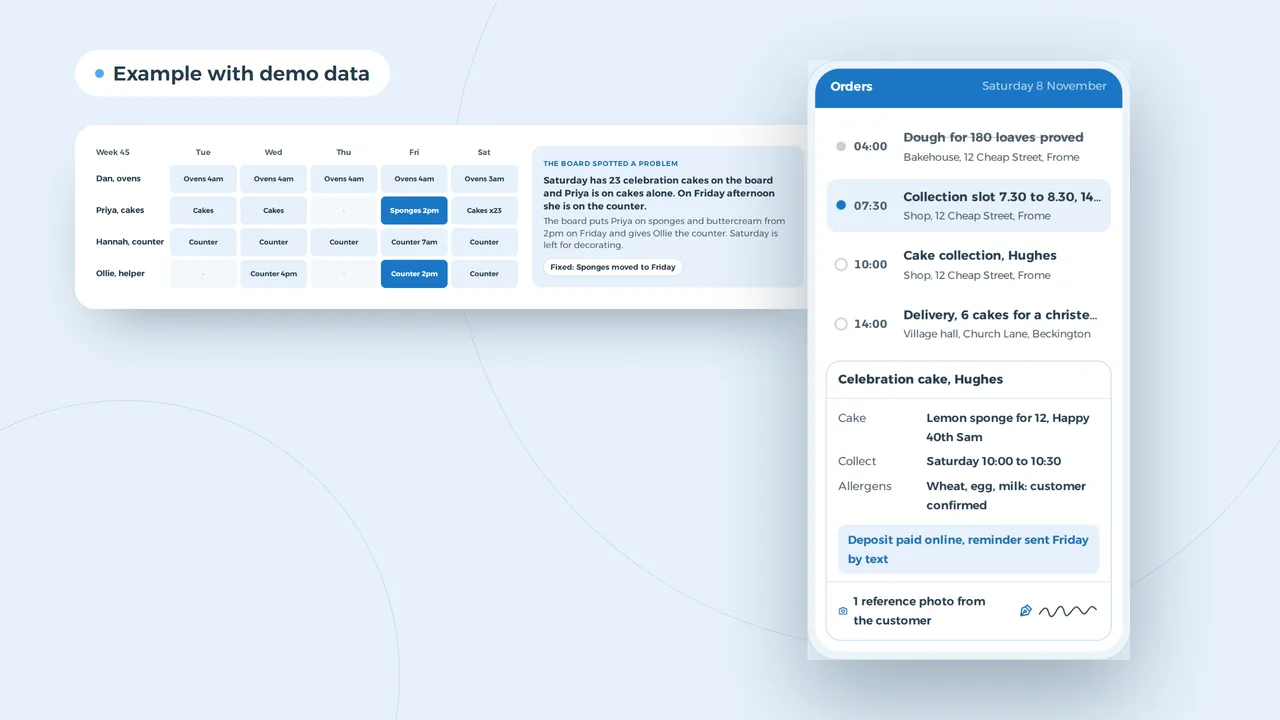
Most bakers who look for bakery software in the UK start with the till. Yet the work that eats the week happens before the shop opens and after it shuts. At half three the dough for 180 loaves has proved, at half seven the first collection slot opens, at ten a customer collects a lemon sponge for twelve, and at two six cakes go out to a village hall for a christening. In between, someone phones for a birthday cake with no nuts.
In most bakeries those two clocks, the night in the bakehouse and the day at the counter, run on an order book, a whiteboard and the memory of whoever has been there longest. That holds until a second shop opens, a new baker starts on nights, or an allergy gets lost between the phone and the bench.
Below, need by need: what we can build next to your till, which rules from the Food Standards Agency and Natasha's Law a bakery wants built into its system, and how much software suits a sole trader or a bakery with three shops.
Saturday morning in the palm of your hand
- Orders sorted by collection slotThe counter sees what has to be ready every half hour. Whoever comes at 7.30 doesn't queue behind the 8.30 orders.
- Allergens travel with the productEvery loaf and cake carries its allergens from the recipe. Counter staff read them off rather than remember them.
- The night's bake adds itself upEverything ordered by 6pm lands on the dough sheet for the night, per bake and per weight.
An example of what we can build, with made-up addresses. You choose which fields an order has.
A week at a bakery, then and now
| Moment | How it often goes | With a system of your own next to the till |
|---|---|---|
| A customer wants a celebration cake | They phone mid-rush and counter staff write it on a slip | They order online in the evening, pick a collection slot and see the allergens |
| The bake sheet for the night | Someone adds up the order book after closing | The sheet adds itself up per bake and per weight, ready at 6pm |
| Saturday collections | A queue at the counter while staff search the bags | Orders sorted by half-hour slot, set out in order |
| A customer asks about nuts or gluten | Counter staff walk back to the bakehouse to ask | Allergens travel with the product, straight from the recipe |
| PPDS labels for sandwiches and pastries | Typed by hand, retyped when a recipe changes | Printed from the recipe, with the 14 allergens in bold |
| The weekly rota | A sheet on the wall, changed in pen | A board that sees when a day is overbooked |
We don't replace the till. Square, Lightspeed or whatever your supplier fitted does its job at the counter. What we build talks to it where the till allows; how that works is under API integration. The cost of a till on its own is in Lightspeed pricing.
Twenty-three cakes and one decorator
The board spotted a problem
Saturday has 23 celebration cakes on the board and Priya is on cakes alone. On Friday afternoon she is on the counter.
The board puts Priya on sponges and buttercream from 2pm on Friday and gives Ollie the counter. Saturday is left for decorating.
Fixed: Sponges moved to Friday
An example of what we can build, with made-up names. You choose what the board checks.
Celebration cakes and a collection slot every half hour
Orders are the heart of a bakery that grows. A customer who wants a birthday cake at nine in the evening orders from the baker who lets them. Online ordering for a bakery isn't a clothes shop: you sell something that doesn't exist yet, for a fixed moment, and it has to be ready at half seven.
So we build it around three things. First the collection slot: the customer picks a half hour, and whoever comes at 7.30 doesn't queue behind the 8.30 orders. Then the celebration cake: how many it serves, flavour, message, a reference photo and a deposit, with a cut-off you set per type of cake. And last the bake sheet: what's ordered goes to the night's bake per product and per weight, with what you bake for the shelves on top.
For some bakers that's an ordering module on the site they already have, for others a full online shop with local delivery. What that shop needs page by page, and what the law asks of it, is on bakery website design. How we build online shops in general is under webshop development.
A sack of flour with its batch number on the night
Wholemeal flour running low
120 kg left, 190 kg needed for orders up to Saturday. Proposal: 8 sacks of 25 kg from the mill.
An example of what we can build, with made-up quantities. You choose per ingredient when the system warns you.
Natasha's Law, labels and batch numbers
For a UK bakery, allergens aren't a poster by the till. Since 1 October 2021, food that is prepacked for direct sale, PPDS, carries a label in England, Wales and Northern Ireland with the name of the food and a full ingredients list, with the 14 allergens emphasised. The Food Standards Agency names bakery products packed on site before the customer selects them as an example. The sandwich in the chiller and the boxed brownies count; the loaf you bag at the counter after the customer asks for it does not.
That's why we tie allergens to the recipe, not to a label template. Swap the flour or the chocolate and every product that uses it changes with it: the label, the product page and the screen at the counter. For loose food you can give allergen information another way, including orally, as long as customers can get it.
Batch numbers work the same way. You keep records of who supplied you and of every business you supply, so a café or a school that buys your bread is in your records too. Scan the sack when it arrives and when it's opened, and the batch hangs on that night's bake. Stock per place, dry store, walk-in and shop, with an alert before the flour runs out, is what we build as inventory management software.
Birthday cake, Frome, ten to ten at night
New order
Birthday cake for 20, nut free, collect 15 Nov
Sophie, Beckington, today 21:40
- A page per type of cake and per town you deliver to
- A Google profile with opening hours, bank holidays included
- Online ordering with a collection slot and allergens on every product
Example with made-up bakeries and reviews.
Being the bakery that shows up for 'birthday cake near me'
People rarely search for a bakery by name. They type 'birthday cake Frome', 'sourdough near me' or 'bakery open Sunday'. The bakery with a page for each of those, showing the cakes you actually make, the towns you deliver to and a button to order, gets the customer. How we work on local search is under local SEO.
The Google profile matters as much. A bakery lives on the question 'are they open now', so bank holiday hours and your summer break must be right. A photo of the counter on Saturday morning does more than a logo. Setting the profile up is covered in create a Google Business Profile; asking for reviews without begging, in get more Google reviews. A bakery site starts from 1,500 euros.
A night baker found through your own site
An example of what we can build, with made-up names. You choose what you ask.
Hiring for nights without a job board
A bakery grows as fast as it finds a baker who wants to work nights. That person isn't scrolling a job board full of office roles; they look at bakeries nearby and ask around. An application that wants a CV as a Word file loses them. So we put the vacancy on your own site, with the real hours in plain sight, and three questions that matter: name and number, experience with bread, pastry or both, and when you can call. What you show the people who might work for you is called employer branding. Who then works which night, which bench and which Saturday, you plan with staff scheduling software that knows who runs the oven and who is the Saturday helper.
A party order by email with an allergy in it
An example of what we can build, with a made-up customer. The AI turns the email into an order and checks it against your recipes, you decide what you confirm.
AI drafts the order, the baker decides
Some orders will always come by email or message: a party with a cake, rolls and sandwiches, a school that wants bread every Friday. AI can read that message and turn it into a draft order with the collection time and the quantities. It lays the order next to your recipes and notices the cake asked for contains nuts while the customer mentions a nut allergy.
What AI does not do is confirm an order on its own or declare anything free from an allergen. The baker reads it and decides, because only the baker knows whether nuts are handled on the same bench. How we build such an assistant is under AI automation. A sole trader who wants to see what AI can do before anything gets built can start with AI for sole traders.
Bakery software UK: what fits your size
A baker on the bench with a partner on the counter doesn't need an ERP. A bakery with a central bakehouse and five shops needs more than an order book. This is what we would build at each size, next to the till.
| Size | What you need | What you don't need (yet) |
|---|---|---|
| Sole trader | A site with online ordering and a collection slot, a Google profile, allergens per product | A rota board, an app of your own, stock per place |
| Team of five | Orders that feed the bake sheet, a rota for ovens, cakes and counter, PPDS labels from the recipe, batch numbers | Roles per shop, an integration with every system |
| 20 to 50 staff | A central bakehouse baking for several shops, orders per shop, stock per place, wholesale to cafés and schools | A large package you only use half of |
| Larger | A platform of your own across bakehouse, shops and trade customers, a portal for wholesale, reports per shop | A second till next to the first |
What drives the cost of such a build is set out in custom software development cost. A bakery that also caters will find the rest under software for caterers; the butcher down the road reads butcher shop software.
The rules a UK bakery builds in
These are the rules that most often need to live in the software. They apply to England unless the table says otherwise.
| Situation | What the rule asks | What the software does |
|---|---|---|
| Opening a bakery | Register with your local authority at least 28 days before you start trading | Nothing: you do this, we build after |
| Prepacked for direct sale | Since 1 October 2021, in England, Wales and Northern Ireland: name of the food and a full ingredients list with the 14 allergens emphasised | Labels printed from the recipe, so a new supplier changes the label too |
| Loose food at the counter | Allergen information must be available; it can be given by other means, including orally | Allergens per product on a screen staff can read off |
| Ordering online | Allergen information available before the customer buys and again when the food is delivered | Allergens on the product page before the order button, and on the order slip |
| Traceability | Records of who supplied you and of every business you supply | Batch numbers per ingredient, orders per trade customer |
| Fresh cream and chilled goods | In England, food that supports harmful bacteria is not kept above 8°C, with listed exceptions | Fridge temperatures logged on a phone, with time and name |
| Food hygiene rating | Rated 0 to 5 on inspection; displaying it is a legal duty in Wales and Northern Ireland, voluntary in England | Cleaning, deliveries and temperatures ticked off, ready for the inspector |
Who has to register, when and with which council is set out in register a food business. The software decides nothing for you. It makes sure you see the rule at the moment it counts. A bakery selling across the Channel also deals with EU rules; what changes is in selling to the EU from the UK.
A bakery of four with a full order book
| Task per week | Order book and phone | With online orders, a bake sheet and a rota board |
|---|---|---|
| Taking orders | 160 minutes | 70 minutes |
| Adding up the bake sheet | 120 minutes | 30 minutes checking |
| Allergen questions | 30 minutes | 10 minutes |
| The rota | 60 minutes | 20 minutes |
| PPDS labels | 45 minutes | 10 minutes |
| Total | 415 minutes | 140 minutes |
The 70 minutes are the orders that still come by phone, plus checking what came in online. The difference is 275 minutes, just over four and a half hours a week. Over 48 working weeks that's 220 hours, more than five weeks of a full-time baker. The forgotten cake on a Saturday morning isn't in these numbers at all.
Starting from an ordinary Saturday
- A conversation about your weekHow do orders come in, who adds up the bake sheet, which till do you use, where does the time go? We look at an ordinary week and a busy bank holiday, not at a list of features.
- A fixed price per projectTogether we pick the part that costs the most time and put a fixed price on it. A website starts from 1,500 euros; software gets a price after the conversation.
- One person uses it firstSomeone on the counter or the bench uses the first version for a few weeks with real orders. What doesn't fit, we change before the rest of the team joins. The code and your recipes stay with the bakery.
We haven't had a bakery as a client yet; booking a free slot from a calendar that shows what's still open is what we built for Villa Lidia, with a booking form and a small admin page for the owner.
What bakers ask us about their system
Does your software replace my till?
No. Your till stays on the counter. We build what sits next to it: online orders, the bake sheet, allergens and labels per product, the rota and stock. Where your till allows an integration, the two talk to each other.
Do my cakes and sandwiches need a PPDS label?
If you pack them on site before the customer chooses them, as with sandwiches in a chiller or boxed cakes on a shelf, yes: in England, Wales and Northern Ireland they need the name of the food and a full ingredients list with the 14 allergens emphasised. Food you pack at the customer's request is loose food.
Do I need allergen labels on online orders?
Online sales are outside PPDS labelling, but allergen information must be available before the customer buys and again when the food is delivered. The simplest way is allergens on the product page and on the order slip, both from the recipe.
Can customers pay a deposit for a celebration cake?
Yes. The customer picks the cake, how many it serves, the message and a collection slot, and pays a deposit online. You set the cut-off per type of cake.
Do I need an app or is a website enough?
For most bakeries a site with online ordering is enough. An app in the App Store only pays off when customers order every week, such as a school or an office. Even then a web app that sits on the home screen often does the job.
What does bakery software from VBS cost?
You pay for the part you want first, at a fixed price after a conversation. A website starts from 1,500 euros. Software gets a price once we know what it has to do.
Custom software
How VBS helps you with this
We build the platform your business runs on every day: your spreadsheets, emails and paperwork in one system that does what you do.
- Your workflow mapped first, then a fixed price
- Screens for the office, the client and the road
- Hosting, backups and security managed by us on AWS
How we approach it is on our page about Custom software.
Less order book and more baking?
Tell us how a Saturday runs at your bakery and which till you use. We'll show you where we would start.
Rather get in touch right away?