Industries: butchers
Butcher shop software built around the cutting room and the counter
Your till and scales stay where they are. We build what sits beside them: Christmas and BBQ orders online with a collection slot, batch numbers that follow the meat, chillers that keep raw and cooked apart.
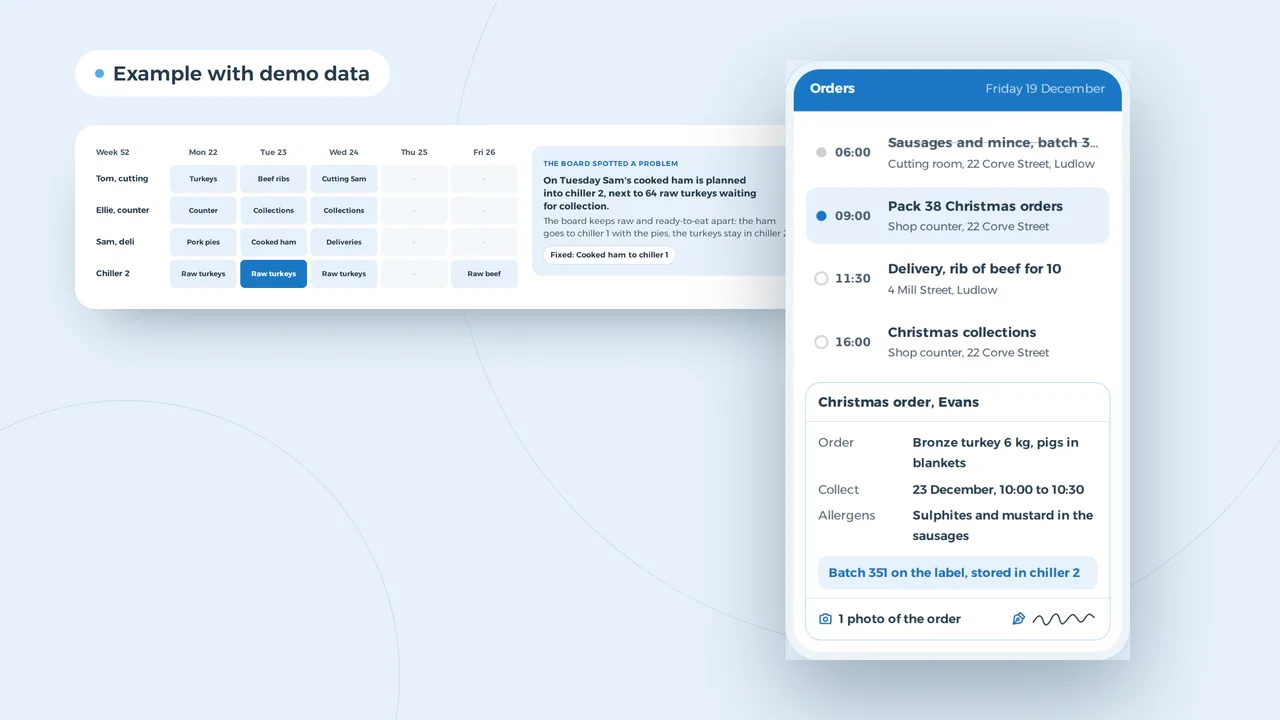
Five days before Christmas at a family butcher
Butcher shop software sounds like a till with scales attached. You have that already. What seizes up in December is everything around it. At six the cutting room turns out sausages and mince from batch 351, at nine 38 Christmas orders need packing, at eleven a rib of beef for ten goes out to Mill Street, and the phone rings for one more bronze turkey with pigs in blankets. The chillers are full.
In most shops that runs on an order book, notes taped to the chiller door and a butcher who remembers everything. It holds until someone is off sick on the 23rd, until the council officer asks which batch Tuesday's sausages came from, or until a customer with a mustard allergy is handed the wrong pack.
Below, need by need: what we can build next to your till and scales, which Food Standards Agency rules a butcher wants built into the system, and how much software suits a sole trader or a shop with a deli counter and three branches.
The run-up to Christmas on one screen
- Every order has a collection slotOn 23 December the counter sees what is due every half hour. The queue stays short on the busiest day of the year.
- The batch follows the meatMince, sausages and boxes carry the batch number of what went in. When the council officer asks, you find it in one tap.
- Allergens per product and sauceCounter staff see what is in every sausage, marinade and sauce, including the ones you buy in.
An example of what we can build, with made-up addresses. You choose which fields an order has.
Order book against a system of your own
The same December week, run two ways.
- A customer wants a Christmas turkey
- Order book and notesThey phone in the rush, and someone writes it in the book
- A system next to your tillThey order online in the evening, choose a collection slot and see the allergens
- The cutting list for the day
- Order book and notesSomeone adds up the book after closing
- A system next to your tillThe kilos of mince, sausages and joints per day are ready by morning
- Chiller space in Christmas week
- Order book and notesNotes on the door and searching behind crates
- A system next to your tillA board that knows what sits in which chiller and when it leaves
- The council officer asks about a batch
- Order book and notesLeafing through delivery notes in a folder
- A system next to your tillThe batch from delivery to label in one tap
- Collections on 23 December
- Order book and notesA queue out of the door
- A system next to your tillOrders per half hour, packed in order
We don't replace the till or the scales. They do their job at the counter, and where they allow an integration, what we build talks to them.
Cooked ham planned next to raw turkeys
The board spotted a problem
On Tuesday Sam's cooked ham is planned into chiller 2, next to 64 raw turkeys waiting for collection.
The board keeps raw and ready-to-eat apart: the ham goes to chiller 1 with the pies, the turkeys stay in chiller 2.
Fixed: Cooked ham to chiller 1
An example of what we can build, with made-up names. You choose what the board checks.
Keeping raw and ready-to-eat apart, every day
A butcher with a deli counter sells raw meat and ready-to-eat food from the same shop. The Food Standards Agency guidance on E. coli O157, which applies in England, Wales and Northern Ireland, asks for separate areas, surfaces and equipment for the two. Complex equipment such as vacuum packers and slicers should not be used for both during a normal working day. Where an area has to be shared, cleaning and disinfecting it between uses is the option with the most risk.
That's a planning problem as much as a hygiene one. In Christmas week, when every shelf is full, the cooked ham ends up next to the raw turkeys because that's where the space is. A board that knows which chiller holds raw and which holds cooked, and when each order leaves, sees the clash before it happens and suggests where the ham can go instead.
The same board plans the team: who's in the cutting room, who's on the counter, who does the deli and who delivers. Who works which day is what we build as staff scheduling software. When the till and scales need to share data with it, that's an API integration.
A batch of beef booked to Tuesday's joints
Pork loin running low
22 kg left, 35 kg needed for orders up to 24 December. Proposal: 15 kg more from your supplier for Monday.
An example of what we can build, with made-up quantities. You choose per product when the system warns you.
Batch numbers, beef labels and PPDS
A butcher works with the product where traceability rules bite hardest. You keep records of who supplied you and of every business you supply: the pub down the road, the school, the village hall. Beef carries labelling of its own on top: a reference number that links the meat to the animal or group of animals, and the country and approval number of the slaughterhouse and the cutting plant.
On paper that's a folder of delivery notes. In a system, the batch travels with the meat. The delivery arrives as batch 4471-1125, goes to chiller 1, becomes mince or sausages in the cutting room, and the batch is on the label. When the council officer asks about Tuesday's sausages, or a supplier recalls a batch, you see in one click which products and which trade customers it touches.
Then Natasha's Law. Since 1 October 2021, food prepacked for direct sale in England, Wales and Northern Ireland needs a label with the name of the food and a full ingredients list, with the 14 allergens emphasised. The Food Standards Agency names burgers and sausages prepacked by a butcher on the premises, ready for sale, as an example. If the allergens come from the recipe, the label changes the moment you switch the rusk supplier. Stock per place with an alert before the pork loin runs out is what we build as inventory management software.
A photo of the delivery note becomes a goods-in record
An example of what we can build, with a made-up delivery. The AI reads the note, you decide what goes into your records.
AI reads the paperwork, the butcher signs it off
For many butchers the food safety records are the job left for the evening: logging deliveries, writing down temperatures, filing notes. AI can read a photo of a delivery note and turn it into a draft goods-in record with product, weight, batch, origin and abattoir. The temperature you measured goes with it, and the system tells you whether it sits within the limit you set yourself.
The same approach works for orders that arrive by email or message: a party wanting a ham and a BBQ box for thirty, a restaurant ordering the same cuts every week. AI drafts the order; you confirm it. What AI doesn't do is put anything in your records on its own or decide that a delivery is fine. How we build such an assistant is under AI automation.
Christmas turkey, Ludlow, on a Sunday evening
New order
Turkey for 10 and pigs in blankets, collect 23 Dec
Rachel, Bromfield, today 20:52
- A page for Christmas, BBQ boxes and meat boxes, priced per box
- A Google profile with your Christmas opening hours
- Online ordering with a last order date per holiday
Example with made-up butchers and reviews.
Turning up when someone searches 'christmas turkey' in your town
People rarely search for a butcher by name. They type 'christmas turkey Ludlow', 'BBQ box' or 'butcher open Saturday'. The shop with its own page for Christmas, BBQ boxes and meat boxes, priced per box and with a button to order, gets that customer. How we work on local search is under local SEO.
The Google profile matters as much. Your hours change around Christmas, and whoever wants to collect on Christmas Eve checks there first. Setting the profile up is covered in create a Google Business Profile; choosing the category in Google Business Profile categories. What an online shop for a butcher needs, page by page, is on butcher website design. A butcher's site starts from 1,500 euros.
A butcher for the cutting room, hired from your own site
An example of what we can build, with made-up names. You choose what you ask.
Hiring when skilled butchers are hard to find
Good butchers are scarce, and the ones you find usually come through someone who knows someone. A vacancy on your own site helps that along: the real hours, time off for an apprenticeship, and three questions that matter. Name and number, experience with cutting, counter or both, and when you can call. An apprentice or someone who wants a few days on the counter replies just as easily. What you show people who might work for you is called employer branding.
Butcher shop software for your size of business
A butcher in the cutting room with a partner on the counter doesn't need an ERP. A shop with a deli, three branches and deliveries to restaurants needs more than an order book. How it scales from one counter to three branches:
| Size | What you need | What you don't need (yet) |
|---|---|---|
| Sole trader | A site with Christmas, BBQ and meat box orders online, a Google profile, allergens per product | A planning board, an app of your own, stock per chiller |
| Team of five | Orders that feed the cutting list, a board for chillers and team, batch numbers and PPDS labels, goods-in on a phone | Roles per branch |
| 20 to 50 staff | A central cutting room for several shops, deli and raw in one system, wholesale to pubs and restaurants, stock per place | A large package you only use half of |
| Larger | A platform of your own across cutting room, shops and trade customers, a portal for wholesale, reports per shop | A second till next to the first |
What drives the cost of such a build is in custom software development cost. A butcher with a large catering side will find the rest under software for caterers; the baker next door reads bakery software.
The rules a UK butcher builds in
These are the rules that most often need to live in a butcher's software. They apply to England unless the table says otherwise.
| Situation | What the rule asks | What the software does |
|---|---|---|
| Opening a butcher's shop | Register with your local authority at least 28 days before you start trading | Nothing: you do this, we build after |
| Raw and ready-to-eat | Separate areas, surfaces and equipment; vacuum packers and slicers not used for both in a normal working day (England, Wales, Northern Ireland) | A chiller board that knows raw from cooked and flags a clash |
| Traceability | Records of who supplied you and of every business you supply | Batch numbers from delivery to label, orders per trade customer |
| Beef labelling | A reference number linking the meat to the animal or group, plus country and approval number of slaughterhouse and cutting plant | The details on the delivery note carry over to the label |
| Prepacked for direct sale | Since 1 October 2021, in England, Wales and Northern Ireland: name of the food and full ingredients with the 14 allergens emphasised | Labels printed from the recipe, sausages and burgers included |
| Ordering online | Allergen information available before the customer buys and again on delivery | Allergens on the product page before the order button, and on the slip |
| Chilled food | In England, food that supports harmful bacteria is not kept above 8°C, with listed exceptions | Chiller temperatures logged on a phone, with time and name |
| Food hygiene rating | Rated 0 to 5 on inspection; display is a legal duty in Wales and Northern Ireland, voluntary in England | Deliveries, temperatures and cleaning ticked off, ready for the inspector |
Whether a shop registration is enough or your activity needs approval, and how the 28 days work, is set out in register a food business. The software decides nothing for you. It makes sure you see the rule at the moment it counts. A butcher who also sells into the EU deals with another set of rules; what changes is in selling to the EU from the UK.
A shop of five in Christmas week
| Task per week in December | Order book and paper | With online orders, a cutting list and goods-in on a phone |
|---|---|---|
| Taking Christmas orders | 300 minutes | 120 minutes |
| Adding up the cutting list | 100 minutes | 25 minutes checking |
| Logging deliveries | 30 minutes | 10 minutes |
| Batch numbers on labels | 60 minutes | 15 minutes |
| Total | 490 minutes | 170 minutes |
The 120 minutes are the orders that still come by phone, plus checking what came in online. The difference is 320 minutes, over five hours a week. Across the four weeks of December that's more than 21 hours, at the very moment every hour on the counter counts. BBQ season comes on top.
Starting from a normal week and Christmas Eve
- A conversation about your weekHow do orders come in, who adds up the cutting list, how do you keep track of the chillers, which till do you use? We look at a normal week and at 23 December, not at a list of features.
- A fixed price per projectTogether we pick the part that costs the most time and put a fixed price on it. A website starts from 1,500 euros; software gets a price after the conversation.
- Someone in the shop uses it firstSomeone in the cutting room or on the counter uses the first version for a few weeks with real orders. What doesn't fit, we change before the rest of the team joins. The recipes, orders and code stay with the shop.
We haven't had a butcher as a client yet; letting customers book direct without paying a platform commission, with availability that keeps itself up to date, is what we built for No4, with a request form on its own site.
What butchers ask us
Does your software replace my till or scales?
No. Till and scales stay on the counter. We build what sits next to them: online orders, the cutting list, batch numbers and labels, the chiller board and goods-in records. Where your till allows an integration, they talk to each other.
Do my sausages and burgers need a PPDS label?
If you pack them on the premises before the customer chooses them, yes: in England, Wales and Northern Ireland they need the name of the food and a full ingredients list with the 14 allergens emphasised. The Food Standards Agency uses burgers and sausages prepacked by a butcher as its own example.
Can customers order Christmas turkeys online with a collection slot?
Yes. The customer picks the bird or joint, the extras and a half hour to collect, and can pay a deposit. You set the last order date per holiday.
How do I trace which batch went into which sausages?
By logging every delivery with its batch and passing that batch on to what you make in the cutting room. It's then on the label and in the system. When the council officer asks, or a supplier recalls a batch, you see at once what it touches.
Can I keep my food safety records on a phone?
Yes. Deliveries, temperatures and cleaning are ticked off on a phone, with time and name. Which checks you do and which limits you work to is set out in your own food safety management system; the software keeps the record.
What does butcher shop software from VBS cost?
You pay for the part you want first, at a fixed price after a conversation. A website starts from 1,500 euros. Software gets a price once we know what it has to do.
Custom software
How VBS helps you with this
We build the platform your business runs on every day: your spreadsheets, emails and paperwork in one system that does what you do.
- Your workflow mapped first, then a fixed price
- Screens for the office, the client and the road
- Hosting, backups and security managed by us on AWS
How we approach it is on our page about Custom software.
A calmer December on the counter?
Tell us how your Christmas orders come in now and which till you use. We'll show you where we would start.
Rather get in touch right away?