Industries: gyms
Gym management software UK: shaped around how your club sells
Most gym software is built for the average club. Yours sells a ten-class pack next to a monthly plan, has two classes that are always full and a front desk that is empty at six in the morning. We build the system around that, and connect it to the door and the till you already have.
A gym sells hours that nobody sees being used
Gym management software in the UK, bought off the shelf, does the basics well: a member list, a timetable, a payment run. The trouble starts where your club differs from the average. A class pack that should expire after three months, a corporate deal where the employer pays one invoice, a personal trainer who rents space and sells his own sessions, a waiting list that nobody works through.
That is where the spreadsheets, the WhatsApp groups and the sticky notes behind the desk come back. Below is what we would build for each of those gaps, for anything from a one-coach studio to a club with several sites, the rules that belong in the system, and how we start.
The hours a gym loses around the edges
Time does not leak in the classes. It leaks at the desk, in the inbox and at the kitchen table on a Sunday evening, where someone goes through the failed Direct Debits of the month.
| Moment | How it often goes | With your own system |
|---|---|---|
| Booking a class | A DM on Instagram or a list on the desk | The member books in the app and the waiting list moves up on its own |
| The class pack | A punch card or a counter in a spreadsheet | Every session comes off by itself, with a nudge at the last two |
| Getting in | A fob that still works after someone cancels | Access depends on a live membership or a valid pack |
| Getting paid | Failed Direct Debits that nobody spots for weeks | A list of failed collections with a reminder that goes out |
| Freezing or cancelling | An email that sits in the inbox | A button in the app, with the notice period and the end date shown |
| Personal training | Sessions in the trainer's own diary, apart from the club | Sessions, packs and programmes per member in one place |
We do not build the turnstile or the till. Those exist, they work, and a turnstile is hardware. We connect to them: the access system asks our software whether a fob may open the door, and the till passes on what it sold. How such a link works with a system you already run is on API integration services.
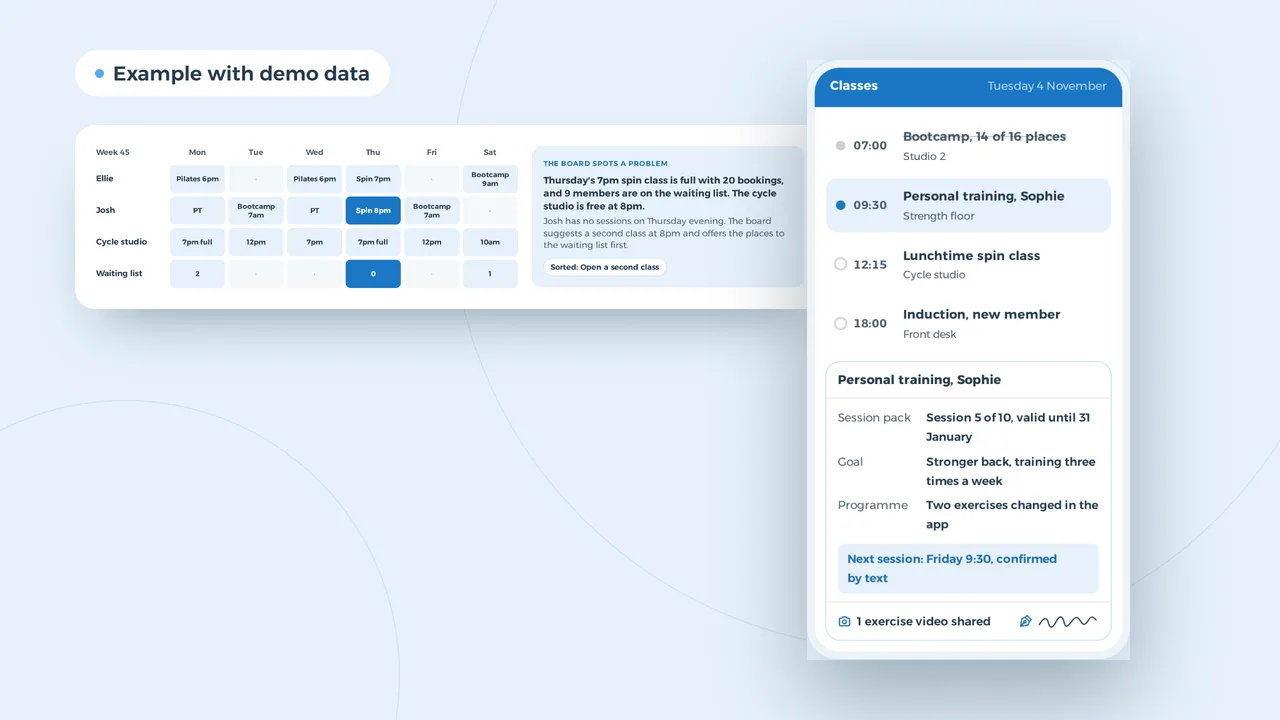
A personal training session, ticked off on the gym floor
- The pack counts down on its ownEvery session comes off the pack. With two left, the member gets a nudge to renew, not a surprise at the desk.
- The programme lives on the member's phoneA short video per exercise, updated after each session, instead of a sheet left in the changing room.
- Works in the basement tooWhat you note on the gym floor is saved as soon as there is signal again.
An example of what we can build, with made-up members. You choose which fields a session has.
Memberships, class packs and PT in one system
A club rarely sells one thing. There is the monthly plan on Direct Debit, the ten-class pack for people who come when they can, the annual plan paid up front, the off-peak and student rates, personal training in blocks of five or ten, and the corporate plan the employer pays for. Most packaged gym software handles a few of those. The rest lives in notes.
In a system of your own, every product is a row with a term, a price, a notice period and what it allows: which classes, which hours, which site. The rest follows from that. The door knows whether a fob or a QR code may get in today. The app knows which classes a member can book. The trainer sees how many sessions are left on a PT block.
- Freezingfor an injury or a pregnancy without losing the paid term, with the new end date worked out.
- Switchingfrom a class pack to a monthly plan, with the unused classes credited.
- An employerwho pays for the team, with one invoice a month instead of a mandate per member.
Members want a place to see their plan, their bookings and their invoices. That can be a small client portal, or an app on the phone if your club is big enough to need one; what an app involves is on app development. If what you mostly need is to follow up leads and trial visits, read about custom CRM development.
A full spin class gets a second session
The board spots a problem
Thursday's 7pm spin class is full with 20 bookings, and 9 members are on the waiting list. The cycle studio is free at 8pm.
Josh has no sessions on Thursday evening. The board suggests a second class at 8pm and offers the places to the waiting list first.
Sorted: Open a second class
An example of what we can build, with made-up names. You decide at what class occupancy the board speaks up.
A class timetable with a waiting list that runs itself
In almost every club the same three classes are always full and others run half empty. A member who cancels leaves a place that nobody sees. The board solves that with rules you set: cancel up to three hours before the class and the place goes back, and the first person on the waiting list gets a message. Two no-shows without cancelling and you cannot book ahead for a week.
The board also reads your coaches' rota. An instructor who is ill swaps with a colleague in the app, and the members who booked get the new name. When a class has been full with a long waiting list three weeks running, the board suggests an extra session at an hour when the studio and a coach are free.
The staff rota itself, with the desk shifts and the coaches' hours, is a job of its own; how that works in a system of your own is on staff scheduling software. If you still run the rota in a spreadsheet, Excel or scheduling software helps you decide when to move. Classes that people book online work like a booking system for your website, with places instead of rooms.
Self-employed instructors and your own staff
Many UK clubs mix employed desk staff with self-employed instructors who rent the studio or invoice per class. The system can hold both: a rota and hours for the people you employ, and sessions and invoices for the people who bill you. Which status someone has is a question for your accountant, not for the software.
A search in Chelmsford that turns into a trial session
New trial booking
Trial bootcamp on Saturday, asks about a 10-session pack
Jess, Springfield, today 20:47
- A page per class and per membership, with the price on it
- A Google profile with opening hours and photos of the studios
- A trial session booked in three taps, no account needed
Example with made-up gyms and reviews.
Being found by people who want to train nearby
Someone looking for a gym looks close to home or to work. They check the map, read the reviews and open two or three sites. What they want to see there is plain: which classes, at what times, what it costs, and whether they can try it first.
That calls for a site with a page per class and per type of membership, a timetable that comes out of the system instead of a PDF, and a Google Business Profile with the right opening hours and photos of the floor. Ask for reviews after the third or fourth visit, not at sign-up; how to do that without nagging is in get more Google reviews.
The site is a story of its own, with its own choices about showing prices, trial classes and the rules on cookies and photos of members. We work that out on the page about gym website design. A website from VBS starts from 1,500 euros, and for showing up in your own town there is local SEO.
Finding a class instructor for the evenings
An example of what we can build, with made-up names. You choose what you ask.
Coaches who fill the hours members want
A club grows as fast as it finds coaches for the hours members ask for: early mornings, lunchtimes and evenings. Many class instructors teach next to another job or work for several clubs. They look on their phone, in the evening, and give up on a form with twenty fields.
A vacancy on your own site with three questions works better: name and number, which classes you teach, which evenings you can do. Replies land in a list, with a trial class as the next step. What you say about your club, the timetable, the people and the freedom to swap classes, is employer branding on a small scale.
Once you employ staff, employers' liability insurance is a legal requirement, with cover of at least £5 million. The system can keep the right-to-work check and the start date with each new starter, so nothing waits until the first shift.
Four dictated notes become a starter programme and a welcome email
An example of what we can build, with a made-up member. The AI drafts from your own notes, the coach decides what goes out.
Inductions and programmes you check instead of write
After an induction the information is in the coach's head: the stiff back, the two mornings a week, the nerves about free weights. Turning that into a programme and a welcome email takes twenty minutes that are rarely there. So the new member gets the standard plan, and the first months are exactly when people drop out.
AI can draft both from four dictated sentences: a starter programme with the classes that fit, and an email with the timetable and how the fob works. The coach reads and changes it. The same approach works for answers to the questions that come back every week, like how freezing works or how long a class pack lasts. That can be an assistant that only knows your own rules; how that works is on a custom ChatGPT for your business.
Health information from an induction is sensitive. An injury or a pregnancy is health data under UK GDPR. Notes like that stay on servers you choose, only the coach sees them, and the AI provider signs a data processing agreement.
Gym management software in the UK: how much a club of your size needs
A personal trainer without premises does not need member management. A chain with five sites needs more than a booking module. From a single studio to a chain, the build changes like this:
| Size | What you need | What you do not need (yet) |
|---|---|---|
| Self-employed PT | A site with online booking, session packs, programmes shared by link | A member app, door access |
| Studio with five coaches | Classes with a waiting list, class packs, Direct Debit, a rota | Several sites, reports per department |
| Club with 20 to 50 staff | Door access by fob or QR, a member app, online freezing and cancelling, a link to the till | An ERP, or a package you use half of |
| Several sites | One member across all sites, roles per site, figures per site | A second system for each site |
What decides the cost of a build like this is in custom software development cost, and you can put in your own numbers with the software development cost calculator. A physio clinic with an exercise studio works differently; that is on software for physiotherapists.
The rules on contracts, collections and member data
A gym signs contracts with consumers every day, collects money through the bank and often plays music in every class. These are the rules that most often belong in the software.
| Situation | What the rule asks | What the software does |
|---|---|---|
| Joining online | 14 days to cancel, for a service counted from the day after the contract is made | The app shows the last day and offers cancelling with one button |
| Direct Debit | Advance notice of the amount and date, normally 10 working days; a full and immediate refund if a collection goes wrong | The notice goes out by itself; failed and refunded collections land in a list |
| Cancelling the Direct Debit | The member can cancel it at any time through their bank | The member's record shows it, so the desk follows up the contract |
| Subscription rules from 2024 | The Digital Markets, Competition and Consumers Act has rules on reminders and easy exit that are not yet in force | Reminders and an online cancel button are built in from the start |
| Entry by fingerprint or face | Biometric data used to identify someone is special category data under UK GDPR | Fob or QR as the default, biometrics only as an option with an alternative |
| Music in classes | A licence for playing music in your business, such as TheMusicLicence from PPL PRS | A reminder before the renewal date |
The software decides nothing about a contract. It makes sure you and the member see the deadline at the moment it counts. How to show the same rules properly on your site, with cookies and a privacy notice, is in a GDPR compliant website and UK cookie law.
A studio with 400 members and a week of loose ends
| Task per week | Now | With your own system |
|---|---|---|
| Messages about bookings | 75 minutes | 25 minutes |
| Keeping class packs up to date | 60 minutes | 10 minutes |
| Chasing failed Direct Debits | 120 minutes | 40 minutes |
| Waiting lists | 45 minutes | 5 minutes |
| Programmes after an induction | 120 minutes | 45 minutes checking |
| Total | 420 minutes | 125 minutes |
That is 295 minutes a week, almost five hours. Over 48 weeks it comes to 236 hours, about six weeks of full-time work at the desk. What you do with it, extra classes or an evening off, is up to you.
Starting from an ordinary week at your club
- A call about your weekHow members book now, which plans you sell, where the Direct Debits go wrong and which software or access system is already in place.
- A fixed price per projectWe pick the part that costs the most time, often the classes with their waiting list or the class packs, and give a fixed price for it. No hourly billing.
- First on your own gym floorOne coach and a handful of members use the first version for a few weeks. What does not work on the floor we change before the whole club moves over.
We have not built for a gym yet. We did build a booking form with an availability calendar and a small admin panel for Villa Lidia. To talk it through for your club, read how we handle custom software or get in touch.
Questions gym owners ask us
Does your software replace my till or my door access?
Usually not. Turnstiles, fob readers and tills are hardware that works. We connect to them, so the door knows whether a membership is live and the till passes on what it sold. If you have nothing yet, we pick a reader with an open interface together.
Can members cancel online?
They can, and it is wise to allow it. The subscription rules in the 2024 Act point the same way, even before they are in force. The app shows the notice period and the end date, and the member gets a confirmation by email.
Can I let members in with their fingerprint?
A fingerprint or a face used to recognise someone is special category data under UK GDPR. You need a lawful condition such as explicit consent, and people who say no need another way in. A fob or a QR code on the phone is simpler and almost always enough.
How does Direct Debit work with a system of your own?
The member sets up the mandate at sign-up, online or at the desk. Collections run through a Direct Debit provider or bureau; we connect to it, send the advance notice and put failed collections in a list with a reminder.
Does this work for a personal trainer without premises?
Yes, but small: a site with online booking, session packs that count down and programmes you share by link. You do not need member management or door access for that.
What does gym software from VBS cost?
After a call you get a fixed price per project, for the part you want first. A website starts from 1,500 euros. What makes software dearer or cheaper in general is in our guide to custom software development cost.
Custom software
How VBS helps you with this
We build the platform your business runs on every day: your spreadsheets, emails and paperwork in one system that does what you do.
- Your workflow mapped first, then a fixed price
- Screens for the office, the client and the road
- Hosting, backups and security managed by us on AWS
How we approach it is on our page about Custom software.
Less time at the desk, more on the floor?
Tell us how a week at your club runs and which plans you sell. We will show you where we would start.
Rather get in touch right away?