Websites for bakeries
Bakery website design that takes the Saturday orders for you
Cakes and bread ordered when the shop is shut, with a collection slot, a deposit and the allergens next to every product. And a site that turns up when someone nearby searches for a birthday cake.
Good bakery website design starts with something an ordinary shop never has to think about: you sell things that don't exist yet. A customer orders a lemon sponge for twelve at ten at night, for collection at half seven on Saturday, with 'Happy 40th Sam' piped on top. It gets baked on Friday and has to be on the shelf before the queue forms. A theme built for clothes or books knows stock, postage and returns. It knows nothing about a collection slot or a bake sheet.
So we design a bakery's site the other way round. It lets the customer pick when they'll come, shows the allergens before they pay, takes a deposit on a celebration cake and adds up everything ordered for the night shift. And it makes sure someone typing 'birthday cake' and the name of their town lands on you.
This page is about the site itself: the pages it needs, how ordering works, which rules show up on screen and what it costs. What happens behind the site, the bake sheet, the rota, batches and stock, is on bakery software.
Found on birthday cake, ordered at twenty to ten
New order
Birthday cake for 20, nut free, collect 15 Nov
Sophie, Beckington, today 21:40
- A page per type of cake and per town you deliver to
- A Google profile with opening hours, bank holidays included
- Online ordering with a collection slot and allergens on every product
Example with made-up bakeries and reviews.
The pages a bakery website needs
A bakery doesn't need a big site. It needs the right pages, each answering a search people actually type or a question that now ties up the phone.
| Page | What's on it | Why it earns its place |
|---|---|---|
| Home | What you bake, today's hours, one button to order | Most visitors want to know if you're open and what's on the shelf |
| Cakes | A page per kind: birthday, christening, wedding, with photos, servings and prices | People search for 'christening cake' or 'birthday cake', not your name |
| Bread and breakfast | The daily range, breakfast boxes, sandwich platters for meetings | Sunday and office orders often come in days ahead |
| A page per town | Where you deliver or where customers come from, with what you bring there | Someone in the next village searches with their own village in it |
| Allergens | Per product, from the recipe, with a plain note on cross-contamination | The customer sees it before ordering; nobody at the counter has to look it up |
| Hours and contact | Opening hours including bank holidays and your summer break, address, phone | 'Are they open now?' is the most asked question of all |
| Jobs | Night baker, counter staff, Saturday help | Anyone who wants to work for a baker checks the site first |
A page per town only works with something of its own on it: the village hall you deliver to, the school that gets your bread, the day you're there. Twenty pages with only the place name swapped help nobody, Google included. How we handle search at town level is under local SEO; the basics fit in local SEO tips.
Photos from your own bench
Stock photos of perfect croissants make a bakery look like every other. Real photos of your own cakes, taken on a Saturday morning at the counter, sell better and show customers exactly what they'll collect.
Ordering with a collection slot and a deposit
The difference between a site that brings in orders and one that just looks nice is the ordering. We build it around the moment the customer turns up, not around a basket.
The customer first picks a day and a half hour. Each slot has a limit you set, so thirty people don't arrive at half seven at once. Every cake has its own last order day: a birthday cake two days ahead, a wedding cake three weeks. Then they choose the products, with the allergens on screen, and pay a deposit or the full amount. The day before, they get a reminder by text or email.
On your side, orders land in a list per slot, and anything ordered by six in the evening goes onto that night's bake sheet. Want to deliver too, to homes or a village hall? You set the days and the minimum order per town. A collection slot works much like an appointment, so the same build sits behind a booking system for your website; how it ties into a till you already use is under API integration services.
Saturday's orders, sorted by half hour
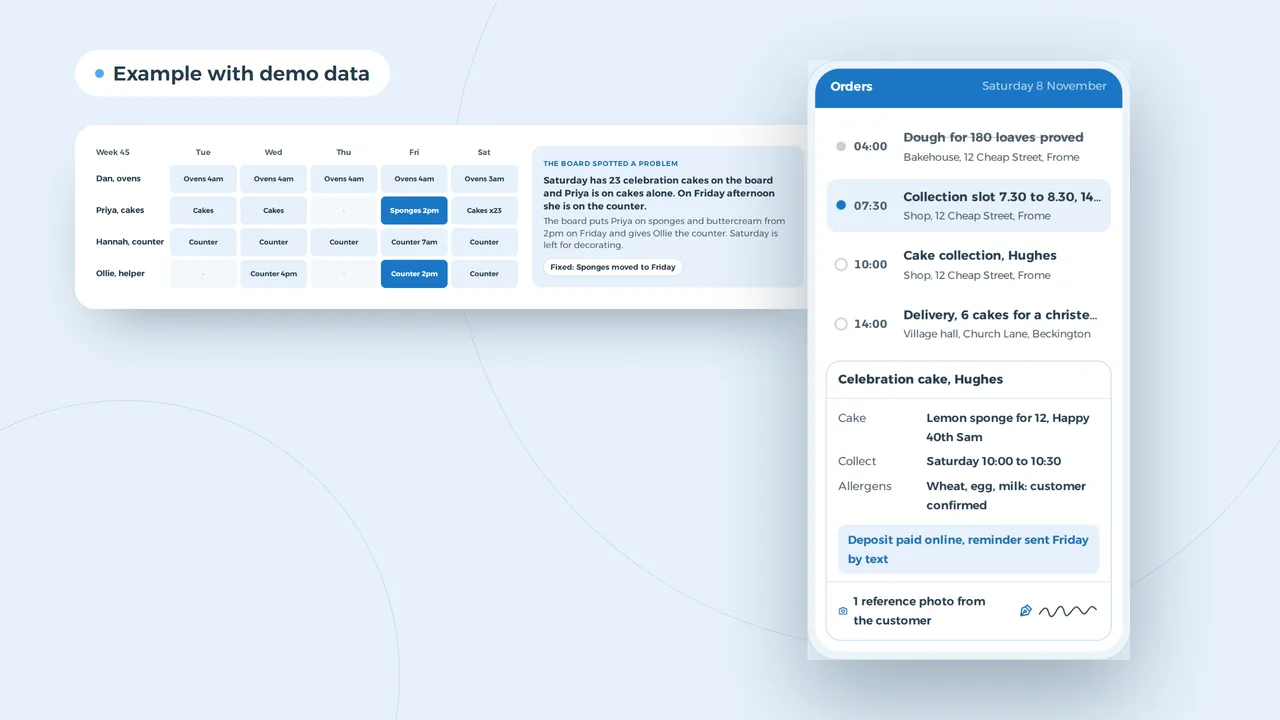
- Orders sorted by collection slotThe counter sees what has to be ready every half hour. Whoever comes at 7.30 doesn't queue behind the 8.30 orders.
- Allergens travel with the productEvery loaf and cake carries its allergens from the recipe. Counter staff read them off rather than remember them.
- The night's bake adds itself upEverything ordered by 6pm lands on the dough sheet for the night, per bake and per weight.
An example of what we can build, with made-up addresses. You choose which fields an order has.
Bakery theme or a site built for the counter
Both can look good. The difference shows on a Saturday morning.
- When the customer comes
- A standard shop themeDelivery address and postage, collection as a workaround
- Built for a bakeryA collection slot per half hour with a limit you set
- Cakes to order
- A standard shop themeProduct variants, piping in a notes field
- Built for a bakerySize, sponge, filling and message, with a last order day per cake
- Allergens
- A standard shop themeTyped by hand in each product description
- Built for a bakeryTaken from the recipe, so a change in flour changes every page
- The night shift
- A standard shop themeSomeone prints the orders and adds them up
- Built for a bakeryOrders flow straight onto the bake sheet
- Costs
- A standard shop themeA monthly plan plus apps and a fee per order
- Built for a bakeryA fixed price for the build; you own the site and the data
A theme is fine for selling jars of jam by post. For cakes collected on a Saturday, the site has to know the clock.
What the rules ask of a bakery website
A bakery selling online deals with food law and with the rules for selling at a distance. These are the points that have to be right on the site itself.
| Topic | What the rule asks | How the site handles it |
|---|---|---|
| Allergens online | For food sold at a distance, the mandatory information, allergens included, is available before the purchase is concluded, at no extra cost | Allergens sit on every product page, above the order button |
| Prepacked for direct sale | Food packed on the premises before the customer orders it, such as wrapped sandwiches, carries a label with the name, full ingredients and the 14 allergens emphasised in England, Wales and Northern Ireland | The label and the product page come from the same recipe |
| Cancellation rights | A customer buying at a distance may normally cancel, but not for goods made to their specifications or goods that go off quickly | A personalised cake and fresh bread fall under the exceptions; the terms say so plainly |
| Cookies | Advertising pixels still need consent first; since 5 February 2026 analytics used only on your own site may run without it, if you explain it and offer an easy way to object | The basket works without a banner; ad tags wait for a yes |
| Food hygiene rating | Displaying the sticker is a legal duty in Wales and Northern Ireland, voluntary in England | Nothing on the site; many bakers show it anyway |
Who has to register with the council, and when, is in register a food business. What every online shop has to show beyond food, such as your business details and terms, is in ecommerce legal requirements; the cookie side is covered in UK cookie law.
An order by email that still makes the list
An example of what we can build, with a made-up customer. The AI turns the email into an order and checks it against your recipes, you decide what you confirm.
Your Google profile, next to the site
For a bakery, the Google profile is often the first thing a customer sees, before the site. It holds your hours, address, photos and reviews. Three things make the difference. Hours for bank holidays and your summer break, because a customer who finds a locked door rarely comes back. Photos of what you actually bake. And a link straight to the order page, not the home page.
Reviews come when you ask at the right moment: when a cake that turned out well gets collected, with a card in the box or a message the day after. Setting the profile up is in create a Google Business Profile; picking the right main category, bakery or cake shop, in Google Business Profile categories; asking for reviews without begging in get more Google reviews.
What bakery website design costs
A website starts from 1,500 euros, at a fixed price you know before we begin. What comes on top depends on what the site has to do, not on the number of pages.
| What you want | What's in it | Price |
|---|---|---|
| A site that gets found | Home, cakes, bread, hours, allergens, a few town pages, your Google profile set up properly | From 1,500 euros |
| Ordering with collection slots | Slots per half hour, last order day per product, online deposit, reminder by text or email | A fixed price after a conversation |
| A full online shop with delivery | Delivery per town, minimum order, online payment, a list per round | A fixed price after a conversation |
| Linking to the bake sheet and your till | Orders flow to the night shift and to your till where it allows it | A fixed price after a conversation |
We don't charge a subscription per order or a share of your turnover. You own the site and the data. Why prices for online shops vary so much is in ecommerce website cost, with UK figures in website cost UK. Torn between Shopify and something of your own? Read Shopify or WooCommerce: for a bakery with collection slots, a standard shop is often the long way round. How we build shops is under webshop development, and you can get in touch to talk it through.
Three steps to a site that takes orders
- A conversation about your shopWhat do customers order now, how does it reach you, what do you bake on a Saturday, which till do you use? We look at an ordinary week and a bank holiday.
- A fixed priceYou get a price for the site and, if you want it, for ordering. A website starts from 1,500 euros; anything more is priced after the conversation.
- The first ordersWe go live with a few products and one weekend of slots. Whatever doesn't work at the counter gets fixed before the full range goes on.
We haven't built for a bakery yet. Booking a free moment from a calendar that shows what's still available, we did build for Villa Lidia, with a booking form and a small admin page for the owner. A butcher with the same questions reads butcher website design.
Webshop development
How VBS helps you with this
We build the steps where your buyer chooses and sees the cost at once: a calculator, a configurator or a booking with the total on screen, and behind it the checkout that suits your business.
- A calculator or configurator with the price on screen
- A checkout with the local payment methods and guest checkout, or a request with the total
- Tracked to the order or the enquiry
How we approach it is on our page about Webshop development.
Orders that come in while you sleep?
Tell us what your customers order now and how. We'll show you what the site would look like.
Rather get in touch right away?