Industries: wholesale
Wholesale software that knows what left the yard
£50,000
Delivery notes on the driver's phone, stock counted per location, and orders the trade counter no longer retypes. Built around how your business already runs.
Merchants live between the counter and the cab
Wholesale software starts at a quarter to seven in the yard. The driver is loading six pallets onto the crane lorry, someone in the warehouse is hunting for a roll of vapour barrier, and a builder at the trade counter wants fifty bags of mortar and asks whether yesterday's drop was complete. Nobody can say for sure, because the delivery note is still in the cab.
Most builders' merchants, plumbers' merchants and electrical wholesalers run their invoicing in a package and the rest of the business on paper, phone calls and memory. The counter retypes a builder's list, the driver writes returned pallets on a slip, and purchasing finds out the insulation board has run out when an order cannot go.
Wholesale management software built for your firm puts those pieces side by side: a delivery note on the phone, stock per location, orders that start from an email or a photo, and invoices your accounts package already understands. You keep what works and replace only what costs you time.
Drivers close each drop with a photo and a signature
- The trade counter sees what landedWhen the builder rings with a question, the counter opens the note with its photo and signature.
- Pallet deposits keep countWhat the driver collects comes off the customer's balance, with no paper list in the cab.
- A shortage becomes a redeliveryWhat was missing is already a drop on the next day's round.
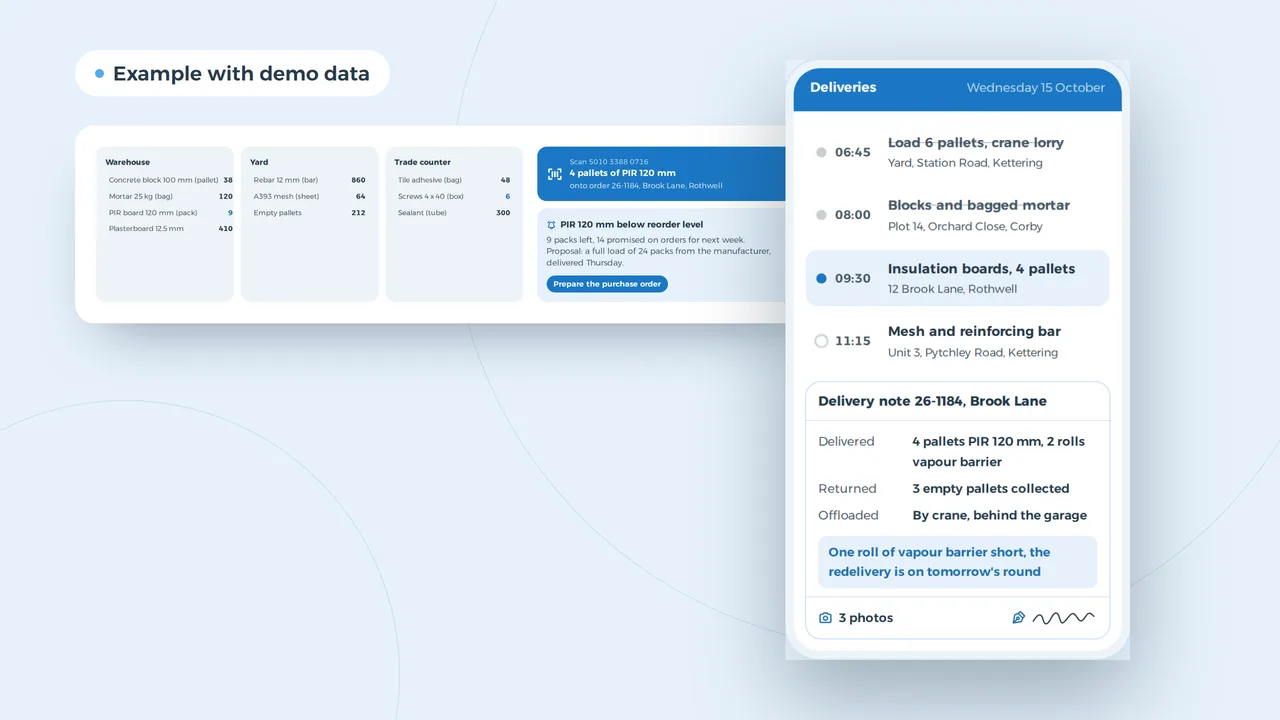
An example of what we can build, with made-up sites and note numbers. You decide which fields the delivery note asks for.
Counter trade, phone calls and the note that goes missing
A merchant earns its margin on volume and service. Things rarely go wrong on price. They go wrong in the gaps between counter, warehouse and lorry: a list retyped twice, a shortage nobody passes on, deposit pallets that never get booked back.
| Moment | How it often goes | With a system of your own |
|---|---|---|
| A builder emails a list | The counter retypes it line by line | The list becomes a draft order from your own products |
| Early loading | The warehouse works from a printed pick list | What is loaded gets scanned onto the delivery note |
| Offloading on site | A paper note and a signature nobody can read | A note on the phone with photo, returns and signature |
| An item is short | The driver rings, or forgets | The shortage becomes a redelivery on the next round |
| A builder rings asking where the drop is | Someone tries to reach the driver | The counter sees where the lorry is and what has landed |
| Invoicing | Notes collected on Friday | The invoice follows from the signed note |
None of those moments is big on its own. Together they decide whether your counter staff are selling or searching. The driver's app is often the first piece, since that is where most of the paper lives; the work order app page shows how such a note works.
Warehouse stock in three places, with a reorder proposal
PIR 120 mm below reorder level
9 packs left, 14 promised on orders for next week. Proposal: a full load of 24 packs from the manufacturer, delivered Thursday.
Example with made-up products and quantities. You set the reorder level and the supplier per item.
Yard stock that counts what is out on site
- Per locationWarehouse, yard and counter racks each hold their own figure, so a pick never starts in the wrong place.
- Promised versus freeStock reserved for next week's orders is held back from what the counter can sell today.
- Pallets on depositWhat the driver collects comes off the customer's balance; what stays on site appears on the next invoice.
- Full loadsA reorder proposal weighs what is promised against a full load from the manufacturer, which often costs less than three part loads.
Inventory management software built for a merchant counts per place and per order. Whoever loads, scans. Whatever drops below the reorder level arrives with purchasing as a proposal, alongside what is already promised. How much margin is left on a product after haulage and crane hire is easy to check with the margin calculator.
Builders search by trade and by town
A builder picks a merchant on three things: what is in stock, how fast it arrives and whether someone answers the phone. More and more that starts with a search on site, with a product and a town in it.
That calls for a site with a page per product range and per area you deliver to, a Google profile with counter hours and photos of the lorries and yard, and a form where the builder can send a list, a site address and a delivery day. Setting up the profile is covered in create a Google Business Profile; more reviews from happy builders come from get more Google reviews. We do website design with that form built in, so a quote request lands straight in the counter's list.
Quote requests arrive with the list and the drop date
New quote request
List for an extension: blocks, lintels, mortar and 8 sheets of mesh, crane offload on 22 October
Mason Build Ltd, Corby, today 07:12
- A page per product range and per area you deliver to
- A Google profile with trade counter hours and yard photos
- A form where the builder sends the list, site address and delivery day
Example with made-up merchants, reviews and builders.
Forklift drivers rarely apply through job boards
A good yard operative with a forklift licence, or a Class 2 driver looking for day work, does not send a CV in a Word file. They see your lorry go past, know someone who works for you, and look at their phone in the evening. So the job goes on your own site with three questions that matter: name, whether they hold a forklift licence, and when they can come in. Everyone who applies sits in a list with their status.
Being visible as an employer is called employer branding. Once people start, staff scheduling software keeps the early loading crew and the counter covered every day. With the National Living Wage at £12.71 from 1 April 2026 and £13.21 from 1 April 2027, rosters that match the real workload matter more each year.
Yard staff apply from their phone
Example with made-up applicants. You choose what the form asks.
Scribbled lists become order lines
Builders order however suits them: a photo of a notebook page, an email full of shorthand, a voice note from the cab. The counter turns that into product codes, units and a delivery day. That translation is exactly what AI does well, as long as it chooses from your products and your prices and a person confirms.
The assistant reads the list, recognises "blocks 100" as the product you sell, sets the unit and drafts an order. The counter checks it, changes what needs changing and confirms. When the AI is unsure it flags the line instead of guessing. More on the approach in AI quote generator and invoice automation, and on how we work in AI automation.
A handwritten list, checked at the counter
A sketch of how this could work for you. The AI picks from your own products and prices, a person confirms the order.
Merchant size decides what you build first
Not every merchant needs an ERP. A sole trader with a counter and one lorry gains more from a good site and clean invoicing than from a system with ten screens for a warehouse they can see in one glance.
| Size | What you need | What can wait |
|---|---|---|
| Sole trader with counter and lorry | A site with product ranges and an enquiry form, invoices from your existing package | Warehouse management, an ERP of your own |
| Crew of 5 | Delivery notes on the phone, stock for the fastest movers, pallet balances per customer | Supplier reorder proposals, a customer portal |
| Business of 20 to 50 | Stock per location with reorder levels, delivery rounds, AI on incoming lists, a link to the accounts | A whole new ERP, while the current package still copes |
| Larger firm with several branches | A custom ERP or a standard package with integrations, a client portal for trade accounts | Nothing: at this size the whole picture pays to review |
Torn between a package and custom work? Read Odoo or custom software and what an ERP costs first. Often API integration between what you already have is enough.
Customs, invoices and markings a merchant handles
A merchant sits between manufacturer and builder and picks up rules from both sides. These touch daily work the most.
| Situation | What the rule asks | What the software does |
|---|---|---|
| You import steel structures (7308) or screws and bolts (7318) | UK CBAM applies from 1 January 2027 above £50,000 of such imports in 12 months; register by 31 January 2028 and pay by 31 May 2028 | Adds up imports per commodity code over a rolling 12 months, so the threshold never comes as a surprise |
| You are VAT registered | Making Tax Digital for VAT applies to every VAT-registered business | Sends sales and purchase figures to the accounts package you file from |
| You invoice other businesses | Peppol e-invoicing between businesses becomes mandatory from 1 April 2029 | Builds invoices from signed notes in a structured format, ready for Peppol |
| You sell construction products | UKCA or CE marking, with no end date set for CE | Keeps the declaration and the marking per product and batch, next to the delivery note |
| You employ staff | Employers' liability insurance is compulsory, with cover of at least £5 million | Keeps the certificate date where the office sees it |
How the coming e-invoicing works is set out in e-invoicing in the UK. The software never files anything with HMRC for you and signs no declaration in your name. It makes sure the figures and documents are ready when you or your customs agent need them. Trading across the Channel? Read selling to the EU from the UK.
Crane lorries and paperwork in a worked example
| Task per week | Paper, email and phone | A system of your own |
|---|---|---|
| Retyping delivery notes, 8 minutes each | 8 hours | 1 hour |
| Working up quotes, 20 minutes against 8 | 10 hours | 4 hours |
| Calls about drops and shortages | 3 hours | 0.5 hours |
| Total | 21 hours | 5.5 hours |
That is 15.5 hours a week. Over 46 weeks it comes to 713 hours, at £35: 713 x 35 = £24,955 a year in time that goes back to selling. Unbooked deposit pallets are not even in that figure. Put in your own numbers with the software development cost calculator and set the project price against them.
Merchants start with an ordinary week
- A conversation at the counterWe look at how an order comes in, who loads, what the driver writes down and when it gets invoiced. An ordinary week says more than a feature list.
- A fixed price per projectTogether we pick the piece where most time leaks away and fix a price for it. From 1,500 euro you get a site with an enquiry form, and software is quoted once the scope is clear.
- One driver and one counter firstThe first version runs on real drops with one lorry and one counter. What does not fit is changed before the rest of the business switches over.
No wholesaler is on our client list yet; the closest thing is the stock that counts each purchase first in, first out for the fuel depot at Zuco Logistics, live since 14 September 2026.
Custom software
How VBS helps you with this
We build the platform your business runs on every day: your spreadsheets, emails and paperwork in one system that does what you do.
- Your workflow mapped first, then a fixed price
- Screens for the office, the client and the road
- Hosting, backups and security managed by us on AWS
How we approach it is on our page about Custom software.
Your yard, counter and rounds in one place?
Tell us how an ordinary week runs at your branch. We will show you where we would start and what it could give back.
Rather get in touch right away?