Industries: steel fabrication
Steel fabrication software that keeps every job in one file
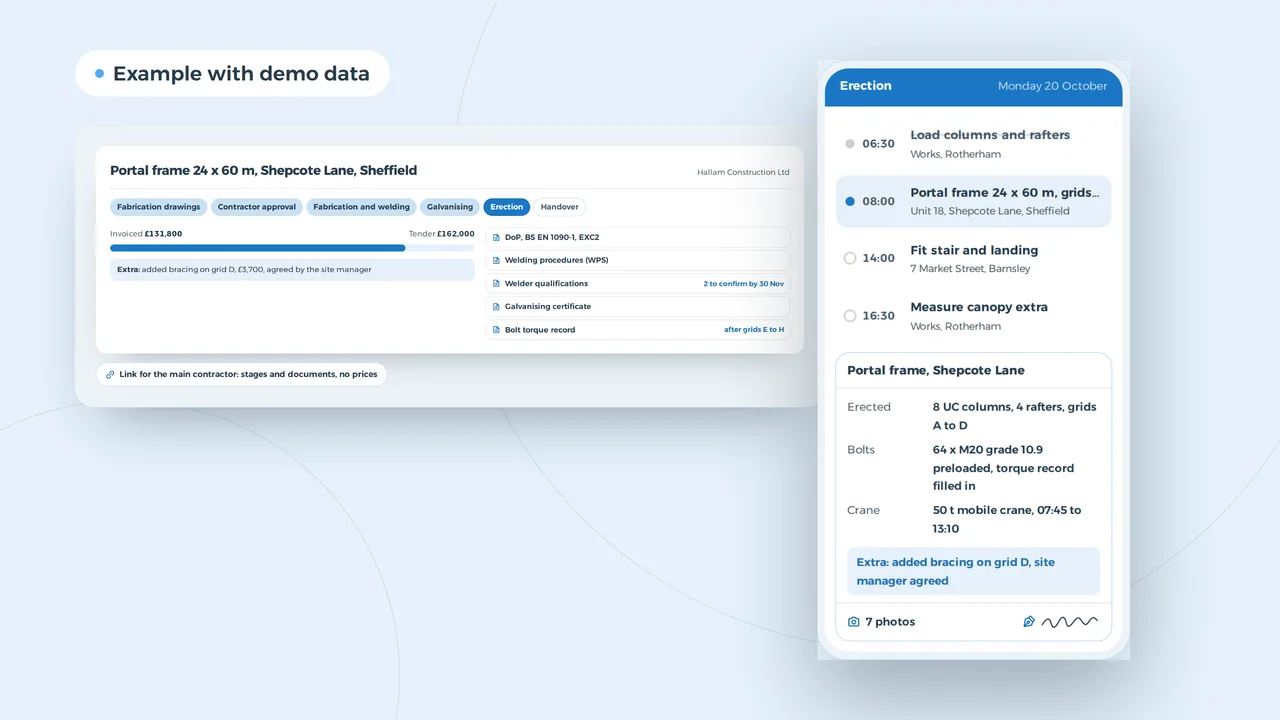
An erection sheet on the foreman's phone, a file per job with stages, cost and marking documents, and a bill of materials that starts from the contractor's drawing.
Steelwork runs on drawings, the shop and the crane
Steel fabrication software starts with a portal frame, 24 by 60 metres, off Shepcote Lane in Sheffield. The fabrication drawings are approved, the columns are back from the galvaniser, and on Monday at a quarter to eight a 50 tonne mobile crane is on site. The foreman needs to know which grid goes up first, which bolts get preloaded and who signs the torque record.
In many steelwork firms that lives in different places: drawings in the detailing package, the programme in a spreadsheet, welder qualifications in a binder, the erection sheet on paper in the cab. At handover someone spends a week pulling together the declaration of performance, the weld procedures and the galvanising certificate. Extras agreed on site by word of mouth never reach an invoice.
Software built for your firm keeps each job in one file: stages, cost against the tender, documents and what the crew did on site. For special-purpose machine builders the file follows each machine, with the bill of materials, risk assessment and technical file in one place.
Erection crews log bolts, crane hours and extras
- The torque record stays with the jobWho tightened which bolts and when is in the file for handover.
- Crane hours feed job costingHire crane hours sit next to what the tender allowed.
- Extras carry a signatureThe added bracing is signed on the sheet before the crane leaves.
An example of what we can build, with made-up sites and sections. You decide what the erection sheet holds.
Fabrication drawings, galvanisers and a site that waits
A steelwork job passes through four pairs of hands: the detailer, the shop, the galvaniser and the erection crew. Every handover is a place where something can stall.
| Moment | How it often goes | With a job file of your own |
|---|---|---|
| Drawings out for approval | Emails back and forth, revisions mixed up | The contractor approves in the file, with date and revision |
| Fabrication and welding | Qualifications and WPS in a binder in the office | Each part carries its welder, procedure and mill certificate |
| Galvanising | Ringing round to ask when the steel is back | The stage moves on when the load arrives, certificate attached |
| Erection | Paper sheet, crane hours from memory | Erection sheet on the phone with bolts, crane hours, photos and signature |
| Extras on site | Agreed verbally, argued about later | Signed on the sheet before the crane leaves |
| Handover | A week of digging for documents | The file is complete the moment the last bolt is in |
Spreading crews across several sites is covered in construction scheduling software. The erection sheet itself is a work order app with a steel erector's fields.
Job files with stages, budget and marking documents
Link for the main contractor: stages and documents, no prices
Example with a made-up job, client and amounts. You set which documents belong in a file.
Special-purpose machines need a technical file each
For a machine builder the job is a machine, and the file follows it for life. Bill of materials, wiring diagrams, risk assessment, instructions, declaration of conformity, and later every service and modification. Build several variants of one machine and you want to see which customer has which build.
The system keeps those pieces per machine and hands the bill of materials to purchasing. What is in stock gets reserved; what is missing goes to the supplier as an enquiry. Shop and installation hours come back to the machine, so the job costing adds up. Talking to your accounts or detailing package is done through API integration; the glossary entry explains the term.
A main contractor or end customer who wants to follow along gets a link to the stages and documents, without prices. That is a small client portal, and it saves calls asking when erection starts.
Portal frames and mezzanines are searched for on a phone
A farmer after a machinery shed, a business that needs a mezzanine in its warehouse, a contractor looking for a steelwork subcontractor: they search by kind of job and by area. They want to see finished work, know how far you travel to erect, and send their drawing straight away.
A site with a page per kind of job, photos of finished frames and stairs, and a form that asks for sizes, drawings and a start date brings enquiries you can budget at once. Getting found locally is covered in local SEO tips and create a Google Business Profile. What sets a construction site apart is in website for contractors.
Machinery sheds arrive as enquiries with drawings
New enquiry
Machinery shed 18 x 36 m, architect's drawing attached, start after harvest
Farm near Penistone, today 19:05
- A page per kind of work: portal frames, mezzanines, stairs, machine frames
- A Google profile with finished jobs and the area you erect in
- A form that asks for sizes, drawings and the start date
Example with made-up firms, reviews and enquiries.
Steel erectors are scarcer than customers
A steelwork firm with a full order book often spends longer finding an erector than a customer. Good erectors work at height, hold an IPAF card, and want to be home in the evening. They rarely answer an advert with a long list of demands. A job on your own site with photos of your sites and three questions works better: experience, cards, and when they can talk.
Everyone who applies sits in a list with their status, and the foreman sees who has an interview. Being visible as an employer is called employer branding. Once people start, staff scheduling software spreads them across crews with their cards alongside.
Erector applications with cards attached
Example with made-up applicants. You decide which cards the form asks for.
Bills of materials from a PDF drawing
A shed enquiry arrives as a PDF with a plan and two sections. The estimator counts columns, rafters, purlins and bracing, looks up lengths and estimates the weight. At ten enquiries a month that is a full day, for quotes you only win some of.
AI can do that first count. It reads the drawing, pulls out sections, lengths and quantities and drafts a bill of materials with an estimated weight. The estimator checks the sections, adds what the drawing does not show and sets the price. When the AI is unsure about a detail it flags it instead of guessing. More on the approach in AI quote generator and AI for construction.
Sections, lengths and weight from the drawing
Demo data, not a real project. The AI reads the drawing, the estimator decides what goes in the quote.
Steelwork contractors by size
A blacksmith who fits the odd staircase needs no six-stage job file. A fabricator with three erection crews and twenty jobs a year does. What to build depends on where you stand.
| Size | What you need | What can wait |
|---|---|---|
| Sole trader with a workshop | A site with finished work and a form for drawings, invoices from your current package | A job file, an ERP |
| Crew of 5 | Erection sheet on the phone, welder qualifications with a date, documents per job | Scheduling across several crews |
| Business of 20 to 50 | A file per job with stages and cost, crew scheduling, bills of materials from drawings, a link to the accounts | A whole new ERP, while the current one copes |
| Larger firm or machine builder | A custom ERP or a standard package with integrations, a technical file per machine | Nothing: at this size the whole picture pays to review |
Working mainly for main contractors? Software for construction companies covers the overlap. Choosing a partner? Read how to choose a software development company.
Execution classes, UKCA and machinery rules in the file
Steelwork and machine building run under rules and standards that all end up as a document at handover. These come back most often.
| Situation | What the rule or standard asks | What the software does |
|---|---|---|
| You supply structural steel | BS EN 1090 asks for factory production control and works with execution classes such as EXC2 | Links mill certificate, weld procedure and welder to each part |
| You mark construction products | UKCA or CE marking, with no end date set for CE | Builds the declaration from data already in the file |
| You import steel structures (7308) | UK CBAM applies from 1 January 2027 above £50,000 of such imports in 12 months | Adds up imports per commodity code over a rolling 12 months |
| You build machines | The Supply of Machinery (Safety) Regulations 2008: keep the technical file and declaration for 10 years; CE stays recognised, and SI 2026/867 accepts EU 2023/1230 from 20 January 2027 | Keeps bill of materials, risk assessment and technical file per machine for as long as needed |
| Your crew works at height | The Work at Height Regulations 2005 | Puts the chosen access equipment and the crew's cards on each erection sheet |
| You weld | HSE treats welding fume as a carcinogen and expects LEV and suitable RPE | Keeps LEV inspection dates and RPE issued per welder |
BS EN 1090 and ISO 9606-1 are industry standards your customers and certification body ask for. The software signs no declaration and passes no weld. It makes sure every document is in place when you sign. Employers' liability insurance of at least £5 million is compulsory once you employ staff; keep the certificate date where the office sees it.
Crane hours and extras in a worked example
| Task per year | Paper, binders and spreadsheets | A job file of your own |
|---|---|---|
| Retyping erection sheets, 15 minutes against 3 | 115 hours | 23 hours |
| Pulling together the handover file, 6 hours against 1 per job | 120 hours | 20 hours |
| Bill of materials from a drawing, 4 hours against 1.5 per enquiry | 160 hours | 60 hours |
| Total | 395 hours | 103 hours |
That is 292 hours a year, at £45: 292 x 45 = £13,140. Say too that on one job in four an extra of £1,300 never gets invoiced because nobody wrote it down: 5 x 1,300 = £6,500. Run your own numbers in the software development cost calculator.
Steelwork jobs start with a conversation
- A look at a recent jobWe take a frame or a machine that has just finished and follow it from enquiry to handover: where did it stall, which document took longest to find?
- A fixed price per projectWe pick the piece that gives back the most and fix a price for it. A site with an enquiry form costs from 1,500 euro; software gets its fixed price after we talk.
- One crew and one file firstThe first version runs on a live job with one erection crew. What slows the foreman down changes before the other crews follow.
No steelwork contractor is on our client list yet; the closest piece is the excise and customs export screen running at Zuco Logistics since 14 September 2026.
Custom software
How VBS helps you with this
We build the platform your business runs on every day: your spreadsheets, emails and paperwork in one system that does what you do.
- Your workflow mapped first, then a fixed price
- Screens for the office, the client and the road
- Hosting, backups and security managed by us on AWS
How we approach it is on our page about Custom software.
Shop, site and job file in one place?
Tell us how a job runs at your firm. We will show you where we would start with custom software and what it could give back.
Rather get in touch right away?