On this page
The ad that only rings is on its way out
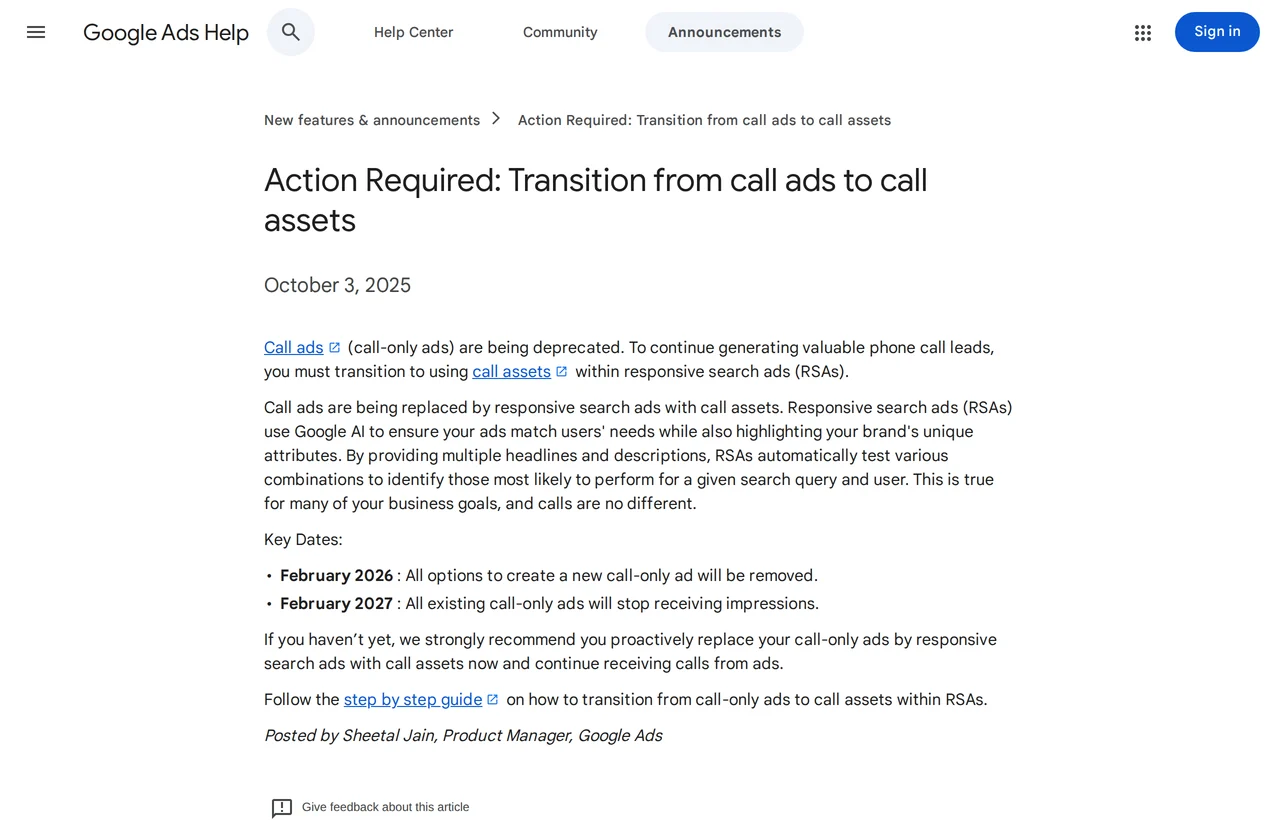
The Google call only ads sunset is set: since February 2026 you cannot create a new call-only ad, and from February 2027 every existing one stops receiving impressions. Google announced it on 3 October 2025 and gives a month, not a day, for both steps.
The replacement is a responsive search ad with a call asset: the same call button, now under a normal search ad that can also send people to your site. It applies in every country where Google Ads runs, so a plumber in Leeds and a locksmith in Ghent face the same deadline.
What Google announced, and what it did not
The announcement sits in the Google Ads Help under "Action Required: Transition from call ads to call assets", posted on 3 October 2025. It contains two dates:
| When | What happens | What you notice |
|---|---|---|
| February 2026 | Every option to create a new call-only ad is removed | You can still edit or pause the ads you have, not add new ones |
| February 2027 | Every existing call-only ad stops receiving impressions | A campaign with only call-only ads shows nothing |
| Now | Responsive search ads with call assets are the replacement | Calls come through the button under a normal ad |
Google's reasoning is that responsive search ads test several headlines and descriptions and pick the combination that fits each search, and that this applies to calls as much as to clicks. What Google did not say: a day in February, or an automatic conversion. Unlike Dynamic Search Ads, which Google moves to AI Max by itself in the same month, nothing converts your call-only ads for you. If you do nothing, the calls simply stop.
The same month also brings a new budget split for Search campaigns that run on the Display Network. February 2027 is a month to review the whole account, not just the call ads.
Who should move first
Call-only ads were built for businesses where the customer wants to talk right now: emergency plumbers, locksmiths, towing, glaziers, boiler repair. On a phone, one tap opened the dialler. No website needed, no form.
| Advertiser | What changes | What to do |
|---|---|---|
| Local trade with emergency jobs | The ad that only calls disappears | Search ad with call asset and a fast landing page, well before February 2027 |
| Office or practice working by appointment | Little, if you already run search ads | Add a call asset with your opening hours to existing ads |
| Online shop | Usually nothing | Only if your sales team closes orders by phone |
| Agency managing client accounts | Every account with call-only ads | List them per client and spread the switch over several weeks |
If you sell into several countries, check every account and every language version: the deadline is global, and an account you rarely open is the one that goes quiet. For the basics of how Google Ads works for a local business, the model stays the same: you pay per click, the CPC, only now that click can also land on your site.
- Create newCall-only adNot possible since February 2026Responsive search ad with call assetAny time, in any ad group
- Tap on a phoneCall-only adCalls straight away, no siteResponsive search ad with call assetCall or visit the site, the user picks
- CopyCall-only adShort fixed copy around the numberResponsive search ad with call assetUp to 15 headlines and 4 descriptions
- Phone numberCall-only adInside the ad itselfResponsive search ad with call assetAs a call asset, with hours per day
- On a desktopCall-only adOf little useResponsive search ad with call assetButton with the number and a QR code
From February 2027 existing call-only ads stop receiving impressions.
The money, with a plumber as the example
A worked example with assumed figures, to show where the difference sits. An emergency plumber in Leeds spends 500 pounds a month on search ads at an average of 2.50 pounds per click: 200 clicks. To estimate your own click price, use the Google Ads budget calculator or read what Google Ads costs.
A tap on the call button costs the same as a click on the headline, a standard CPC. Clicks to your site are not wasted money as long as the page does the job the call button used to do. What each pound returns shows in the ROAS calculator; whether a job still pays after ad costs, in the margin calculator.
The landing page now carries half the weight
A call-only ad needed no page. A search ad does, and Google counts the page in your Quality Score and so in your price per click. A landing page for urgent jobs does four things in the first screen of a phone:
- The phone number large and tappable, with the hours you answer.
- One sentence on what you do and where, for example "Leaks and blockages across Leeds, on site within the hour", if that is true.
- A short form for people who cannot call, like someone at work.
- Fast loading. Test it with the website speed test and fix what it finds with the speed guide.
How to turn more of those visits into calls is the subject of CRO.
Before February 2027, in this order
- Export every call-only ad with last month's calls per campaign, so you have a baseline
- Add your business name at account or campaign level
- Add every number as a call asset in international format, for example +441130000000
- Set the asset schedule to the hours someone actually answers
- Write one responsive search ad per ad group, with the call asset attached
- Switch on call reporting and track clicks on the number on your site as a conversion
- Run old and new side by side for one to two weeks, then pause the call-only ads
Tracking which call becomes a job
With call reporting switched on, Google shows a forwarding number and creates a conversion called "Calls from ads", on the Search Network only. One gap remains: people who reach your site and then call are not in that count. Track the click on the number on your site as a separate conversion.
| What you track | Where | Why it matters |
|---|---|---|
| Tap on the call button in the ad | Google Ads, call reporting | Shows which search term produced the call |
| Tap on the number on your site | Your analytics, imported as a conversion | Without it, every visit looks like a lost click |
| Submitted form | Your analytics and inbox | The customer who cannot call |
| Call that becomes a job | Your own list or software | The only number that says revenue |
In the EU and the UK, conversions that depend on cookies are subject to consent, and Google's consent mode decides what reaches the bidding. A conversion you cannot measure is one Google cannot learn from.