Industries: heat pump installers
Heat pump installation software that carries the job to the grant claim
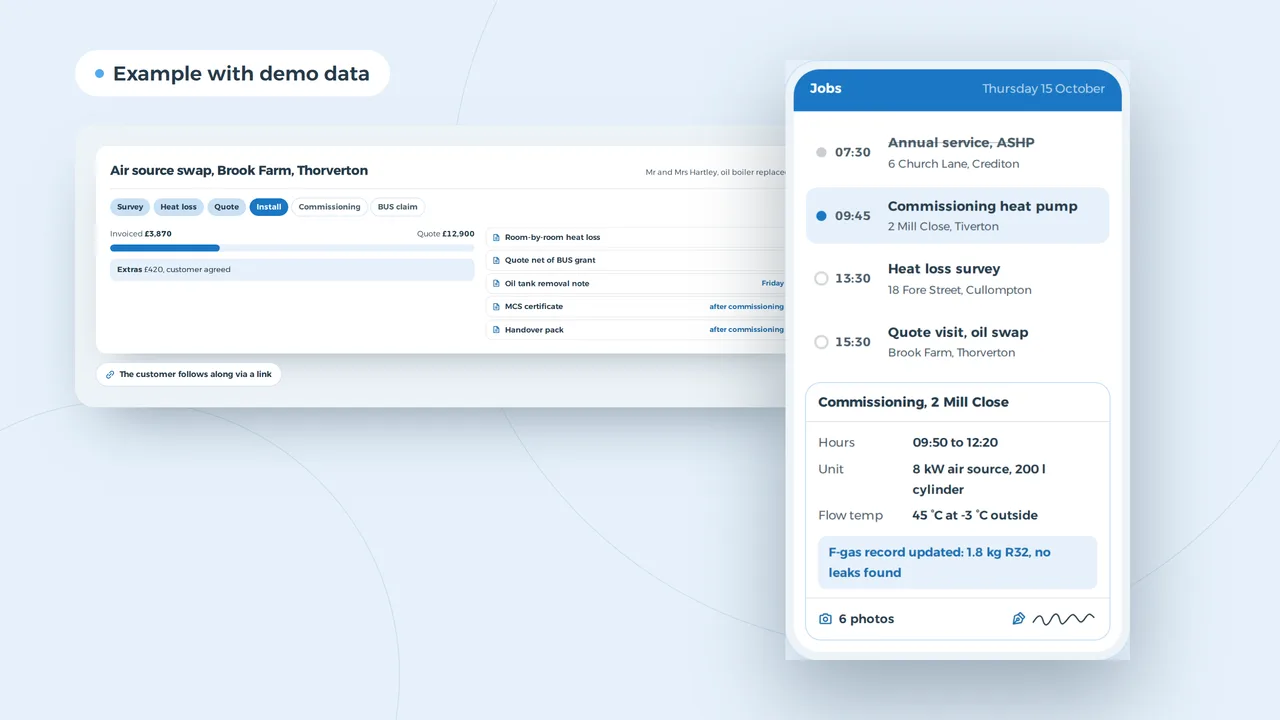
A job sheet that fills in the F-gas record, a board that knows who holds which qualification, and a file per home that carries the BUS paperwork. Built around how your team already works.
A Thursday in Mid Devon with four vans out
Heat pump installation software starts with an ordinary day. A 7.30 annual service in Crediton, a commissioning visit in Tiverton, a heat loss survey in Cullompton after lunch and a quote visit for an oil swap near Thorverton. In between, a customer rings to ask whether the grant has gone through, the merchant texts about a cylinder, and the office wants to know who logged the refrigerant on yesterday's job.
In most small firms that lives in a diary, a spreadsheet of service contracts, a folder of heat loss calculations and the owner's phone. Heat pump software built for your firm puts it in one place: job sheets on the phone, a board for the week, a file per home and a website that brings in the right enquiries. Below is what we would build for each part of the work, the rules the trade brings with it, and how much system a firm of your size needs.
Commissioning with the job sheet open on the phone
- Photos go into the handover packNameplate, outdoor unit and settings are filed with the address, ready for the MCS certificate and the BUS claim.
- The F-gas record stays with the unitRefrigerant, charge and every visit sit with the system, even when a colleague does next year's service.
- The office invoices the same dayHours, parts and extras are ready for the invoice. Nobody types up paper sheets.
An example of what we can build, with made-up addresses. You choose which fields a job sheet has.
An oil swap followed stage by stage
The customer follows along via a link
An example of what we can build, with made-up names and amounts. You choose the stages of your projects.
Where a heat pump firm loses its hours
Fitting a heat pump is skilled work. The money leaks out around it: the photo of the nameplate nobody took, the F-gas record filled in on Friday from memory, the customer who rings three times about the grant.
| Moment | How it often goes | With your own system |
|---|---|---|
| Enquiry | A call during a job, a note on the dashboard | A form with the age of the house, fuel use and photos of the boiler and radiators |
| Survey | Measurements on paper, typed up later | Room by room on the phone, ready for the heat loss calculation |
| Quote | Written at night from an old quote | Built from your own units and prices, with the grant taken off |
| Install and commissioning | Refrigerant and pressure test on a separate sheet | The job sheet updates the record that stays with the system |
| Grant and handover | Paperwork chased by email for weeks | Photos, certificate and invoice in one file, ready for the claim |
| Annual service | A spreadsheet of dates nobody follows up | Each contract books itself in and the customer picks a slot |
What an engineer fills in on the sheet, and why, is on our work order app page. Hours per job belong in a time tracking app, and the outdoor units, cylinders and refrigerant in stock in inventory management software.
A CRM for HVAC contractors starts at the property
Most HVAC software in the UK is sold as one package for every heating and cooling trade, priced per engineer per month. That suits some firms. Others find that half the screens are for work they never do, and the part they need, the heat pump paperwork, is missing.
A standard CRM thinks in deals. A CRM for HVAC contractors thinks in systems: an address with a unit, a refrigerant, a charge in kilograms, a flow temperature, a service contract and a warranty. So we build the file around the home. Whoever does next year's service opens the address and sees what was fitted, how it was set up and what the record says.
For a new heat pump the file runs from the first survey to the grant. The heat loss calculation, the quote, the MCS certificate, the final invoice and the photos sit together, and the customer gets a link to see where the job stands without ringing the office. How that link works is on client portal; the base is a custom CRM shaped around your trade. If you are weighing one big package against two smaller tools, read CRM vs ERP.
Firms that also fit solar panels or car chargers keep them in the same file. What those trades bring with them is on our pages for solar installers and EV charger installers.
A week where the cylinder arrives late
The board spotted a problem
The cylinder for Tiverton arrives on Tuesday afternoon, but the install starts on Monday.
The board starts the install on Wednesday and fills Monday and Tuesday with the services that were waiting.
Fixed: Install moved to Wednesday
An example of what we can build, with made-up names. You choose what the board checks.
HVAC scheduling software for a small business has to know more than who is free. Only an engineer with the right F-gas category may work on a system with refrigerant, and Category 2 stops at small systems. Gas work needs Gas Safe. A ground source install waits on the borehole team, an air source swap on the cylinder delivery. In winter, breakdowns jump the queue; in spring and autumn the board fills the days with services from the contracts.
The board keeps all of that in view. A job with refrigerant only goes to someone qualified for it, and a job stays grey until the parts are in. If you are still planning in a spreadsheet, start with Excel scheduling or planning software; who works which week belongs in staff scheduling software.
Someone in Tiverton wants a heat pump
New enquiry
1930s cottage, oil boiler from 2009, about 1,800 litres a year, radiators throughout
Helen, Tiverton, today 20:47
- A page per system and per town you cover
- A Google profile with photos of real installs
- A form that asks what you need before the survey
Example with made-up businesses and reviews.
Enquiries from the towns you cover
A heat pump installer works within an hour's drive. When someone in Tiverton or Crediton searches for "air source heat pump", "heat pump installer" or "heat pump service", your name should be there, with reviews and a button to book a survey.
Three things make that happen. A website with a page per system you want to fit and per town you cover. A Google profile with photos of real installs and recent reviews; create a Google Business Profile and get more Google reviews show how. And a form that asks what you need before the survey: age of the house, insulation, fuel use, radiators or underfloor heating.
Most questions from homeowners are about money: the grant, the VAT, the running costs. A firm that explains the Boiler Upgrade Scheme clearly on its site gets better enquiries. We build that kind of site through website design, with websites from 1,500 euro. Being found in your own towns is local SEO, and the search side for heating firms is set out in SEO for HVAC companies.
Hiring an engineer who already holds Category 1
An example of what we can build, with made-up names. You choose what you ask.
Good heating engineers are scarcer than customers. They look at firms on their phone in the evening, and a job page on your own site with three real questions works better than an advert that vanishes after a month: which F-gas category they hold, whether they are Gas Safe, when you can call. A Gas Safe engineer moving into heat pumps is worth hearing from if you pay for the training; say so on the page. What you show as an employer is called employer branding.
An email with photos turned into a survey brief
An example of what we can build. The AI prepares from your own way of working, you decide.
AI does not size a heat pump. It prepares what you would otherwise pull out of an email at night: the age of the house, the oil or gas use, which rooms have radiators, whether there is a photo of where the outdoor unit could go. From your own units and price list it lays out a first draft of the quote; you check it, change it and send it. Emails about breakdowns, quotes and deliveries land in their own list with a suggested reply that a person approves. How that works is on AI quote generator and, for a neighbouring trade, AI for plumbers.
One engineer or forty staff: how much system fits
A sole trader fitting air-to-air units does not need an ERP. A firm with thirty engineers and a thousand service contracts needs more than a job sheet.
Sole trader
A website with an enquiry form, a Google profile, and a job sheet that fills in the F-gas record and makes the invoice. No planning board, no roles and permissions, no ERP.
A team of five
Job sheets, a board that knows each engineer's qualifications, a file per home and service contracts that book themselves in. Purchasing and a stock module can wait.
A firm of 20 to 50
A board across several teams, stock per van, contracts with fixed prices and a link to your accounts package. Not a big suite you use half of. At this size the question often moves to stock and margin per job, which is where custom software earns its keep.
A larger company
Projects for developers and consultants, job costing, subcontractors and a portal per building. Not a second system next to the first. If you also do plumbing and boilers, the broader page is software for installers.
F-gas, MCS and the grant at a glance
A heat pump firm works to rules its customers have never heard of, and you have to be able to show them. These are the ones that most often belong in your files.
| Topic | What the rule asks | What the software does |
|---|---|---|
| Engineers working on refrigerant | A personal F-gas qualification: Category 1 covers every activity, Category 2 only systems under 3 kg (6 kg if hermetically sealed) | Jobs with refrigerant only go to someone with the right category |
| The firm | Company F-gas certification, through Refcom or Bureau Veritas | Your certificate and each engineer's qualification sit in the system with their dates |
| Boiler Upgrade Scheme | £7,500 for air source or ground source, £2,500 for air-to-air, plus £1,500 for homes on oil or LPG until March 2027; England and Wales | The quote shows the grant taken off the price |
| Who applies | An MCS certified installer applies on the owner's behalf; Ofgem then asks the owner to confirm | The file holds what the claim needs, and the owner's confirmation becomes a task |
| After the application | The installer commissions within 120 days | The board shows how many days each job has left |
| VAT on the install | 0 % on energy-saving materials until 31 March 2027, then 5 % | The invoice sets the rate from the date |
| Gas work and landlords | Gas work only by a Gas Safe registered engineer; a landlord's gas safety check every 12 months | A reminder per property, to someone who is registered |
The software certifies nothing and claims nothing for you. It makes sure you and your customer see the deadline.
Service contracts in hours and pounds
| Task per year | Phone, paper and spreadsheets | Your own system |
|---|---|---|
| Booking services, 12 minutes against 3 per contract | 120 hours | 30 hours |
| Typing up sheets and the F-gas record, 10 minutes against 2 per sheet | 160 hours | 32 hours |
| Chasing paperwork for the grant, 45 minutes against 15 per install | 60 hours | 20 hours |
| Total | 340 hours | 82 hours |
That is 258 hours a year. At £45: 258 x 45 = £11,610. Add the contracts that lapse because nobody rang. Say 30 of the 600 customers drift away at £120 a service: 30 x 120 = £3,600. Together £15,210 a year in this example. Yours may be more or less; count your own sheets and contracts for a month. If the spreadsheet is the real problem, read replace Excel with software.
Getting started before the heating season
- A conversation about your yearHow does work come in, who books the services, what does the engineer write down, when do you invoice? We look at your busiest and your quietest month, not at a list of features.
- A fixed price per projectTogether we pick where you lose the most time and set a fixed price for that piece. Websites start from 1,500 euro; software gets a price after the conversation.
- One team uses it firstAn engineer and the planner use the first version on real jobs, ideally before winter. What does not fit is changed before the rest follow. You own the code and the data.
We have no heat pump firm as a client yet. We did build a platform with files, tasks, documents and a client portal for Business Centrum.
Heat pump firms ask us
- Can the system keep the F-gas record for each system?
- Yes. Every job sheet with refrigerant writes the type, the charge and the leak check against the system. At the next service the engineer sees the whole history on the phone.
- Will the board warn me when an engineer's qualification is not right for a job?
- Yes, once we add each engineer's category. A job on a larger system will not go to someone who only holds Category 2.
- Can my customer follow the grant claim?
- Yes. The customer gets a link to their file with the quote, the certificate and the invoice. You apply as the MCS installer; the link shows them where it stands.
- Does it replace my heat loss software?
- No. We do not rebuild a calculation tool. The file keeps your calculation and carries over the survey measurements, so nobody types them twice.
- Do I have to change my accounts package?
- No. Customers, items and invoices go to the package your accountant uses.
- What does heat pump software cost?
- You pay for what you want first: job sheets, a board, a project file or a website. After a conversation you get a fixed price per project. Websites start from 1,500 euro. Book a call.
Custom software
How VBS helps you with this
We build the platform your business runs on every day: your spreadsheets, emails and paperwork in one system that does what you do.
- Your workflow mapped first, then a fixed price
- Screens for the office, the client and the road
- Hosting, backups and security managed by us on AWS
How we approach it is on our page about Custom software.
Your contracts, records and grants in one place?
Tell us how a season runs at your firm. We will show where we would start and what it could save you.
Rather get in touch right away?