On this page
- 01Register a food business in the UK: who has to
- 02Registration or approval: which one you need
- 03What registration costs and what it doesn't cover
- 04Your food hygiene rating and the first inspection
- 05Selling online: what your website has to show
- 06Bakers, butchers, caterers and farm shops
- 07How the website fits the registration
- 08Checklist before you open
To register a food business in the UK, you tell your local authority what you do and where, at least 28 days before you start trading. It is free, it can't be refused, and it applies to far more set-ups than people expect: a market stall, a kitchen at home, a food van, an Instagram cake shop and an office that brokers food it never touches all count. If you supply food to the public regularly, paid or free, you are a food business.
This guide covers England, Wales and Northern Ireland, where the Food Standards Agency sets the rules and local authorities apply them. In Scotland, registration runs through Food Standards Scotland and your council. The guide explains who registers, when approval replaces registration, what the first inspection looks like, and what changes when orders come in through a website.
Register a food business in the UK: who has to
| How you trade | Register? | What to watch |
|---|---|---|
| Shop, café, bakery or butcher with customer-facing premises | Yes | Your premises have to meet the hygiene rules before you open |
| From home | Yes | Your home kitchen is your premises, and the same hygiene rules apply to it |
| Mobile unit, market stall or temporary premises | Yes | The premises rules apply to the unit itself |
| Online only, through a website or social media | Yes | Distance selling rules and allergen information come on top |
| Several trading names, for example on a delivery platform | Yes, once | One registration can list all the trading names |
| An office that distributes or brokers food without storing it | Yes | Even if no food is ever kept there |
| More than one site | Yes, per site | Each premises registers with its own local authority |
Taking over an existing food business counts as starting one. The new owner registers, even if the shop has traded at the same address for years.
28 days, free and it can't be refused
Register at least 28 days before your first sale, but not much earlier: the Food Standards Agency advises waiting until you are about 28 days from opening. Registration costs nothing and your local authority can't refuse it. What it does do is put you on the list for an inspection.
Found on a phone, with the allergens already on the menu page
New enquiry
Wedding 11 June 2027, 110 guests, barn venue, 3 vegan
Hannah, Wilmslow, today 21:14
- A page per occasion: weddings, corporate, wakes, private dining
- The allergen matrix on every menu page and the hygiene rating in view
- An enquiry form that asks for guest numbers and dietary needs per table
Example with made-up caterers and reviews.
Registration or approval: which one you need
Most shops, cafés, bakeries and caterers that sell to the public only register. Approval is a separate, stricter step under retained Regulation 853/2004. It applies to establishments that handle food of animal origin, such as meat, fish, dairy or eggs, and supply it to other businesses.
| Type of establishment | What you need | Who decides |
|---|---|---|
| Bakery, café, restaurant, caterer or butcher selling to the public | Registration | Local authority |
| Business making meat products, fish, dairy or egg products for other businesses | Approval | Local authority |
| Slaughterhouse, cutting plant, game handling establishment or wholesale meat market | Approval | Food Standards Agency |
| Office-based distributor or broker of food | Registration | Local authority |
Approved establishments are listed publicly by the Food Standards Agency. If you are a butcher who also sells sausages to a pub or cuts meat for another shop, check with your local authority whether that pushes you from registration into approval before you take on the order.
A farm that sells its own meat, milk or eggs straight to customers starts with registration too. Supplying those products to shops, pubs or restaurants is what can bring approval into play. A short call to the food safety team at your council settles it.
How the daily work of a catering kitchen looks in practice is on our page for caterers; hotels that serve food have their own page for hotels.
Registering a food business in five steps
- Decide how you'll tradePremises, home, mobile unit, online or a mix. Each set-up has its own guidance, and if you trade from more than one site, each site registers separately.
- Get the premises readyEnough washbasins with hot and cold running water, adequate ventilation, lighting and drainage, and surfaces you can clean. This applies to your whole premises, including a kitchen at home.
- Put a food safety system in placeEvery food business uses HACCP procedures or a HACCP-based system such as Safer Food, Better Business. It records how you control temperatures, cleaning, allergens and cross-contamination.
- Register 28 days before tradingOnline through the register a food business service on gov.uk, which sends your details to the right local authority. One registration can cover several trading names.
- First inspection and ratingA food safety officer inspects, unannounced, and gives a hygiene rating from 0 to 5. Higher-risk businesses come first, so a low-risk start-up can wait several months for its first visit.
What registration costs and what it doesn't cover
Registration is free. It is also only one line on a longer list. Three things sit next to it.
- TaxIf you start trading as a sole trader, you tell HMRC that you are self-employed.
- TrainingA food hygiene certificate is not compulsory, but the Food Standards Agency recommends a food hygiene qualification, and your local authority can advise which level fits. What you do need is to be able to show that you have been adequately trained in food hygiene.
- RecordsYour food safety records, from temperature checks to allergen information for each recipe, have to be kept up to date and be available at every inspection.
Registration is not a permit for everything else. Running a food business from home comes with its own requirements, and your local authority can tell you which other permissions apply to your premises.
Your food hygiene rating and the first inspection
The Food Hygiene Rating Scheme rates businesses that supply food directly to the public from 0 to 5. The rating reflects what the officer finds on the day. Every business should be able to reach a 5, and if you don't, the officer explains what to improve.
Where the rating has to be shown depends on the nation.
| Where | Window sticker | Online |
|---|---|---|
| Wales | Required by law, at or near the entrance | Encouraged, with the official images or code |
| Northern Ireland | Required by law, at or near the entrance | Encouraged, with the official images or code |
| England | Encouraged, where customers can easily see it | Encouraged, with the official images or code |
Online, the Food Standards Agency asks you to use its downloadable rating images or its JavaScript code, not the window sticker artwork. Its guidance says the rating should be readily seen before a customer selects food or places an order, for example in your website header or on the menu. Only your current rating may be used. Showing an old or wrong rating breaches the rules for using the images and can be an offence under consumer protection law, and in Wales and Northern Ireland under their own hygiene rating acts.
Selling online: what your website has to show
A website or social media shop doesn't need a separate registration, but it brings extra rules with it. The main law on distance selling is the Consumer Contracts (Information, Cancellation and Additional Charges) Regulations 2013, and if you sell over the internet, the Electronic Commerce Regulations 2002 apply as well. You must also deliver food in a way that keeps it safe to eat.
The rule that catches most food businesses is allergen information. When food is sold online or by phone, you give allergen information at two stages:
- Before the purchase is completed. In writing on the website or menu, or orally by phone.
- When the food is delivered. In writing, with allergen stickers or a copy of the menu in the bag, or orally by the driver.
For a bakery or caterer with a webshop, that means the 14 allergens belong on every product page, not just in the kitchen. If you also pack food on your own premises before it is ordered, such as sandwiches or sausage rolls in the display, the labelling rules for prepacked for direct sale apply too. Our guide on Natasha's Law explains those, and the general webshop rules are in ecommerce legal requirements. Whether you have to show your company number on your website depends on how you trade.
Bakers, butchers, caterers and farm shops
The registration is the same for each trade, but the questions behind it differ.
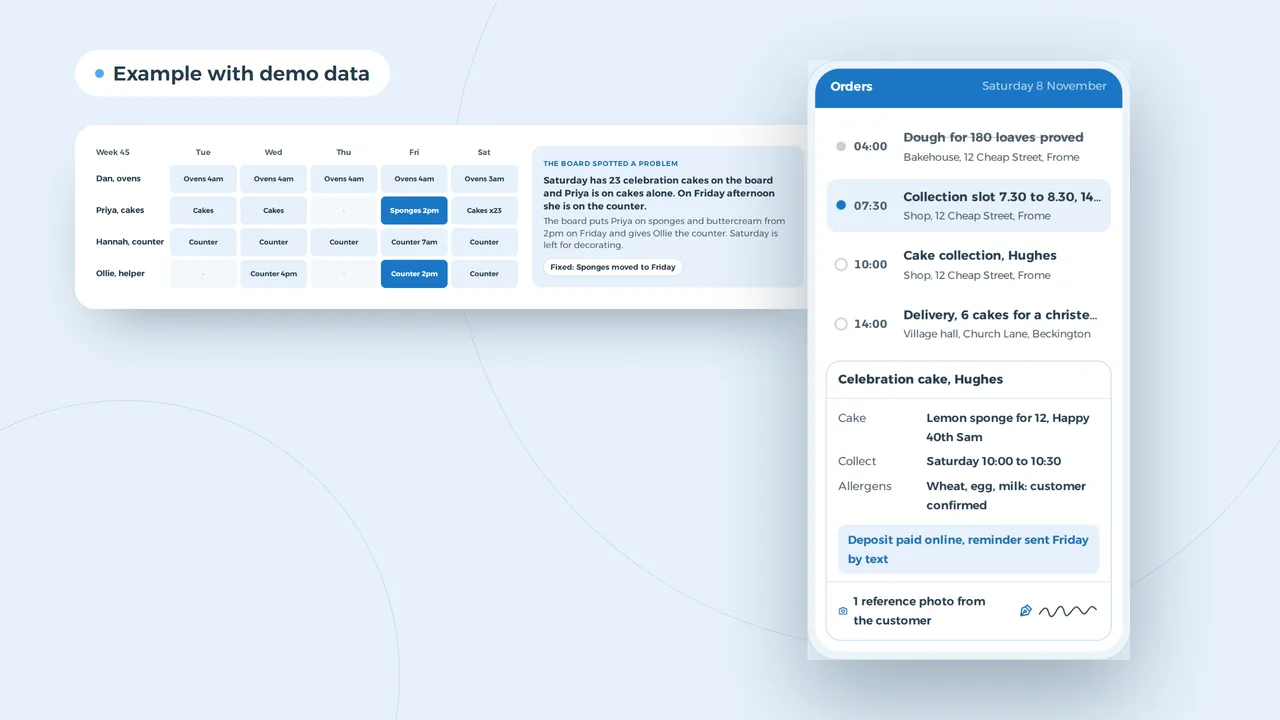
- BakersMost of the work is on allergens and on what is packed before it is ordered. Cake orders with a collection time and an inscription are where mistakes happen, because the details travel from phone to paper to the bench.
- ButchersRegistration covers a shop that sells to the public. Supplying other businesses or cutting for them is where approval comes in. Burgers and sausages packed on site to sell later are prepacked for direct sale.
- CaterersAllergen information has to reach the guest at a buffet, item by item, which is hard when a menu changes per booking.
- Farm shopsSelling your own produce straight to the public starts with registration. Supplying meat, dairy or eggs to other businesses can change that.
On the stock side, a scan at the cold room door that books a batch onto a production run makes traceability a search instead of a hunt. How that works is on our page on inventory management software.
How the website fits the registration
A registered food business still has to be found, and for most of them that starts with a search on a phone. Three things matter there: a Google Business Profile with the right category and opening hours, a website that loads quickly and shows the menu or range, and an order flow that captures allergens and collection times without anyone retyping an email.
We build a website from 1,500 euros. A webshop or an ordering system that feeds the kitchen gets a fixed price per project after a conversation, as does local SEO for a shop that wants to be found in its own town. If your orders now come in by phone, email and the counter, tell us how it works today and we'll show what a single flow would look like. Our page on restaurant websites shows the same thinking for places that seat guests.
Checklist before you open
- Registered with the local authority at least 28 days before trading, per site.
- HACCP-based food safety system in place and filled in.
- Allergen information recorded for every recipe, with supplier specification sheets kept.
- Food hygiene training done and allergen training planned for the team.
- If you sell online: allergen information on every product page and with every delivery.
- If you supply other businesses with meat, fish, dairy or eggs: approval checked.
- A place ready for your hygiene rating, at the door and online.
We haven't built a site for a UK bakery, butcher or caterer yet; we build them the same way as for our other clients, starting from the order and the allergens.
Quick answers on registering a food business
How long does it take to register a food business?
The online form is short. You register at least 28 days before you start trading. The first inspection can follow weeks or months later, as higher-risk businesses are inspected first.
Does it cost anything to register?
No. Registration is free and your local authority can't refuse it. The cost sits elsewhere: getting the premises ready and keeping your food safety system up to date.
Do I need to register if I only sell online?
Yes. Selling online through a website or social media counts. You register the place where the food is made or stored, and distance selling and allergen rules apply on top.
Do I need a food hygiene certificate?
It isn't compulsory, but the Food Standards Agency recommends a food hygiene qualification. You do need to be able to show you have been adequately trained in food hygiene.
Do I have to show my hygiene rating on my website?
Not by law. The Food Standards Agency recommends placing it where customers see it before they order, using its official images or code, and only your current rating.
What if I trade under more than one name?
One registration can include all your trading names, for example a shop name and a separate brand on a delivery platform. A second site needs its own registration.