Websites for joiners
Joinery website design that shows your work and fills the diary
1,500
A site with a page for sashes, doors, stairs and fitted furniture, photos of real jobs, and enquiries that arrive with what you need to price them.
Joinery website design starts with the work, not the template
Joinery website design is easy to get wrong. A template with a hero photo, three boxes and a contact form looks tidy, but it tells a homeowner in Bath nothing about whether you can match the mouldings on a Georgian sash, and it tells Google nothing about the work you want. A joiner website has to sell the craft and filter the enquiries.
This page is about the website. For the full picture of a joinery firm, with surveys, quotes, workshop and fitting, read our page on joinery. If the quote is the bottleneck, see joinery quoting software; for how we build sites in general, see website design.
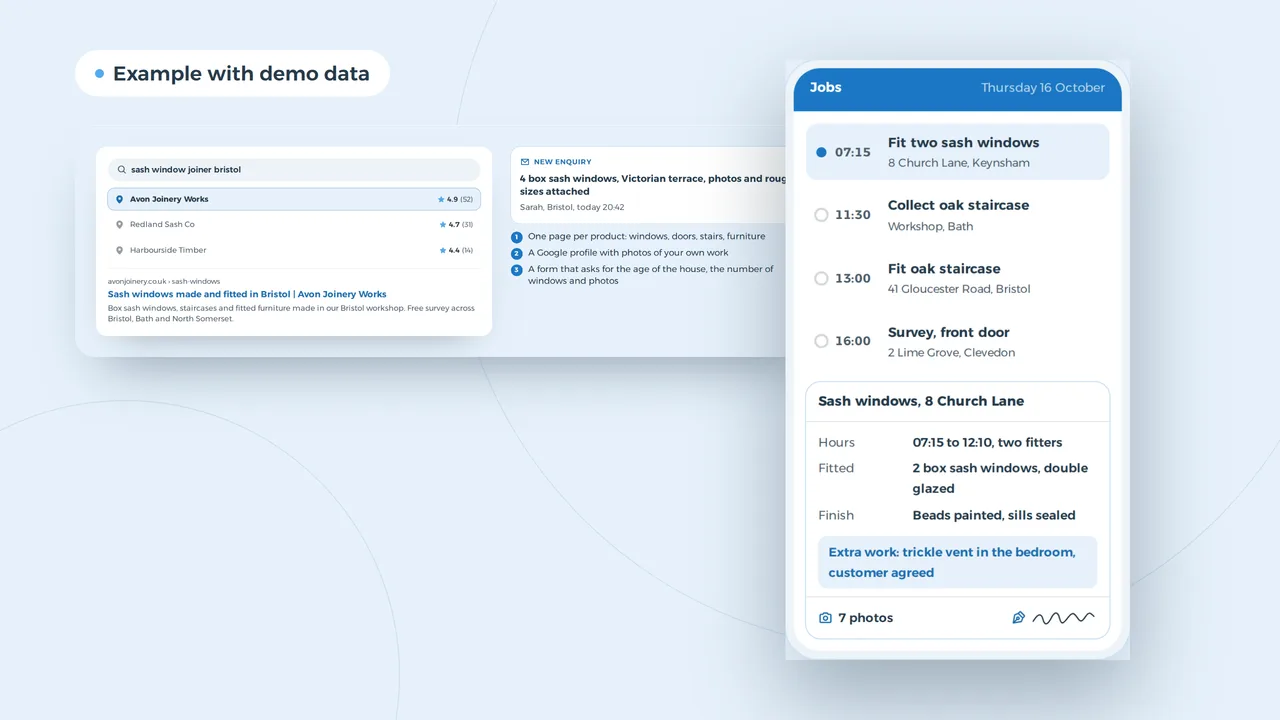
Found for sash windows in Bristol
New enquiry
4 box sash windows, Victorian terrace, photos and rough sizes attached
Sarah, Bristol, today 20:42
- One page per product: windows, doors, stairs, furniture
- A Google profile with photos of your own work
- A form that asks for the age of the house, the number of windows and photos
An example with made-up joinery firms and reviews.
Pages a joiner website needs
Each kind of work gets its own page, with its own photos and words. That is how people searching for one thing find you.
Sash windows
Repair, draught-proofing and replacement. Box sashes, weights and pulleys, slim double glazing where the building allows it.
Front doors
Hardwood and engineered doors, frames and fanlights, with the ironmongery you fit and the security standard it meets.
Staircases
New stairs, oak treads on an existing carcass, balustrades. Show the before and the after.
Fitted furniture
Wardrobes, alcove units, built-in storage. The page where a homeowner sees what bespoke means.
Work for builders
Second fix, door sets, windows on new builds. A page for main contractors, with capacity and areas.
Areas you cover
Bristol, Bath, Keynsham, Clevedon: a short page per area with jobs you did there.
Photos that do the selling
Joinery is bought with the eyes. A bespoke joinery website lives or dies on its photos, and stock images of oak worktops are worse than nothing. What works:
- Before and after from the same angleA rotten cill, then the new one. A tired staircase, then oak treads.
- DetailsA mortice and tenon, a hand-cut dovetail, a moulding matched to the original. The details that justify a bespoke price.
- The finished roomA wardrobe in its alcove with the light on, a door from the street. People picture it in their own home.
- A few lines per jobArea, timber, finish, what the customer wanted. Short, specific, true.
We set up the site so you add a job from your phone: photos, area, a few lines. It lands on the right page and in the area page, without a call to a web designer. Shoot on site in daylight, wipe the dust off first, and keep the camera level. That is most of it.
A bespoke joinery website can also show process: the board before it is machined, the frame dry-fitted on the bench, the finish going on. Customers who pay for bespoke like to see that it is made, not ordered in.
Photos and a few lines, then a first quote
An example: the AI works from your own prices per profile and per m2 of glass, you decide.
A form that asks what you would ask
A plain contact form brings in "how much for a door?" and a phone number. Then you call back, ask for photos and sizes, and half the time hear nothing. A form built for joinery asks those questions up front, in plain words.
| Question on the form | Why you want it | What it saves |
|---|---|---|
| What kind of work | Sashes, doors, stairs, furniture, or work for a builder | Routing to the right person |
| Photos of what is there now | You see rot, style and access before you drive out | A wasted survey |
| Rough sizes | Enough for a first range, not millimetres | A call to ask |
| Age of the house, listed or conservation area | Listed buildings may need consent before windows change | A job that stalls on consent |
| Postcode | Whether it is in your area | A polite no that takes two minutes |
| When they want it done | Your lead time against theirs | An expectation you cannot meet |
The answers land in one place with the photos attached. If you want a first quote prepared from them, that is software on top of the site: see joinery quoting software and AI quote generator.
A template site or a joinery site
A template site is quick to launch. A site built for joinery takes a little longer and works for years.
- Pages
- Template siteHome, about, services, contact
- Site built for joineryA page per kind of work and per area
- Photos
- Template siteStock images and a slider
- Site built for joineryYour jobs, added from your phone
- Enquiries
- Template siteName, email, message
- Site built for joineryPhotos, sizes, house age, postcode
- Search
- Template siteFound for the firm's name
- Site built for joineryFound for sash windows in Bath or stairs in Bristol
- Speed on a phone
- Template siteOften slow with heavy themes
- Site built for joineryBuilt light, loads fast on site
If you only need a card online, a template does it. If you want enquiries for the work you choose, the site has to be built around that work.
Mistakes we see on joiner websites
- One services page listing everything from sashes to kitchens, so nothing ranks.
- Stock photos of oak that a joiner spots in a second, and a homeowner does too.
- A contact form with no room for photos, so every enquiry needs a call back.
- No areas named anywhere, so the site competes with the whole country.
- Gallery images of several megabytes each that take ages to load on a phone on site.
- No mention of the competent person scheme on the window pages.
- The last job added two years ago, which makes a busy firm look quiet.
Words that rank for the work you want
Photos sell, but words are what search engines read. Each page needs enough plain text to say what you do, where and how, in the terms your customers use. Not keyword lists: sentences a homeowner would want to read.
| Page | What people type | What the page should say |
|---|---|---|
| Sash windows | sash window repair Bath, sash window replacement | Repair or replace, draught-proofing, slim double glazing, listed buildings, how long a set of sashes takes |
| Front doors | bespoke front doors Bristol, hardwood front door | Timber, glazing, ironmongery, security standard, lead time from survey to fit |
| Staircases | oak staircase, staircase renovation | New or re-cladding, treads and balustrades, what happens to the room during the work |
| Fitted furniture | fitted wardrobes, alcove units | Measured and made in your workshop, finish options, how the fit day runs |
Those search phrases are examples to show the shape, not measured volumes; we check real search data for your area before we write. Each page also links to the next step: the enquiry form, with the type of work already filled in. More on writing for search in SEO and marketing for construction companies.
Local search for joiners in your own towns
Most people look for a joiner within a short drive. They type the job and the town, and look at the map before the results. Three things decide where you show up.
- Your Google Business Profile. Category, areas served, photos of each finished job, and replies to reviews. See create a Google Business Profile.
- Reviews that keep coming. A short message after each job with a direct link to leave a review. See get more Google reviews.
- Pages that match the search. A page for sash windows in Bath ranks for sash windows in Bath; a home page with a list of services rarely does.
More in local SEO and our local SEO tips. If you work mostly for main contractors, they search differently: see website for contractors.
A job page for bench joiners and fitters
An example with made-up names; you choose what the form asks a joiner, from bench or site work to a driving licence.
Hiring through your own site
A joinery site is also where good joiners look you up before they say yes. A job page with photos of the workshop and the kind of work you do tells them more than an advert on a board. Keep applying short: name, phone number, bench or site, and a photo of something they made.
Apprentices get a section of their own. Many workshops grow by training their own, and a page that shows what an apprentice learns in the first year brings in better applications than a single line. Planning people once they start is covered in staff scheduling software.
The job page also works for the firm's name. A joiner who hears about you from a mate will look you up first, and a page that shows a tidy workshop, the machines you run and the kind of jobs on the bench answers most of what he wonders about. Say what a normal week looks like, whether the work is mostly bench or site, and how far the jobs travel.
Speed, hosting and keeping it current
A joiner's customers often look on a phone, sometimes in a room with poor signal. A site that loads in a second keeps them; one that spins loses them to the next result. We build sites light: compressed photos in modern formats, no heavy theme, no plugins you do not need.
The site should also be easy to keep current. Adding a finished job from your phone is the one habit that keeps it working: new photos for the gallery, a new line on an area page, a fresh sign of life for Google. We set that up so it takes minutes, not an evening.
Prefer to spread the cost? Read pay monthly website and what a cheap site often leaves out in cheap website design. A sole trader joiner can start small: see web design for freelancers and small business website.
The price of a joinery website
FromEUR 1,500
A website from VBS starts from EUR 1,500. You get a fixed price per project after a first conversation, so you know where you stand before we start. What moves the price:
- PagesA page per kind of work and per area makes you findable on more searches, and needs more photos and words.
- The enquiry formA form with photo upload and questions per type of work takes more building than a plain contact form.
- Software on topA first quote prepared from the enquiry, or a link to your job sheets, is custom work with its own price.
The site as the front door of the firm
A site is the front door. Behind it sits the rest of the firm: survey, quote, workshop, fitting and invoice. For a sole trader joiner, a strong site and a Google profile may be all that is needed for years. A team of five gains most when the enquiry flows straight into the quote. A firm of 20 to 50 adds a job page for hiring and a portal for main contractors. A larger firm connects the site to what already runs.
Weighing up offers? Read compare website quotes, custom website or WordPress and website cost UK. Want to talk it through? Get in contact. For SN Group, a building firm in Ghent that does external joinery, we built a site with a cost calculation wizard: see our work for SN Group.
Website design
How VBS helps you with this
We build your site from design to copy, imagery and code, in one team, so that Google and your buyers find it and get in touch.
- Design and copy built on your buyers' questions
- Fast, multilingual when you need it, at a fixed price
- Forms, cookieless analytics and hosting on AWS
How we approach it is on our page about Website design.
Show the work, get the enquiries you want
Send us your current site, or tell us you have none. We show you which pages we would build first, with a fixed price.
Rather get in touch right away?