Software for joiners
Joinery quoting software that prices from the survey, not from memory
Sizes taken once on site, prices from your own lists, options side by side, and a quote that becomes a cutting list and an order when the customer says yes.
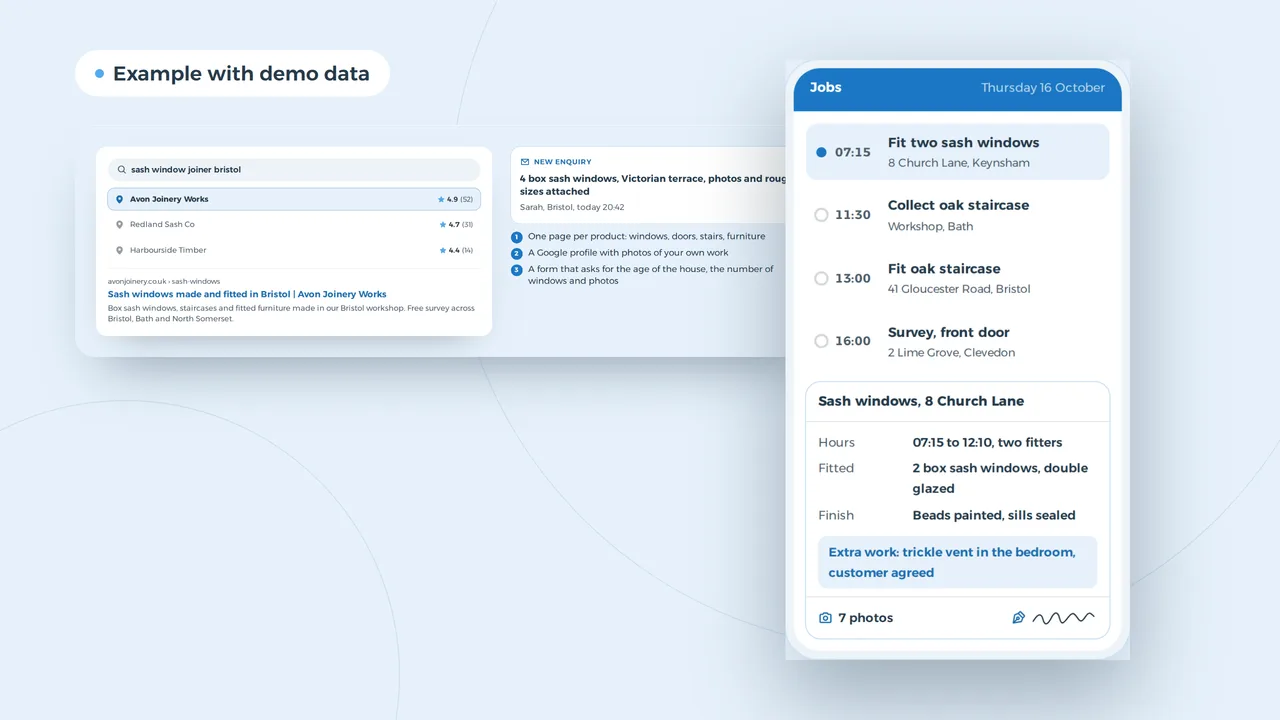
Joinery quoting software for bespoke work
Joinery quoting software is mostly sold to window factories: pick a system, pick a profile, get a price. A bespoke workshop quotes differently. One quote is three box sashes with new cills, the next an oak staircase, the next a run of alcove units. The sums repeat, but the job never quite does, and the evenings disappear into spreadsheets.
This page is about the quote: from survey to a price the customer accepts, and from there to the bench. For the wider picture of a joinery firm, with website, workshop, fitting and hiring, see our page on joinery. How we build software in general is on custom software.
Photos and a few lines, then a first quote per window
An example: the AI works from your own prices per profile and per m2 of glass, you decide.
What goes into a joinery quote
Every joiner has a way of pricing, usually in a spreadsheet that only one person fully understands. The parts are much the same from firm to firm. Joinery estimating software takes those parts and makes them repeatable.
| Part | How it is priced | Where it goes wrong |
|---|---|---|
| Timber | Per metre or cubic metre by species and section, plus waste | An old price, or waste forgotten on a curved head |
| Glass | Per m2 by type: double, slim double, toughened, laminated | Safety glazing missed in a critical area |
| Ironmongery | Per opening: hinges, locks, sash weights, pulleys, handles | A lock set left off a door quote |
| Machining and bench time | Hours per item type, from your own history | A gut feel that has not been checked in years |
| Finish | Primer, coats, spray or brush, per m2 or per item | Finish quoted for one side only |
| Fitting | Hours on site, access, making good, removal of old frames | Scaffold or parking left out |
| Certificates | Registering replacement windows through a competent person scheme | The FENSA or CERTASS fee not on the quote |
The software keeps those prices in lists you control, and keeps your own bench hours per item type. When the timber merchant changes his prices, you change one list, not forty quotes.
Enquiry to accepted quote in five steps
- The enquiry arrives with photosThrough your site: type of work, rough sizes, photos, age of the house and postcode. It opens as a job, so nothing is typed twice.
- AI sets out a first versionItems per window or door, an option such as Accoya next to softwood, and the questions the photos cannot answer. You decide whether a survey is worth the drive.
- Survey on the phoneExact sizes per opening, reveal, cill, a photo and a note. The quote updates as you measure.
- You check and sendChange what only you can judge: a rotten cill, access, a listed building. The quote goes out as a link with your branding.
- The customer accepts onlineOptions picked, terms accepted, deposit requested if you work with one. The job moves to the workshop board.
The survey and the fit on the same job
- Survey sizes travel with the jobWhat was measured on site is on the cutting list and on the job sheet. Nobody copies it from the back of an envelope.
- The workshop sees what must be readyA staircase or wardrobe that goes in tomorrow shows red on the workshop board today if it is not finished.
- Certificates stay with the addressThe FENSA or Building Control record, the invoice and the photos sit in the file of that house when the owner sells.
An example with made-up windows and addresses; you choose what a joinery fitting sheet asks for.
Sizes taken once, used everywhere
The most expensive mistake in joinery is a size typed wrong. A frame 15 mm too wide does not go in, and a remade sash eats the margin of the job. So in this software a size passes through one hand only: at the survey.
- Per openingEach window or door gets a line with width, height, reveal, cill, opening type and a photo. Notes such as an out-of-square opening or a lintel that sags go with it.
- Into the quoteThe items follow from the sizes and your lists. Change a size and the price changes with it.
- Into the cutting listWhen the quote is accepted, the same sizes become the cutting list for the bench and the order for glass and ironmongery.
- Onto the fitThe fitter opens the job and sees the sizes, photos and notes from the survey.
The job sheet on site works like our work order app; the workshop and fitting days are planned as in construction scheduling software.
A spreadsheet or quoting software
Most joiners start in a spreadsheet, and many good ones still use it. Here is where it starts to cost.
- Prices
- SpreadsheetCopied into each quote, often out of date
- Quoting softwareOne list per supplier, used by every quote
- Sizes
- SpreadsheetTyped from the survey sheet at night
- Quoting softwareTaken once on the phone at survey
- Options
- SpreadsheetA second file per option
- Quoting softwareSide by side in one quote, the customer picks
- After acceptance
- SpreadsheetRetype into orders and cutting lists
- Quoting softwareThe quote becomes the order and the cutting list
- Who can use it
- SpreadsheetThe person who built it
- Quoting softwareAnyone in the firm with access
A spreadsheet is fine for a sole trader quoting a few jobs a month. Once two people quote, or the quotes run to several a week, the retyping costs more than the software.
Options side by side, the customer chooses
Customers rarely know what they want until they see two prices. Carpentry quoting software that shows options side by side makes that choice easy, and saves you a second round of emails.
| Option | What changes in the quote | Why customers ask |
|---|---|---|
| Accoya instead of softwood | Timber price per metre, sometimes the finish | A stable timber, often chosen for exposed elevations |
| Slim double glazing in a sash | Glass type and weight, sometimes the sash section and weights | Warmer rooms without losing the look |
| Repair instead of replace | Bench hours and new parts, no new frame | Listed buildings and tight budgets |
| Factory finish instead of on-site paint | Finish cost moves from site to workshop | Fewer days with an open window |
Timber on the rack once the quote is accepted
Butt hinges 100 mm running low
16 on the shelf, 30 needed for the doors this week. Proposal: 2 boxes of 20 from the ironmonger.
An example with made-up quantities. You choose per item when the system warns you.
After yes: orders, cutting lists and stock
A quote that stops at the price only does half the job. When the customer accepts, the same lines drive the rest of the work.
- Orders to suppliersGlass, ironmongery and timber go out as orders in the form each supplier wants: a portal, a file or an email. Where a supplier offers a connection, we build it; see API integration services.
- Stock firstBefore ordering, the software checks what is on the rack and the shelf, including offcuts big enough for the job. More in inventory management software.
- Bench time against the quoteHours booked on the job show whether the quote was right. That history makes the next quote better.
- Invoice from the quoteDeposit, stage payments and the final invoice follow from the accepted lines, with extras signed on site added.
Quotes for builders and main contractors
Quoting for a homeowner and quoting for a main contractor are different jobs. A builder sends a schedule of door sets or windows for a new build, wants a price per item and per floor, and pays later with a CIS deduction taken off. The quote has to match his schedule line by line, or it is put to one side.
- Import the scheduleA list of door sets or windows comes in as a file or a PDF. AI reads it into lines; you check the sizes and specifications before pricing.
- Price per line and per stageFirst fix, second fix, ironmongery fitted or loose. The builder sees the same structure as his own schedule.
- CIS on the paymentAs a sub-contractor you suffer a 20% deduction when registered, 30% when not, nothing with gross payment status. The software keeps what was deducted per payment, so the year adds up.
- Progress in one placeA client portal lets a main contractor see what is made, delivered and fitted without a phone call.
Winning that work also starts online: builders check your site for capacity, areas and examples. See website for contractors. Hours on site and in the workshop are logged with a time tracking app, and the wider use of AI in the trade is on AI for construction. When the quoting tool grows into a full system with logins for staff and clients, that is web application development.
Joiners of every size, a different starting point
Not every joiner needs the full chain. Size decides where we start.
- Sole traderA clear quote template, your price lists and an enquiry form that brings photos and sizes. Often that is enough; a spreadsheet you trust can stay.
- A team of fiveSurvey on the phone and a quote that follows from the sizes. This is where the evenings come back.
- A firm of 20 to 50Several estimators, options side by side, quotes that become orders and cutting lists, and bench hours that feed the next price.
- A larger firmAn accounts package or ERP already runs, maybe a production package too. We build the quoting around it and connect, rather than replace what works.
Still pricing in Excel and wondering when to move? Read replace Excel with software. Working for main contractors with CIS deductions on every payment? See software for construction companies.
AI in the quote, with a joiner in charge
AI is good at the dull part: reading a customer's email and photos, setting out the items, filling in the prices from your lists, and drafting the cover note. It is not good at judging a rotten cill from a blurry photo, or knowing that a conservation officer will want a particular glazing bar. So the model prepares and you decide; nothing is sent without your check.
More on how this works in AI quote generator and AI automation. The enquiry that feeds it all comes from your site: see joinery website design. A website from VBS starts from EUR 1,500; quoting software gets a fixed price per project after a conversation. Want to talk it through? Get in contact.
Custom software
How VBS helps you with this
We build the platform your business runs on every day: your spreadsheets, emails and paperwork in one system that does what you do.
- Your workflow mapped first, then a fixed price
- Screens for the office, the client and the road
- Hosting, backups and security managed by us on AWS
How we approach it is on our page about Custom software.
Quotes out the same day, without the spreadsheet evenings?
Send us one of your recent quotes with the names taken out. We show you how it would run from survey to accepted price.
Rather get in touch right away?