Industry: joinery
Joinery software for UK workshops, built around the bench and the van
Sizes taken once on site, a quote that follows from them, a workshop that knows what is next, and a fitter who has every detail on his phone.
Joinery software UK firms can shape to their own workshop
Most joinery software UK firms are offered starts from a catalogue: a window system, a set of profiles, a cutting list. A small joinery firm in Bristol or Bath rarely works like that. One week it is a pair of box sash windows in Clifton, the next an oak staircase in Keynsham, then a run of fitted wardrobes and a front door in Clevedon. The measurements change, the timber changes, and the quote has to follow.
This page shows what we build for joiners and joinery firms: a website that brings in the right enquiries, a job sheet on the phone, stock that follows the job, a job advert that works and AI that prepares a first quote. If you mainly need the website, read joinery website design; if the quote is what keeps you up at night, see joinery quoting software. How we build software in general is on custom software.
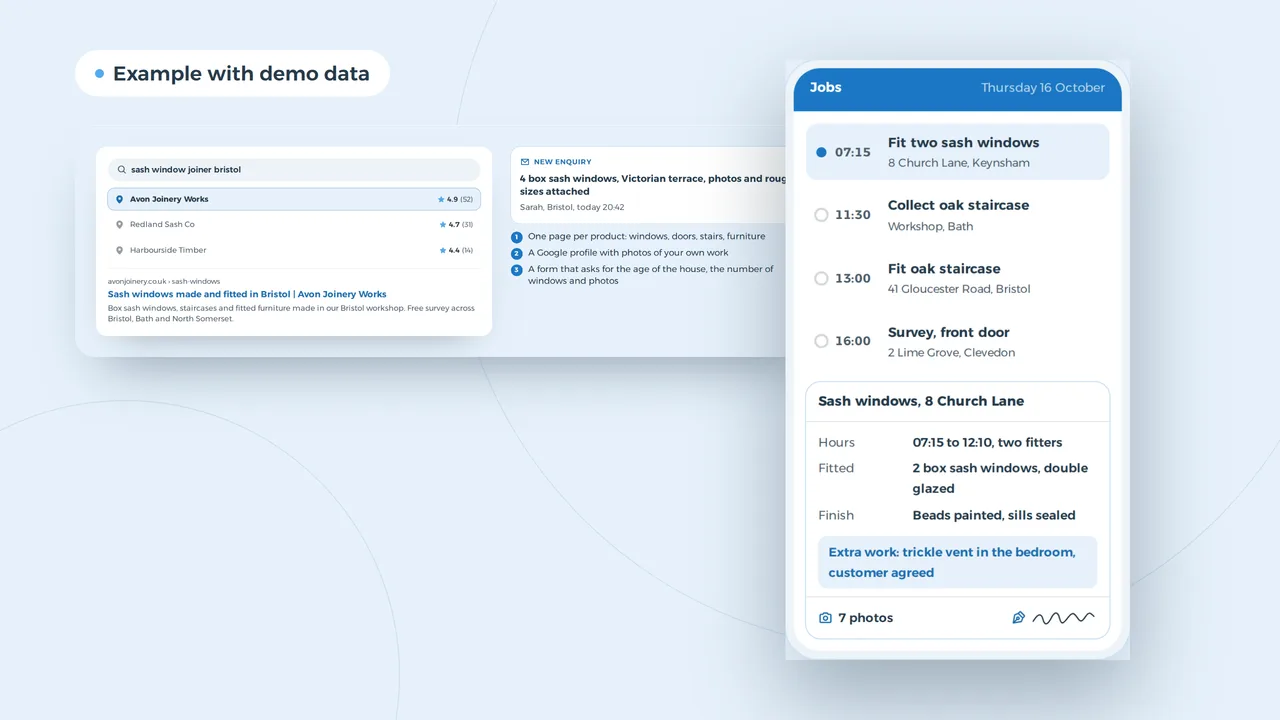
A joiner's day on one screen
- Survey sizes travel with the jobWhat was measured on site is on the cutting list and on the job sheet. Nobody copies it from the back of an envelope.
- The workshop sees what must be readyA staircase or wardrobe that goes in tomorrow shows red on the workshop board today if it is not finished.
- Certificates stay with the addressThe FENSA or Building Control record, the invoice and the photos sit in the file of that house when the owner sells.
An example with made-up windows and addresses; you choose what a joinery fitting sheet asks for.
Where a joiner's week leaks time
A joiner's week has two halves that rarely talk to each other: the bench and the site. The time goes where they meet.
| When | What happens | What it costs |
|---|---|---|
| Monday morning | The fitter rings from site: the reveal is 15 mm narrower than the drawing | A frame that will not fit, or a day of rework |
| Tuesday at the bench | Two phone calls about a quote, one about ironmongery that has not arrived | A glue-up left too long, a machine standing still |
| Wednesday | A survey in Bath, written on the back of a delivery note | Sizes typed in again at night, with a chance of a slip |
| Thursday evening | Three quotes: timber, glass, ironmongery, finish, fitting | An hour or more each, after a full day |
| Friday | Extra work agreed on site by word of mouth | A dispute when the invoice lands |
None of this is unusual. It happens because the same size lives in three places: the survey sheet, the cutting list and the quote. Software earns its place when a size is taken once and then flows to the bench, the order and the invoice.
An enquiry for sash windows in Bristol
New enquiry
4 box sash windows, Victorian terrace, photos and rough sizes attached
Sarah, Bristol, today 20:42
- One page per product: windows, doors, stairs, furniture
- A Google profile with photos of your own work
- A form that asks for the age of the house, the number of windows and photos
An example with made-up joinery firms and reviews.
Getting found for the work you want
People looking for a joiner search close to home. They add their town or area, look at the map and read the reviews. A joinery firm that wins there has a few things in place.
- A page per kind of workSash window repair and replacement, timber casements, front doors, staircases, fitted wardrobes, kitchens. Each with photos of real jobs and a few lines on how you do it: draught-proofing a sash, matching mouldings, the timber you use.
- The places you work, by nameClifton, Redland, Bath, Keynsham, Clevedon: name them, with a job you did there. See local SEO and our local SEO tips.
- A Google Business Profile that is kept upPhotos of each finished job and a review after each one. See create a Google Business Profile and get more Google reviews.
The enquiry form does the rest. It asks for photos of the existing windows or doors, rough sizes, the age of the house and whether it is listed or in a conservation area. That last question can mean consent is needed before a sash is changed, and asking it early saves a wasted visit. For the website on its own, see website design and joinery website design.
Timber, ironmongery and the van
Butt hinges 100 mm running low
16 on the shelf, 30 needed for the doors this week. Proposal: 2 boxes of 20 from the ironmonger.
An example with made-up quantities. You choose per item when the system warns you.
Stock that follows the job
A joinery workshop holds more stock than it thinks: boards of Accoya and oak, sheet material, glass on order, ironmongery on a shelf and half a van of fixings. When nobody knows what is where, a job waits for hinges that were already in the van.
- Timber per jobWhen a quote is accepted, the timber for it is reserved. Offcuts go back on the rack with a size, so the next small job can use them.
- Ironmongery and glass on orderSash weights, pulleys, locks, hinges and sealed units have lead times. The order date sits on the job, and the fit moves when the delivery moves.
- The van as a placeA scan when you load the van books fixings and sealant to the job. An alert proposes an order before a common item runs out.
More on stock in inventory management software. The job sheet itself, with hours, materials and the customer's signature, is on the work order app, and fitting days planned around the workshop on construction scheduling software.
Photos become a first quote, checked by the joiner
An example: the AI works from your own prices per profile and per m2 of glass, you decide.
AI that prepares, a joiner who decides
Quoting joinery is repetitive arithmetic wrapped around judgement. The arithmetic is timber per metre, glass per square metre, ironmongery per opening, finishing and fitting hours. The judgement is yours: a rotten cill, a listed building, a customer who wants Accoya instead of softwood.
- The customer sends photos and a few lines through the site, or you survey with the phone.
- AI reads it and sets out the items per window or door, with an option such as Accoya next to softwood.
- You check. You change what the photos could not show and send it.
- The customer accepts online. Extra work on site becomes its own line with a signature.
Nothing goes out unchecked. AI can also read supplier emails and put a delivery date on the job, or sort enquiries by area and type of work. More on AI quote generator, AI for construction and AI automation.
Hiring a bench joiner from your own site
An example with made-up names; you choose what the form asks a joiner, from bench or site work to a driving licence.
Hiring when good joiners are scarce
A good bench joiner is not scrolling job boards with a CV ready. He is at a bench with a phone in his pocket. A job page on your own site asks three things: name and phone number, bench, site or both, and a photo of something he made. That photo says more than a CV: tight joints, clean mouldings, a door that hangs true.
You see who applied, book a chat or invite them for a trial day. Apprentices get their own place on the page, because that is where most joiners start.
For planning people across jobs, see staff scheduling software and the time tracking app.
A window package or software around your workshop
Big joinery packages are built for window factories. They are good at profiles and cutting lists. A bespoke workshop often needs something else.
- Starting point
- Window factory packageProfiles, systems and production
- Software around your firmThe enquiry, the survey and the job
- Bespoke work
- Window factory packageHard outside the catalogue
- Software around your firmStairs, sashes and fitted furniture in one flow
- Site work
- Window factory packageOften outside the package
- Software around your firmJob sheet on the phone, extra work signed
- Changes
- Window factory packageThrough the vendor's roadmap
- Software around your firmBuilt around how you work
Run a factory with CNC lines and your own window system, and a package is often the right choice; we connect to it. Run a bespoke workshop, and the gain starts with the enquiry and the survey.
Sole trader, team or firm: where to start
A sole trader joiner does not need an ERP. A firm of forty with a showroom needs more than a website. This is where we start, by size.
| Size | What hurts most | Where we start |
|---|---|---|
| Sole trader | Calls while working, quotes at night | A website with a strong enquiry form and a Google Business Profile; a simple job sheet on the phone when it helps |
| A team of five | Bench and site out of step, sizes typed twice | Survey on the phone, quote from the sizes, one board for workshop and fitting |
| A firm of 20 to 50 | Several fitting teams, sub-contractors, suppliers | Job file from enquiry to sign-off, CIS records per sub-contractor, stock per job and van |
| A larger firm | Systems running side by side | Links to the accounts package or ERP already in place, and a client portal for main contractors |
Still on spreadsheets? Read replace Excel with software first.
Rules a joinery firm works under in 2026
Software that knows the rules puts the right figures on the invoice and keeps the proof you need. These are the ones that come up most for joiners in England.
| Rule | What it asks | What the software does |
|---|---|---|
| Construction Industry Scheme | Contractors deduct 20% from registered sub-contractors, 30% from unregistered, nothing with gross payment status. Monthly return by the 19th, £100 penalty from one day late. Since 6 April 2026 nil returns are back | Keeps deductions per sub-contractor and flags the return date |
| Making Tax Digital | Sole traders over £50,000 qualifying income since 6 April 2026, over £30,000 from April 2027, over £20,000 from April 2028. Quarterly updates by 7 August, 7 November, 7 February and 7 May | Keeps income and costs by quarter, ready to send |
| VAT on renovation | Work on an occupied home is standard-rated at 20%. Replacement windows and doors are not energy-saving materials; only draught stripping qualifies for the relief | Sets the rate per line, not per job |
| Building Regulations for windows | Replacement glazing has been covered since 1 April 2002: sign-off through a competent person scheme such as FENSA or CERTASS, or Building Control. Escape windows keep a clear opening of at least 450 mm and 0.33 m2. Safety glazing in critical areas | Asks the right questions at survey, stores the certificate on the job |
| Building Safety Act, Part 2A | Since 1 October 2023 anyone carrying out building work in England plans, manages and monitors it so it complies, and stays within their competence | Keeps the plan, photos and sign-off per job |
| Waste carrier | Defra guidance puts construction waste, even your own offcuts, in the upper tier: £191.02, renewed every 3 years | Reminds you before renewal |
Four joiners, five quotes a week
| Task | Now per week | With software per week |
|---|---|---|
| Typing up quotes | 6 hours 15 | 2 hours 5 |
| Calling back for photos and sizes | 1 hour | close to nothing |
| Looking for ironmongery and offcuts | 1 hour | a glance at the phone |
Starting with VBS
- A conversationIn the workshop or online. You walk us through an enquiry, from the first call to the last invoice, and show us where it sticks.
- A fixed price per projectYou get a proposal with a fixed price. A website starts from EUR 1,500; software and AI get their own price after the conversation.
- Built in parts you use straight awayFirst the site and the enquiry form, then the job sheet or the quote. Each part works on its own.
- Adjusted to what you notice on siteA field missing on the job sheet, a question the form should ask: we change it.
Other trades on the same job
A joinery job rarely stands alone. Kitchens, bathrooms and full refurbishments bring in other trades. See renovation, kitchen fitters and tilers. Working mostly for main contractors? Read website for contractors and software for construction companies. For marketing beyond the site, there is marketing for construction companies.
Want to talk about your own workshop? Get in contact. For SN Group, a building firm in Ghent that does external joinery, bathrooms and floors, we built a site with a cost calculation wizard: see our work for SN Group.
Joiners ask us
Is there joinery software for a small bespoke workshop?
Most packages are built for window factories. For a bespoke workshop we build around your own flow: enquiry, survey, quote, bench, fitting and invoice. You start with the part that hurts most and add the rest when it earns its place.
Do replacement windows need a FENSA certificate?
Replacement glazing in England has fallen under Building Regulations since 1 April 2002. The installer either belongs to a competent person scheme such as FENSA or CERTASS and registers the work, or Building Control signs it off. The homeowner needs that proof when they sell.
Can I charge 5% or 0% VAT on new windows?
Usually not. Work on an occupied home is standard-rated at 20%, and replacement windows and doors are not energy-saving materials. Only draught stripping qualifies for the relief. The 5% rate can apply to homes empty for two years or to conversions, under conditions.
Does the software handle CIS deductions?
We can build it to keep deductions per sub-contractor, show the rate that applies and remind you of the monthly return by the 19th. Since 6 April 2026 you file a nil return in months with no payments unless you told HMRC in advance.
What does a joinery website cost?
A website from VBS starts from EUR 1,500. After a conversation you get a fixed price for the project, depending on the pages, the photos and whether an enquiry form with photo upload comes with it.
Survey, quote and bench on one line?
Tell us how an enquiry runs in your workshop, from the first call to the invoice. We show you where we would start, with a fixed price.
Rather get in touch right away?