The grant rules as of October 2026
The chargepoint grants were reset on 1 April 2026: higher amounts per socket, three schemes closed and a new claim process. Five schemes run until 31 March 2027. What follows is the state on 31 October 2026; check gov.uk before you rely on a date.
What OZEV authorisation gets you
If you want to know how to become an OZEV approved installer, start with what it is for. The Office for Zero Emission Vehicles runs the grants that pay part of a customer's chargepoint. The customer cannot claim those grants themselves: an authorised installer claims on their behalf and takes the grant off the bill. Without authorisation you can still fit chargers, but you compete with a price that is up to £500 per socket higher than the firm down the road.
These are the schemes an authorised installer can claim for until 31 March 2027.
| Scheme | Who it is for | Up to |
|---|---|---|
| Flat owners and renters | Owner-occupiers of a flat and people renting any home, with private off-street parking | £500, one socket |
| On-street parking | Households without a driveway, using a cross-pavement solution | £500 |
| Residential landlords | Landlords of rented homes | £500 per socket, up to 200 sockets |
| Workplace Charging Scheme | Businesses, charities, the public sector and small accommodation businesses with their own off-street parking | 75 percent of costs including VAT, capped at £500 per socket, up to 40 sockets |
| Workplace Charging Scheme, education | State-funded schools and colleges | Up to £2,000 per socket |
The staff and fleets scheme, the commercial landlord scheme and the residential landlord infrastructure scheme closed on 31 March 2026. Pages and quotes that still mention them are out of date, and so are the old £350 amounts.
For a firm that does mostly domestic work, the first three schemes are where the volume is. For a firm that already wires offices and units, the Workplace Charging Scheme is often the bigger job per visit. Our page for EV charger installers shows how both kinds of work run through one system.
How to become an OZEV approved installer in five steps
- Join a competent person scheme or the ECAFor homes: NAPIT, NICEIC, SELECT or OFTEC. For commercial work: NAPIT, NICEIC or SELECT. Membership of the ECA also counts, in the category that matches the work you will claim for.
- Choose residential, commercial or bothThe schemes you can claim for follow the category of your membership. A firm that does both kinds of work needs to be registered for both.
- Gather the details the form asks forCompany name, a head office in the UK, the bank details the grant should be paid into, the name and number of your scheme or your ECA number, and an email address and phone number OZEV can reach.
- Apply onlineThe application runs through an online form on gov.uk. An incomplete application is sent back, and OZEV may check your credit, look for fraud and ask about customer feedback. The outcome comes by email.
- Fit only after the date you are authorisedOnly installations carried out after the date of your authorisation qualify for a grant. A charger fitted the week before cannot be claimed later.
Which membership counts for which work
The category matters more than the logo. ECA membership counts only in the category that matches the work, and the same principle applies to the schemes: a domestic-only registration does not open the workplace grant.
| Route | For residential grants | For the Workplace Charging Scheme |
|---|---|---|
| Competent person scheme | NAPIT, NICEIC, SELECT or OFTEC | NAPIT, NICEIC or SELECT |
| ECA membership | Electrical installations within dwellings (Part P) | Commercial and industrial electrical installations |
| Representative | Work through an authorised installer as a subcontractor | The same, with public liability cover of at least £2 million |
Most electrical firms are already in one of these schemes for Part P work, so the step is shorter than it looks. If you are not, the scheme sets its own entry checks and fees, and that is where the real time goes. The gov.uk guidance itself does not ask for a separate EV course or a manufacturer's training for authorisation; what it asks for is the membership, the application and the duties below. A course can still be worth it for the work itself.
Working as a representative instead
There is a second way in. A firm that is not authorised itself can work as a representative: it fits chargers as a subcontractor for an OZEV-authorised installer, who then makes the claim. For this route OZEV asks for public liability insurance of at least £2 million; employer's liability on its own does not count.
The representative route suits a sole trader who fits a few chargers a month and does not want the claim admin. The trade-off is that the authorised firm owns the customer relationship on paper and carries the duties, so agree in writing who takes the photos, who notifies the DNO, who issues the certificate and who keeps the records. If that agreement is loose, a claim fails on a missing photo and nobody feels responsible.
Once the volume grows, most firms apply in their own name. At that point the admin moves in-house, which is where a job sheet that collects the claim details on site starts to pay; see the work order app.
The duties that keep you on the list
- Make at least one grant claim every two years, or OZEV removes you from the list
- Keep the documents for every claim for at least three years
- Notify the distribution network operator of every installation
- Issue an Electrical Installation Certificate to BS 7671 for every install
- Fit only models that are on the eligible list, and test that they work safely
- Take the grant off the bill: the customer pays the cost minus the grant
- Report changes to your company details to the DVLA, as the guidance asks
- Accept the regular emails OZEV sends to installers and act on them
A claim on the new process, worked through
Since 1 April 2026 claims run through a new platform. You get a link to a digital claim form, there is no portal to follow the status, and the first assessment can take up to ten working days. The customer should only go ahead with the install once they have been told they are eligible.
| Day | What happens | Who |
|---|---|---|
| 1 | Survey, quote with the grant shown as a separate line, eligibility questions | Installer |
| 1 to 10 | Eligibility checked, customer told they qualify | OZEV and customer |
| 12 | Install, test, four photos, serial number, EIC issued | Installer |
| 12 | DNO notified, invoice sent for the cost minus the grant | Installer |
| 13 | Claim submitted through the digital form with make, model, serial number, invoice and photos | Installer |
The four photos are the part that goes wrong most often: a close-up of the charger, the make and serial number, the charger with its parking space, and a wide view of the building or the area around it. Take them before you pack up. A quote template or an AI quote generator can put the grant line on the quote from the first visit.
Workplace claims follow a different rhythm. The business applies for a voucher, which comes within five working days and stays valid for 180 days. Install and claim have to land inside that window, so a voucher that arrives in a busy month needs a date in the diary at once.
The chargers themselves have rules too
A grant only pays for a model on the eligible list, and since the Smart Charge Points Regulations 2021 a chargepoint for a home or workplace must be smart: it comes with default charging hours outside peak times, a randomised delay before charging starts and security built in. The customer can change the hours, but the defaults are where the law starts. Explain them at handover and note what you left set, with the serial number, so a later question has an answer.
The install itself falls under BS 7671:2018+A4:2026, the current edition of the wiring regulations, and in a home under Part P of the Building Regulations. The certificate you issue is the same Electrical Installation Certificate you would issue for any new circuit.
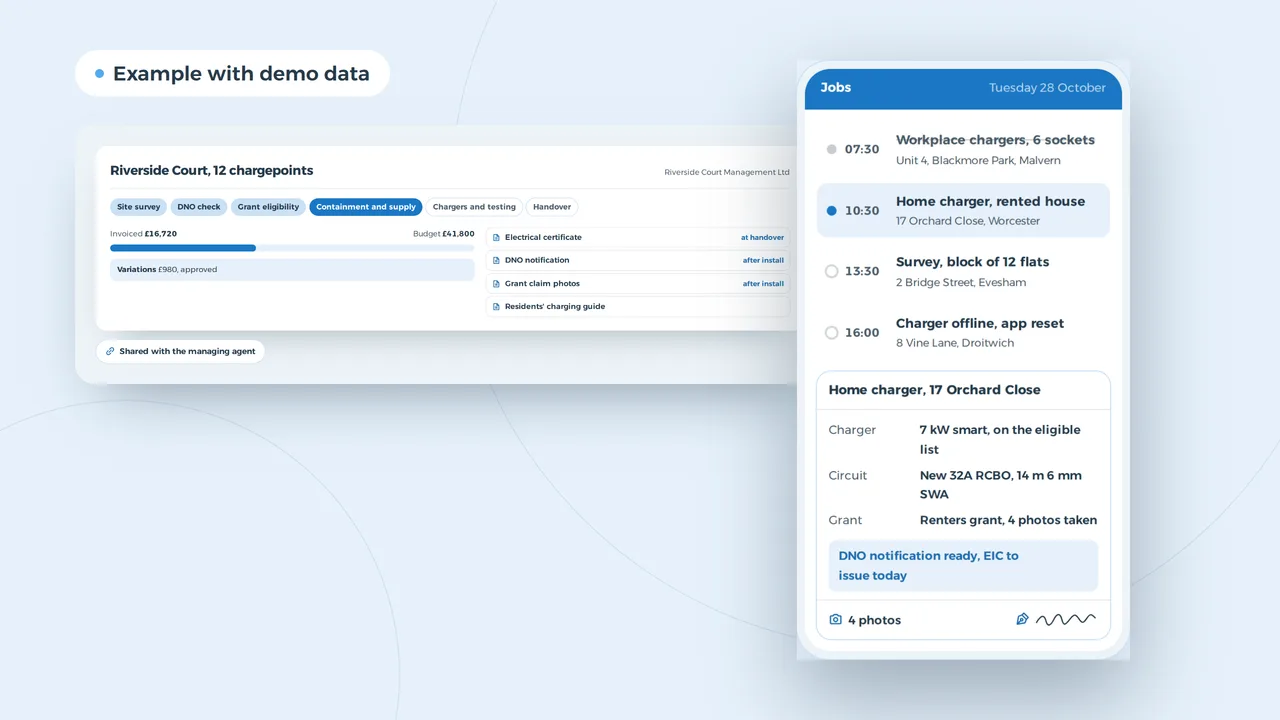
In practice that means three records per charger on top of the grant claim: the certificate with the test results, the DNO notification and a note of the smart settings at handover. All three draw on the same facts, the charger, its serial number, its rating and the circuit, so they belong in one job file rather than in three places. That is the core of what we build in software for installers, and the evening write-up of those records is one of the tasks we look at in AI for electricians. Three years of records sounds like a lot until an auditor asks for one claim from two years ago and you can open it in a minute.
What installers ask about OZEV
Is there a fee to become OZEV approved?
The gov.uk guidance names no fee for the OZEV application itself. The cost sits in the membership of your competent person scheme or the ECA, which each set their own fees.
How long does approval take?
The guidance gives no fixed time. A complete application is the fastest one; an incomplete one is sent back. The outcome comes by email.
Do I need an EV charger installer course?
Not for OZEV authorisation itself, going by the guidance. Your scheme can set its own entry checks, and a course helps with the work itself.
Can I claim for a charger I fitted before I was approved?
No. Only installations after the date of your authorisation qualify.
What happens if I stop claiming?
If you make no claim for two years, OZEV removes you from the list. You can apply again, but claims stop in between.
Once you are listed, get found for it
Authorisation is only worth something if people who want a grant find you. Put it on your site, with a page per grant and the towns you cover; SEO for electricians shows how those pages are built, and website design for electricians covers the site around them. Add it to your Google profile as well (create a Google Business Profile) and ask every grant customer for a review (get more Google reviews).
Chargers sit well next to the rest of an electrician's work. For the wider picture of quotes, job sheets and certificates, see software for electrical contractors and how to get more electrical work. If you also fit solar panels, the same customers often ask for both; see solar installers. When you are ready to put the claim admin into one system, tell us how a job runs at your firm or read what custom software involves.