Industries: solar installers
Solar panels website design, and the systems behind it
A site that turns a search into a roof survey, then job sheets, a planning board and the MCS and DNO paperwork in one place. Built around how your teams already work.
Most solar work starts with a search
Solar panels website design matters to an installer for a plain reason: almost every job starts with someone typing solar panels and the name of their town. A homeowner in Wymondham who wants to cut the bill, a couple in Dereham who already have panels and want a battery, a farm near Aylsham with a barn roof facing south. They look at the map, open two or three sites and send one enquiry.
What happens next decides whether that enquiry becomes a job. In many firms it lands in a shared inbox without a roof photo or an address, waits for a call back, and turns into a quote written at the kitchen table on Thursday night. The install takes a day; the paperwork after it, the MCS certificate, the DNO notice, the handover pack, takes weeks.
This page follows that chain from the outside in. First the site that brings the enquiry, then the day on the roof, then the people you need and the AI that prepares the quote. Each part comes with an example of what we would build, with made-up names.
A search in Norwich that becomes a roof survey
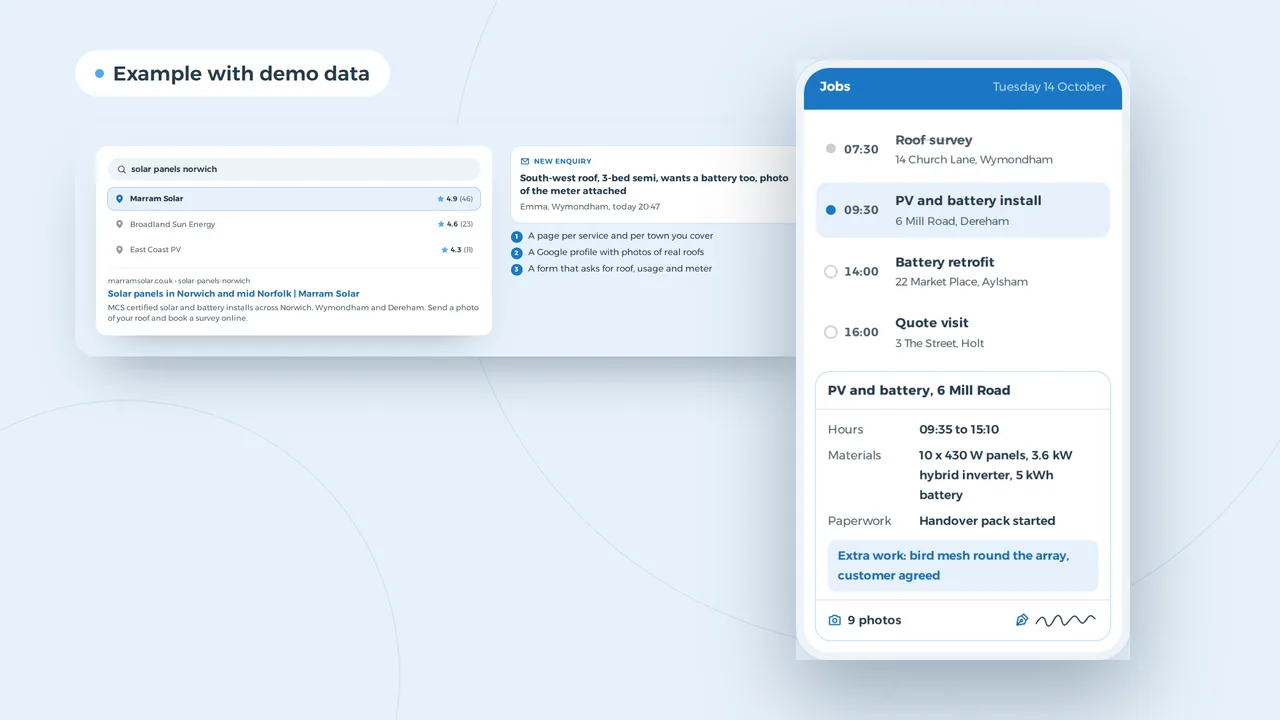
New enquiry
South-west roof, 3-bed semi, wants a battery too, photo of the meter attached
Emma, Wymondham, today 20:47
- A page per service and per town you cover
- A Google profile with photos of real roofs
- A form that asks for roof, usage and meter
Example with made-up businesses and reviews.
Solar panels website design that books surveys
A solar panels website has one job: turn a search into a survey you can price. Three things do most of the work.
A page per service and per town you cover. Solar panels, batteries, a battery added to an existing system, EV chargers if you fit them, each with its own page, and a page for each town your vans reach. Someone in Holt searching for a battery retrofit should land on a page about exactly that, with photos of roofs near Holt.
A form that asks the right questions. Roof direction, a photo of the roof and the meter, yearly usage from the last bill, whether they want a battery. With that, the first reply can already carry a rough size and a date for the survey. Show your MCS certification and your trade association membership where buyers look for them, near the form and on every service page.
A Google profile that matches the site. The same services, the same towns, photos of real installs and a steady flow of reviews. How to set it up is in create a Google Business Profile and get more Google reviews.
We build websites from 1,500 euro, with the pages per town and the enquiry form included in the plan. What drives the price is in what a website costs, and you can work out a rough figure with the website cost calculator. Showing up in the map pack for each town is the work of local SEO.
A brochure site against a site that books surveys
Both look fine on a laptop. Only one fills the diary.
- Pages
- Brochure siteHome, about, services, contact
- Site built for enquiriesA page per service and per town, each answering one search
- Enquiry
- Brochure siteName, email, message
- Site built for enquiriesRoof photo, direction, usage, meter, battery or not
- Trust
- Brochure siteA logo strip at the bottom
- Site built for enquiriesMCS certification, real roofs and reviews next to the form
- Follow-up
- Brochure siteAn email in a shared inbox
- Site built for enquiriesA job in your system with a survey slot to pick
- Phone
- Brochure siteA shrunk desktop page
- Site built for enquiriesBuilt for the phone first, where people search from the sofa
A brochure site tells people you exist. A site built for enquiries gives your office a job it can price the same day.
Solar installer marketing past the website
Solar marketing in the UK runs in seasons. Searches climb when energy prices make the news and when the days get longer, and drop in the dark months. Solar installer marketing works best when it follows that rhythm instead of fighting it.
- Search ads for the busy weeksGoogle Ads on the towns and services you want, switched up when your diary has gaps and down when it is full.
- Social for the winterShort videos of real installs and a battery explained in thirty seconds keep you in mind until spring, through Facebook and Instagram ads.
- Answers in AI searchHomeowners also ask ChatGPT whether a battery pays for itself. Pages that answer that clearly get quoted; see found in ChatGPT.
- SEO that lastsPages per town and per question keep bringing enquiries after the ads stop. How that works for solar firms in particular is on SEO for solar companies.
The job sheet goes up the ladder
- The handover pack builds itselfPanel and inverter serials, test results and photos land in the job file, ready for the MCS certificate.
- The DNO notice is not forgottenCommissioning starts the clock, and the office sees which G98 notices are still open.
- The customer signs on the phoneExtra work is agreed on the roof, so it does not turn into a dispute on the invoice.
An example of what we can build, with made-up addresses. You choose which fields a job sheet has.
Paperwork that follows every install
Once the panels are on the roof, the rules take over. These are the ones that come back on almost every job, and what a system can do with them.
| Rule | What it asks | What the system does |
|---|---|---|
| MCS certification | The Smart Export Guarantee needs an MCS (or equivalent) certified installation and installer | The MCS certificate is a step in the job, not a task for later |
| Smart Export Guarantee | An MCS certified install plus an export meter | The customer link lists what their supplier will ask for |
| G98 | Fully type tested systems up to 16A per phase: notify the DNO within 28 days of commissioning | Commissioning starts a 28-day clock the office can see |
| G99 | Above 16A per phase: approval from the DNO before you connect | The board will not book a connection date without it |
| VAT on energy-saving materials | 0% on qualifying installs in homes from 1 May 2023 to 31 March 2027, 5% from 1 April 2027 | Quotes for work near the end of March 2027 get flagged for a rate check |
| Part P | Notifiable electrical work goes through a competent person scheme or building control | The notification sits in the job file |
| BS 7671 | The current edition is BS 7671:2018+A4:2026 | Test results in the job file follow the current amendment |
The job sheet behind this is the same one we build for other trades; what it records and why is on work order app. The wider picture for installers, with call-outs, servicing and certificates, is on software for installers.
A solar job that stays open until the DNO is told
Customer link: schedule, documents and SEG paperwork
An example of what we can build, with made-up names and amounts. You choose the stages and the documents.
One file per roof
An install is a project with fixed stages: survey, quote, design, install, commissioning, DNO notice and handover. Each stage leaves documents behind: the roof layout and string plan, data sheets for panels, inverter and battery, the electrical installation certificate, the MCS certificate and the invoice. In your own system those hang off the job, and the job knows what is still missing.
The customer gets a link with the schedule and their documents, so they stop ringing to ask when the scaffolders come. A battery added two years later becomes a new job at the same address, with the first install's details already there: which roof, which inverter, which strings.
A file per property with documents and deadlines is at heart a custom CRM; add stock and purchasing, panels by the pallet and inverters by serial number, and it leans towards an ERP. The difference is in CRM vs ERP. A planning board that knows about scaffolding and deliveries is close to construction scheduling software, and a place where customers download their own certificates is a client portal.
Finding a roofer who wants to do solar
An example of what we can build, with made-up names. You choose which questions the form asks.
Hiring from the van, on a phone
Roofers and electricians who want to move into solar do not sit down with a CV. They look on their phone in the evening. A vacancy page on your own site that says what the work really is, the team, the area, the training you pay for, and lets them apply in three taps, gets more replies than a form with ten fields. The office sees who applied and who gets a chat or a trial day.
Once they start, their hours per job go straight into the system with a time tracking app, and who is on which roof sits on the staff scheduling board.
A roof photo and a bill as a first proposal
An example of what we can build. The AI proposes from your own price list and kit, you decide.
Quotes on the day of the enquiry
A solar quote is the same sum every time: how many panels fit, what array size suits the usage, which inverter, whether a battery fits, which mounting kit for this roof, and whether the job needs a G99 application. AI can draft that first proposal from the photo, the usage and what the homeowner wrote, using your own price list and kit. The installer checks the layout, sets the price and sends it. AI decides nothing; it prepares.
The same works for the inbox: a question about a fault, an invoice or the export tariff lands in the right list with a reply ready to read. More on AI quote generator, and a starting point for the layout of the quote itself is the quote template.
How much system each size of firm needs
Nobody with one van needs an ERP. This is roughly what fits each size.
| Firm | What it needs first | What can wait |
|---|---|---|
| Sole trader with a mate | A site with an enquiry form, a Google profile, job sheets with photos and signatures | Planning software: a shared calendar does the job |
| Two install teams and an electrician | A planning board with deliveries and scaffolding, a file per job with MCS and DNO steps, quotes from the enquiry | Stock control per serial number |
| Twenty to fifty staff | Stock by pallet and serial, a client portal, links to your accounts package, reports per team | A full rebuild of what already works |
| Larger firm with sales and service | Its own platform for sales, purchasing, planning, service and maintenance contracts | Nothing; it is the platform |
Whether to build or buy at each stage is weighed in build vs buy software.
Two install teams in hours and pounds
| Task per week | Today | With your own system |
|---|---|---|
| Answering enquiries and booking surveys, 20 a week | 4 hours | 1.5 hours |
| Writing quotes, 10 a week | 10 hours | 3.5 hours |
| Planning teams, deliveries and scaffolding | 4 hours | 1.5 hours |
| Handover packs, MCS certificates and DNO notices, 5 a week | 5 hours | 1.5 hours |
| Job sheets and invoices | 3 hours | 1 hour |
| Total | 26 hours | 9 hours |
That is 17 hours a week, 782 hours over 46 weeks. At 28 pounds an hour: 782 x 28 = 21,896 pounds a year. Quotes that go out a day sooner are not in that sum; what they win depends on your market and your price, and we do not count it for you. If you are still planning in spreadsheets, Excel scheduling or planning software weighs when it is time to move.
Where we start with a solar firm
- FirstA conversation about an ordinary weekWhere do enquiries come from, who writes the quotes, who books scaffolding and the electrician, who tells the DNO? We look at your week, not at a list of features.
- ThenA fixed price per projectWe pick the part that costs you the most, often the website and the enquiry form, and give a fixed price for it. Websites start from 1,500 euro; software is priced after the conversation.
- After thatOne team uses it on real roofsAn install team and the office work with the first version on real jobs. What does not fit, we change before the rest follow. You own the code and the data.
We have no solar installer as a client yet; the Business Centrum website we rebuilt was seen 46 times more often in Google within five weeks, from 220 to 10,200 impressions a day.
Questions solar installers ask before they start
Should a solar website show prices?
A price range for a typical system helps people decide to ask for a survey. A firm price only comes after the survey, and the page should say so. A calculator that asks for roof and usage can give a range from your own price list.
Can the system send the G98 notice to the DNO for us?
The notice stays your responsibility, and each DNO has its own route. The system gathers the details from the job, starts the 28-day clock at commissioning and keeps reminding the office until the notice is marked as sent.
Does it work for batteries and EV chargers too?
Yes. A battery or a charger is a job with its own steps and documents at the same address. If chargers are a big part of your work, read software for EV charger installers.
Can we bring our jobs over from spreadsheets?
Yes. We import customers, addresses and open jobs, with a list of what is duplicated or missing. How such a move goes is in replace Excel with software.
What does solar panels website design cost?
Websites start from 1,500 euro. The final price depends on the number of service and town pages and what the form has to do. After a conversation you get a fixed price per project.
Custom software
How VBS helps you with this
We build the platform your business runs on every day: your spreadsheets, emails and paperwork in one system that does what you do.
- Your workflow mapped first, then a fixed price
- Screens for the office, the client and the road
- Hosting, backups and security managed by us on AWS
How we approach it is on our page about Custom software.
More surveys booked, less paperwork after?
Tell us where your enquiries come from and how a job ends today. We will show where we would start.
Rather get in touch right away?