On this page
An Odoo implementation is all the work between an empty Odoo database and a team that runs the business in it every day: mapping your processes, configuring the apps, importing customers, products and open balances, testing with real orders and training your people. The licence is the small part. What Odoo charges per user is in Odoo pricing; whether a single app really stays free is answered in is Odoo free.
Implementation is not included in the licence. You buy it separately, in one of two ways: as a Success Pack, a block of hours with a consultant employed by Odoo, or from one of the partners Odoo lists per country. Belgium alone has 141. Odoo's own rule of thumb: companies under 50 employees usually work directly with Odoo on a Success Pack, larger ones usually with a partner, and from 250 employees you talk to Odoo itself.
This guide follows a project from the first workshop to go-live: which route fits your company, what each step asks of you and of the consultant, where Odoo Online stops, how to shortlist a partner and where projects stall in practice. Not sure yet that an ERP like Odoo is the answer? Read Odoo or custom software and Odoo alternatives first.
Success Pack or partner, side by side
What you buy when you have Odoo set up, according to Odoo's own pages.
- Who does the work
- Odoo Success PackA consultant from Odoo, assigned to your project
- Odoo partnerThe partner's own team: project lead, consultants and developers
- How you pay
- Odoo Success PackA fixed block of hours up front, from 4 to 200
- Odoo partnerUsually per day of consulting or development, against an estimate
- Typical client, per Odoo
- Odoo Success PackCompanies under 50 employees
- Odoo partnerCompanies over 50 employees
- Configuration, training, email and phone support
- Odoo Success PackIn every pack
- Odoo partnerIn the partner's quote
- Help with the data import
- Odoo Success PackFrom the 25-hour Basic pack
- Odoo partnerYes, often with their own import scripts
- Onsite consulting
- Odoo Success PackFrom the Standard pack, travel time and costs extra
- Odoo partnerUsually, many partners work in their own region
- Building custom modules
- Odoo Success PackNot included, billed per day
- Odoo partnerYes, the core of what a partner sells
- Maintaining customisations
- Odoo Success PackA monthly fee per customisation
- Odoo partnerWith the partner, who has to carry every module through each upgrade
A pack is predictable and you know up front how many hours you buy, but Odoo builds nothing for you. A partner can build, yet every module they write has to be checked again with each new Odoo version.
What the hours in a Success Pack buy
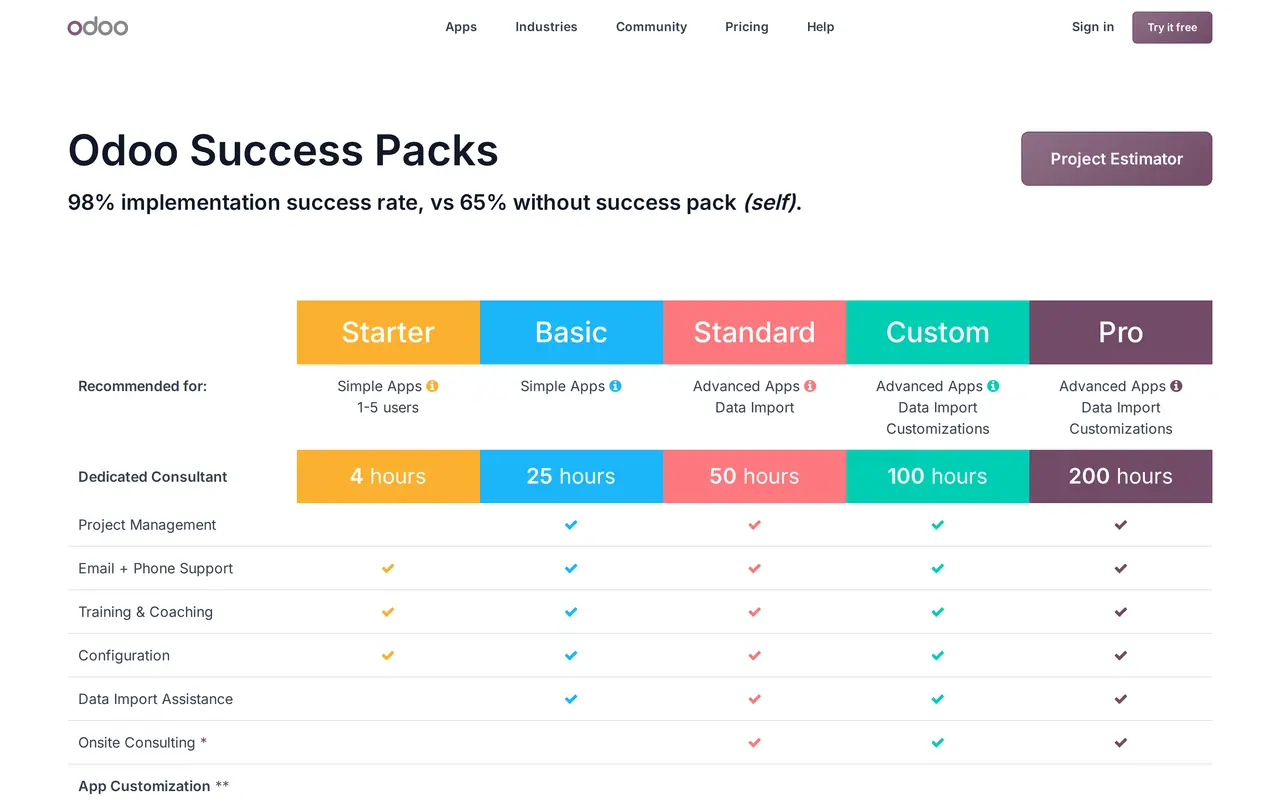
A Success Pack is a number of hours with a dedicated Odoo consultant: 4 in Starter, 25 in Basic, 50 in Standard, 100 in Custom and 200 in Pro. Odoo recommends Starter for simple apps and 1 to 5 users, Standard once you use advanced apps and import data, and Custom or Pro when you also customise. Prices per pack are in Odoo pricing.
Project management comes with Basic and up, onsite consulting with Standard and up. No pack includes development: Odoo or a partner bills that per day. If an existing database is already slow, Odoo asks for a pack of at least 50 hours to deal with performance.
Odoo states a 98 percent implementation success rate with a Success Pack, against 65 percent without. That is Odoo's own figure, not an outside audit. What is certain: 4 hours is enough to learn one app properly, not to move a company onto a new system.
Which route fits which company
Our own grid, built on what Odoo recommends per pack and on the 50-employee line Odoo draws itself. Headcount is only half of it: how much you want to change weighs just as much.
| Your situation | Route | Scope |
|---|---|---|
| 1 to 5 people, one or two apps such as Invoicing and CRM | Yourself, with Starter | 4 hours to get the basics right |
| 5 to 20 people, sales, purchasing and stock, data from spreadsheets or an old package | Odoo with Basic or Standard | 25 to 50 hours |
| 20 to 50 people, several departments, some customisation | Odoo with Custom, or a partner | 100 hours, or an estimate in days |
| Over 50 people, custom modules, integrations, several legal entities | A partner | An estimate in days, with a staging database |
| Over 250 people | Odoo directly, often alongside a partner | Scoped by Odoo |
Two things push you down that table whatever your size: custom modules and connections to other software. The moment you need something the standard apps do not do, you need the Custom plan and someone who can develop. Still weighing Odoo against another ERP? See Odoo vs Business Central, or Odoo or Teamleader if you mainly send quotes and invoices.
Where Odoo Online stops
Odoo Online is a private database hosted and managed by Odoo, and the only place the Standard plan runs. The limit that surfaces too late in many projects: Odoo Online does not run custom modules or modules from the Odoo Apps Store. If you expect modules to be written, start on Odoo.sh or your own server, which means the Custom plan.
| Odoo Online | Odoo.sh | Your own server | |
|---|---|---|---|
| Plan | Standard or Custom | Custom | Custom |
| Hosting | By Odoo, in the licence | By Odoo, billed separately | By you or your partner |
| Custom modules and Apps Store modules | No | Yes | Yes |
| Other software calling Odoo's API | With Custom | Yes | Yes |
| Who runs the server | Odoo | Odoo, you own the code | You or your partner |
Each major Odoo version is supported for three years, with extra time after that to finish your upgrade. Every custom module has to come along on each upgrade. That work returns, and the more you customise, the bigger the bill. It is the technical debt of an ERP: invisible on the first quote, back with every new version.
Odoo implementation in eight steps
- Write down your processes, not your wishesDescribe how an order runs today, from quote to payment, and who does what. A software requirements template helps even if nothing gets built. What is not on paper, the consultant finds out after it is configured.
- Pick the apps and the planSwitch on only what you will really use in the first three months. Every extra app means more setup, more testing and more training. If you customise, or other software has to call Odoo, you need Custom.
- Name a key userSomeone on your team who decides when the consultant puts a choice on the table, and who is given the time for it. A project squeezed between other work slips.
- Clean your data before the importDuplicate customers, products without a unit, VAT numbers that do not check out: whatever you import, stays. Clean it in the source file, not afterwards in Odoo. If it all lives in spreadsheets, read replace Excel with software first.
- Configure, then test with real ordersTake ten orders from last month and run them through, exceptions included: a credit note, a partial delivery, a customer on a special price.
- Decide what stays connectedA webshop, a planning tool, an accountant on another package. Agree per piece of data which system is the source. How that works technically is in Odoo integration.
- Train per roleA sales rep works in other screens than someone in the warehouse. Every Success Pack includes training; plan it just before go-live, not a month ahead.
- Go live on a fixed datePick the start of a month or quarter, so open balances and stock move over on one cut-off date. Keep the old system for a while, read-only.
How much implementation weighs in a first Odoo year
5 peopleStandardStarter, 4 hours
1,194 + 499€ 1,69329% of year one goes to implementation
Licences, year 2: € 1,49415 peopleStandardStandard, 50 hours
3,582 + 4,675€ 8,25757% of year one goes to implementation
Licences, year 2: € 4,48240 peopleCustomPro, 200 hours
17,232 + 16,830€ 34,06249% of year one goes to implementation
Licences, year 2: € 21,552
Our own worked example in euros, with Odoo's prices: everyone a user, yearly billing, one Success Pack with the new-customer discount. Ask whether VAT is included. Partner work, Odoo.sh hosting and upkeep of custom modules come on top.
How to shortlist an Odoo partner
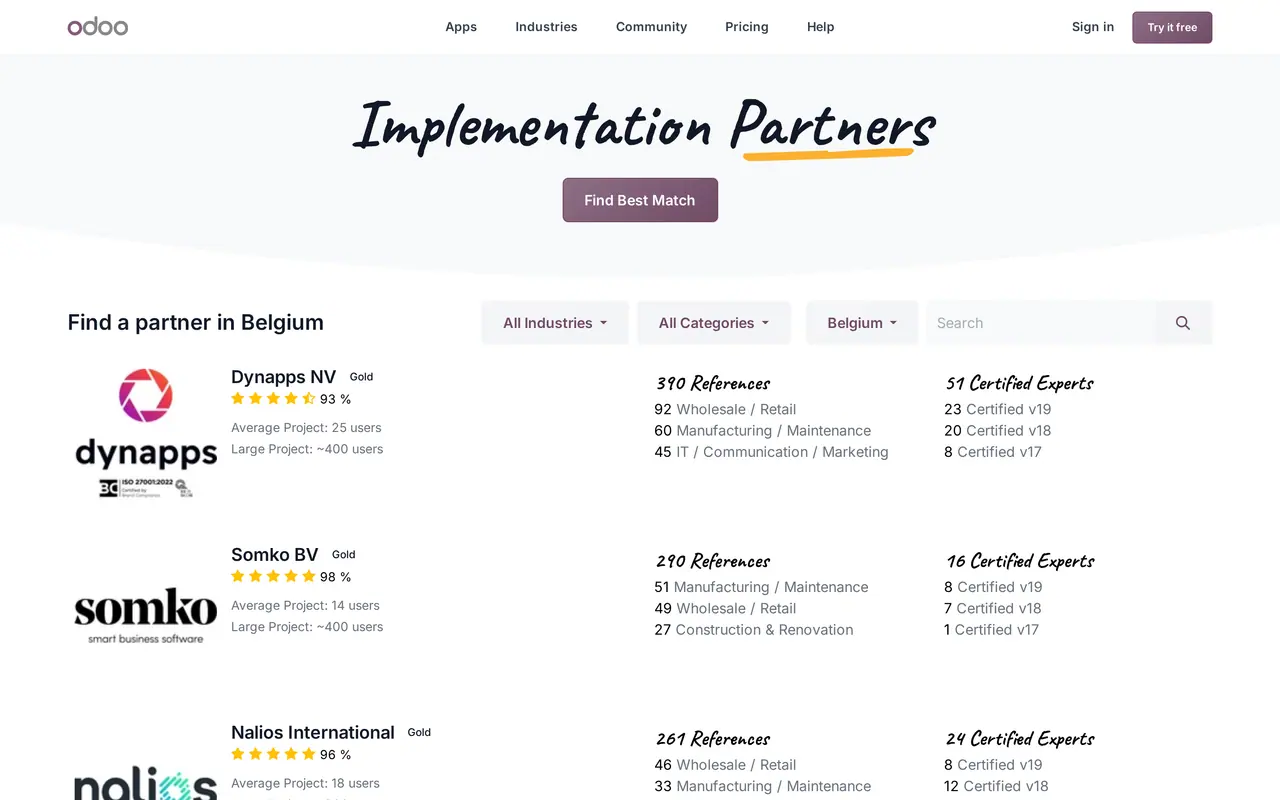
Odoo's partner directory filters by country and industry. For Belgium it lists 141 partners: 18 Gold, 32 Silver and 91 Ready. For each one it shows the number of references, certified experts per version, the size of an average and a large project and the industries with the most references. Those numbers say more than the tier. Dynapps, top of the Belgian list, shows an average project of 25 users; bring 6 and you are a small file there.
Five questions for every partner on your list:
- How many references in your industry?A wholesaler and a construction firm use Odoo very differently. Ask for two clients you can call.
- Who actually works on your project?Ask for the consultant and the developer, not just the salesperson, and for their certification on the version you will get.
- What is standard and what is custom?Have every custom module listed separately on the quote, with its hours and its monthly maintenance.
- Where does the code of your modules live?In a repository you can access. Otherwise a new partner starts from zero later.
- Where does your database run?On Odoo Online, Odoo.sh or the partner's own server. If the partner hosts your data, ask for a data processing agreement.
General advice on picking a builder, Odoo or not, is in how to choose a software development company.
How long an implementation takes
On its Success Pack page, Odoo writes that 80 percent of the projects it describes there reach production in 200 hours or less. Hours are not weeks: a consultant rarely works full time on a small company's project, and your own team does the work nobody else can do in the meantime.
What belongs next to Odoo
Odoo is strong at what every company does: quotes, invoices, stock, purchasing and accounting. It strains where your work has its own rules: route planning with drivers and vehicles, a client portal with case files, a calculation only your company makes. You can build that as a custom Odoo module, but then it has to come along on every upgrade. As a separate platform that talks to Odoo through the API, it stays independent of the Odoo version.
An example from our own work: the planning of DA Logistics runs on its own platform, used daily by 31 users, with about 30 drivers and 34 vehicles. As an ERP module, that planning would need rework with every new version. How a custom part sits next to a package is covered in custom ERP development and API integration services; what an API integration does is in the glossary.
Odoo 19 introduced a new external API, JSON-2, which works with API keys. Other software calling Odoo needs the Custom plan. What Odoo itself sends out, such as payment providers and bank synchronisation, does not count.
Where Odoo projects stall
- Switching on every app at once instead of getting sales and invoicing running first.
- Importing a spreadsheet with five years of exceptions without cleaning it.
- Rebuilding every current habit as a custom module.
- Nobody on your side who decides when the consultant asks for a choice.
- Testing with invented orders instead of real ones from last month.
- Planning custom modules on Odoo Online, where they do not run.
- Leaving integrations until after go-live, while the webshop still talks to the old system.
- Budgeting the first-year discount and forgetting year two.
Quick answers on setting up Odoo
Can you implement Odoo yourself, without a partner?
Yes, with one or two apps and little data. For 1 to 5 users on simple apps, Odoo recommends the 4-hour Starter pack. Doing it all yourself is possible too, but by Odoo's own numbers projects without a pack succeed less often.
How many hours does an Odoo implementation take?
Odoo's packs run from 4 to 200 hours, and Odoo says 80 percent of the projects on that page go live in 200 hours or less. Custom modules and integrations come on top and are billed per day.
What is an Odoo partner?
A company that resells and implements Odoo, with a tier of Ready, Silver or Gold. Odoo's site lists them per country, with references and certified experts.
Can I switch partners later?
Yes, your database and data are yours. Make sure the code of any custom module sits in a repository you can access, or a new partner starts from scratch.
How long is an Odoo version supported?
Three years per major version, with extra time to finish the upgrade. Starting now, begin on the latest version your partner supports.