SEO for solar
SEO for solar installers, one town and one question at a time
Homeowners search for solar panels in their own town, then for whether a battery pays. A site that answers both, with proof from real roofs, gets the call.
Two searches before every enquiry
SEO for solar comes down to being there for two kinds of search. The first is local: solar panels Norwich, battery storage Dereham, solar installer near me. The second is a question: is a battery worth it, how does the Smart Export Guarantee work, can I add panels to my roof later. A homeowner usually does both, often weeks apart, before sending a single enquiry.
Most solar sites answer neither well. They have one services page for the whole county and a blog post from three years ago. National comparison sites and lead brokers take the questions, and the map pack goes to whoever has the most reviews nearby. The installer who does the actual work pays a broker for a lead that three rivals also got.
Solar SEO done properly gives you your own place in both searches. It is not a trick; it is a site built around what people type, with proof from roofs you have actually done.
Bought leads against your own search traffic
Lead brokers fill a quiet week fast. The question is what you own when you stop paying.
- Who else gets it
- Leads from a brokerOften sold to several installers at once
- Enquiries from your own pagesOnly you, the homeowner chose your site
- What the homeowner knows
- Leads from a brokerLittle about you, they filled in a generic form
- Enquiries from your own pagesYour installs, your reviews and your area
- Cost over time
- Leads from a brokerA price per lead that rises in the busy months
- Enquiries from your own pagesWork up front, then pages that keep bringing enquiries
- When you stop paying
- Leads from a brokerThe leads stop the same day
- Enquiries from your own pagesThe pages stay and keep ranking while you maintain them
- What it teaches you
- Leads from a brokerNothing about which towns or questions work
- Enquiries from your own pagesSearch Console shows which searches bring which enquiries
Brokers can bridge a gap. A site that answers the searches in your own towns is the part you keep.
A page map built on what homeowners type
Every page on a solar site should answer one search. This is the map we start from, before we look at your own data in Search Console.
| What people type | Page that answers it | What the page must show |
|---|---|---|
| Solar panels plus a town | A page per town you really cover | Installs in and near that town, your survey slots, a form |
| Battery storage plus a town | A battery page per area | Batteries on new and existing systems, what you fit |
| Add a battery to existing solar | A retrofit page | Which inverters you work with, what the survey checks |
| Solar panels cost | A price guide | A range for typical systems, what moves the price, the VAT rate in force |
| Is solar worth it | An honest guide | Usage, roof direction, export payments, when it does not pay |
| Smart Export Guarantee | A plain explanation | MCS certified install and an export meter are needed |
| MCS certified installer near me | Your about page | Your certification number and who on the team holds what |
| Solar panel repair or cleaning | A service page | Whether you do other firms' systems, call-out area |
The split between a local page and a question page is the difference in search intent: one person wants a firm, the other wants an answer first. Each page is a landing page for one of those, not a copy of the next with the town name swapped.
What winning a local search looks like
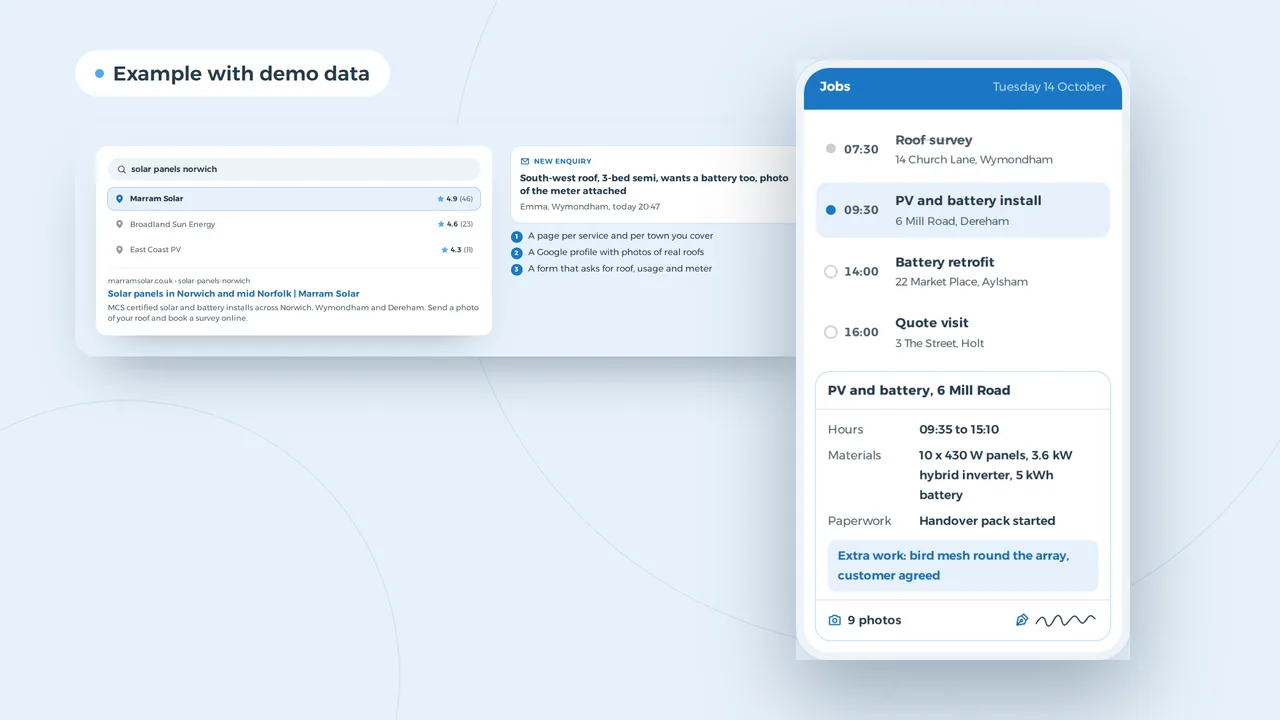
New enquiry
South-west roof, 3-bed semi, wants a battery too, photo of the meter attached
Emma, Wymondham, today 20:47
- A page per service and per town you cover
- A Google profile with photos of real roofs
- A form that asks for roof, usage and meter
Example with made-up businesses and reviews.
Signals that put an installer in the map pack
A Google profile that matches your site
The same services, the same towns, the right primary category and photos from real roofs. See Google Business Profile categories.
Reviews that keep coming
A steady flow beats a burst. Ask at handover, when the customer has just seen the app show their first generation. More in get more Google reviews.
Town pages with real substance
A page per town with installs, roof types and local planning notes, not the same text with a new place name. That second kind gets ignored.
Links from local sites
A parish newsletter, a community energy group, a supplier's installer list. Each backlink from a real local source counts for more than a directory.
Answers to the money questions
The questions homeowners ask before they buy are about money and paperwork. A solar firm that answers them clearly on its own site earns trust before the first call, and gets quoted when people ask an AI assistant instead of Google.
- What it costsA price range for typical systems, what moves it up or down, and the VAT rate. Energy-saving materials such as solar panels installed in homes are at 0% VAT until 31 March 2027, and 5% from 1 April 2027. That date is worth a page of its own in the months before it.
- What it earnsThe Smart Export Guarantee pays for power sent to the grid, but only with an MCS certified installation and installer and an export meter. Say that plainly, and show your own MCS certification next to it.
- What happens after the installWho tells the DNO, why a bigger system needs approval before it connects, and what the customer receives at handover.
Writing those pages well is its own craft; see SEO copywriting. How answers get picked up by ChatGPT and other assistants is in how to get found in ChatGPT, and how that differs from classic search in SEO vs GEO.
The job sheet that feeds the next search
- The handover pack builds itselfPanel and inverter serials, test results and photos land in the job file, ready for the MCS certificate.
- The DNO notice is not forgottenCommissioning starts the clock, and the office sees which G98 notices are still open.
- The customer signs on the phoneExtra work is agreed on the roof, so it does not turn into a dispute on the invoice.
An example of what we can build, with made-up addresses. You choose which fields a job sheet has.
Every install is proof for the next search
The strongest content a solar firm has is already on the job sheet: photos of the roof before and after, the number of panels, the battery, the town. Most of it never leaves the phone of the installer who took it.
If the job sheet asks for consent and a couple of good photos at handover, each install can become a short entry on the right town page and a post on the Google profile, without anyone in the office writing from scratch. Over a season that builds what a lead broker cannot copy: dozens of real roofs in the towns you serve.
That connection between the job app and the site is something we build; how the job sheet itself works is on work order app, and the whole picture for solar firms, from enquiry to DNO notice, is on software and websites for solar installers.
The technical floor under a solar site
Content wins the ranking, but only on a site Google can read quickly. These are the checks we run on every solar site before we write a word.
| Check | What goes wrong on solar sites | What it should be |
|---|---|---|
| Speed on a phone | Heavy drone videos and sliders on the home page | Fast on a phone signal, video loaded only when tapped |
| Town pages | Dozens of near-identical pages, or none at all | One real page per town you serve, each with its own installs |
| Structured data | No business details for search engines | Your business, area served, services and reviews marked up |
| Calculator | A savings calculator that hides everything behind a form | A range shown first, the form after |
| Forms | A form that breaks on a phone or never sends | Tested on a phone, with a copy to the office inbox |
| Old offers | Pages about schemes that closed years ago | Removed or updated to what is open now |
You can run a first scan yourself with the SEO checker and the website speed test. The full list is in technical SEO, and a thorough review of an existing site is an SEO audit.
Half an hour on your own solar site
- Search for solar panels plus each town you cover, on your phone, logged out. Note where you appear on the map and in the results.
- Open your Google profile: check the primary category, the service area and the date of the last photo.
- Count your town pages. If there are none, or they differ only in the place name, start there.
- Look for pages that still mention schemes or rates that no longer apply.
- Fill in your own enquiry form on a phone and see how long it takes to reach the office.
- Check your MCS certification is visible next to the form, not only in the footer.
Where VBS fits in
We plan the pages, write them, build the site and keep it growing, alongside the Google profile. Websites start from 1,500 euro; SEO work is priced per project after a conversation, and what drives that price is in SEO cost. How long it takes before rankings move is in how long does SEO take. Use the SEO checklist if you would rather start on your own, or read how we work on SEO and local SEO. Need the site first? That is website design.
We have no solar installer as a client yet; the Business Centrum site we rebuilt went from 220 to 10,200 impressions a day in Google within five weeks.
SEO
How VBS helps you with this
We find the questions your buyers ask Google, write the pages that answer them in full and measure every week what climbs.
- A term map: every search term with proof on its own page
- Guides, tools and comparisons with tables and sourced figures
- Rankings and impressions from Search Console every week
How we approach it is on our page about SEO.
Your solar firm on the map in every town you cover?
Send us your site and the towns you work in. We will show which searches you miss today and where we would start.
Rather get in touch right away?