Industries: sports clubs
Sports club management software for members, subs, teams and the work off the pitch
80%
A membership list that is right, subs that come in without a treasurer chasing parents, teams that never end up on the same pitch, and a coach who ticks off attendance on a phone. Built around how your club actually runs.
Clubs run on volunteers and a spreadsheet nobody dares to sort
Sports club management software starts with the club secretary on a Monday night. Weekend sign-ups sit in three inboxes, half the subs came in without a reference, and the under-11s still do not know whether Saturday kick-off is at nine or ten. Whoever sorts that out each week usually does it next to a full-time job.
We build sports club software that makes that work smaller: a membership system with subs and reminders, an app for coaches and parents, a board for pitches and halls, and a place for volunteers, the bar and sponsors. Everything comes from one list, so a change happens once. If your club is also a registered charity, our page on software for charities covers rotas, Gift Aid claims and grant files in more depth.
A youth coach's Wednesday, with attendance and drop-outs
- Parents send the apologiesA parent marks their child as away in the app. The coach sees it before the session and rings nobody.
- The squad comes from the registerWho trained and who is free on Saturday is already ticked. The message to parents goes out from the same list.
- Subs sit beside the nameAn unpaid sub shows as a dot. The membership secretary sends the reminder, not the coach.
An example of what we can build, with made-up names. You choose what a coach sees.
The weekly jobs a club secretary still does by hand
In most clubs the work is not one big project. It is dozens of small jobs that come back every week, and they only look small until you add them up over a season with fifteen teams.
| Job | How it often goes | With club software built for you |
|---|---|---|
| New member joins | Paper form or email, typed into a spreadsheet | Joins through the website, appears in the list straight away |
| Collecting subs | Bank details in an email, payments matched by hand | Payment request per member, the payment marks itself as paid |
| Dropping out of training | Messages in three group chats | A parent taps the session, the coach sees it before kick-off |
| Sharing out pitches and halls | A printed grid on the clubhouse door | A board that refuses double bookings |
| Staffing the bar and match days | Asking round until there are enough people | Shifts volunteers sign up for themselves |
| Coaches' DBS checks | A folder, or someone's memory | A tick and a renewal date per coach |
No club needs all of it at once. A club with two adult teams gains most from a clean membership list and subs, which is the core of any CRM adapted to members instead of customers. A club with a big junior section gains from the coach app and contact with parents. Start with whatever takes the most time each week. If you are not sure your spreadsheet has had its day, read our guide on Excel or planning software first.
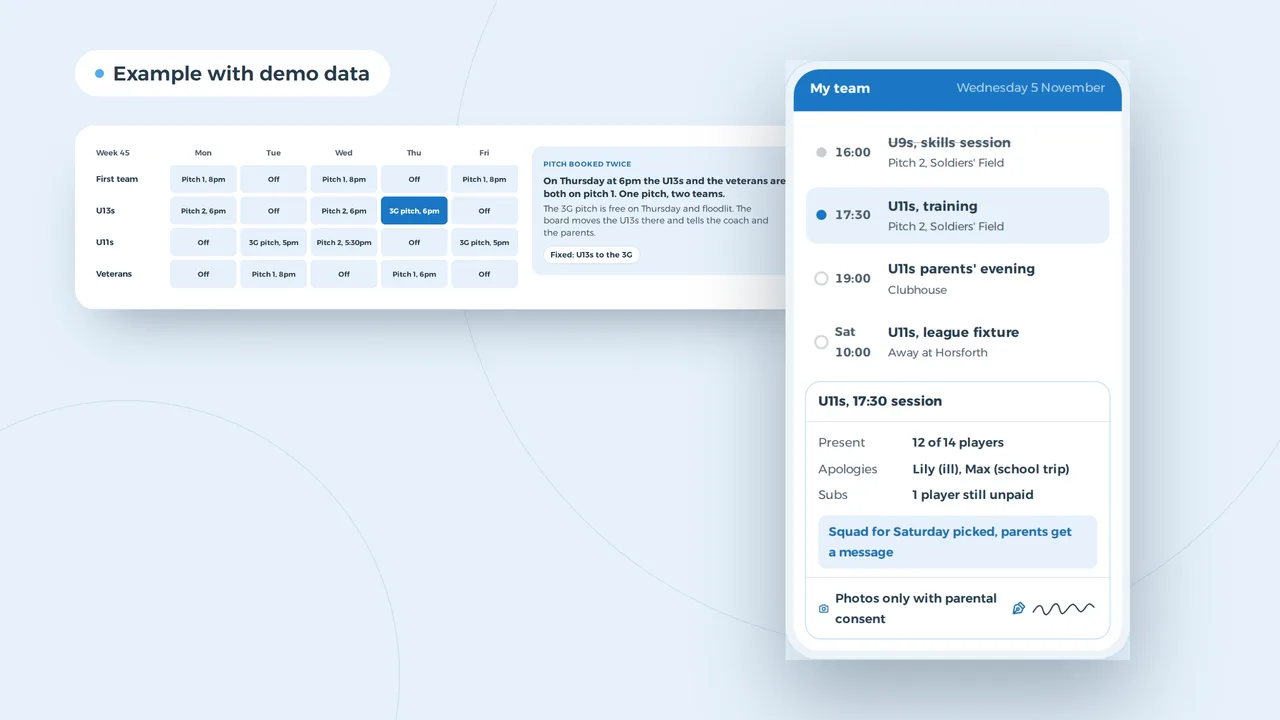
Under-13s and veterans on the same pitch, Thursday at 6pm
Pitch booked twice
On Thursday at 6pm the U13s and the veterans are both on pitch 1. One pitch, two teams.
The 3G pitch is free on Thursday and floodlit. The board moves the U13s there and tells the coach and the parents.
Fixed: U13s to the 3G
An example of what we can build, with made-up teams. You decide which rules the board checks.
Teams, training and pitches on one board
A club plans two things at once: which team trains, and on which pitch or in which hall. A pitch takes one team at a time, and a floodlit 3G pitch is worth its weight in gold in January. The board knows every pitch, every hall and every team, and stops two coaches booking the same slot.
League fixtures sit on the same board. When a home game moves, the board shifts the session that was in that slot and tells the coach and the parents of that team. A coach only sees his own squad on his phone: who is coming, who has dropped out and who can make Saturday. The app runs in the browser as a PWA, so nobody has to download anything from an app store.
If your club hires out a pitch or the function room to other clubs, schools or businesses, those bookings belong on the same board. A request through the website arrives as a proposal and never clashes with training. How that works is on our page about a booking system for your website.
Subs that come in without chasing parents
Subs are the biggest income for most clubs, and collecting them is the most thankless job on the committee. Payments without a reference, one payment for two children, or a season paid in three parts turn matching into an evening's puzzle.
In the membership system every member gets a payment request with its own reference. When the money arrives, the member is marked as paid. A reminder goes out by itself after the period you choose, in a friendly tone and with a link to pay. Family discounts, instalments or a reduced rate for those who cannot afford the full fee are set up once. The treasurer sees per team what is still outstanding, the coach only a dot next to a name.
For a registered community amateur sports club, fees matter for more than cash flow. HMRC's guidance treats a club charging more than £1,612 a year as not open to the whole community, and where membership costs more than £520 a year the club must make provision for members who cannot afford more. A membership system that knows every fee and every reduction makes that easy to show.
The league's fixtures export becomes a weekend plan
An example of what we can build, with made-up teams and times. AI reads the fixtures and proposes; a person decides.
AI does not replace your youth coordinator. It removes the retyping: a fixtures export from the league, an email from an opposing club moving a game, or a list of summer camp sign-ups becomes a proposal that someone checks and approves. The coordinator decides, the software does the typing. How we build those steps is on our page about AI automation.
CASC, Gift Aid, DBS and data rules a club meets
A sports club handles children's data, pays some coaches, often runs a bar and may be registered with HMRC as a community amateur sports club. These are the rules that most often end up in the software. Check the current figures with HMRC, the DBS and the ICO, and with your accountant before you rely on them.
| Topic | What the rule says | What the software does |
|---|---|---|
| Business rates as a CASC | A registered CASC gets mandatory 80% relief on business rates | Keeps the records that show the club still meets the conditions |
| Members who play | At least 50% of members must be participating members | Counts playing and social members per season |
| Paying players | A CASC may pay a player at most £10,000 in 12 months | A running total per paid player |
| Trading and property income | Income from non-members and property stays under £100,000 a year; Corporation Tax exemption needs trading turnover under £50,000 and property income under £30,000 | Splits bar, hire and sponsor income from subs |
| Gift Aid and small donations | 25p back per £1 donated; up to £2,000 a tax year on cash or contactless gifts of £30 or less under the small donations scheme | Declarations per donor, donations kept apart from subs |
| DBS checks for coaches | Standard and enhanced checks are free for volunteers; basic and standard cost £20, enhanced £41 for paid roles | A tick, the level and a renewal date per coach |
| Data protection fee | Most organisations, charities included, pay the ICO £52 or £78 a year; some are exempt | Members' data kept to what the club needs, with access per role |
Photos of players, medical notes for juniors and emergency contacts all count as personal data, and health information is special category data. Ask only what a coach needs to keep a child safe, and let only that coach see it. How UK GDPR differs from the EU version is in our guide on UK GDPR and EU GDPR, and what your club website needs is in our guide to a GDPR-compliant website.
Questions to ask before you pick club software
- Can a parent join, drop out of a session and pay without creating an account with a password?
- Does a coach see only his own squad, and the treasurer only what the treasurer needs?
- Are donations with a Gift Aid declaration kept apart from subs from the first payment?
- Does each player's photo consent show up for whoever posts on social media?
- Can you export everything if you ever switch?
- Does a supplier who stores the data sign a data processing agreement with the club?
A call for youth coaches and bar volunteers
An example of what we can build, with made-up names. You pick what the form asks.
Coaches, volunteers and sponsors who stay
Almost every club is looking for the same people: a coach for the youngest teams, someone for the bar on Saturdays and a few parents who will drive to away games. A page on your site with a short form works better than a message in a group chat that sinks within the hour. Whoever signs up picks the role and the days, and the coordinator sees straight away who still needs a DBS check before working with children.
For the bar and match days, volunteers sign up for shifts themselves. The software shows which shift is still empty and sends a reminder the day before. It is the same idea as our staff scheduling software, without contracts and with more patience for people who cancel.
Sponsors get a place of their own: which board along which pitch, which logo on which shirt, which deal ends this season and which invoice still has to go out. Whether sponsorship invoices carry VAT depends on your club's VAT position, so ask your accountant. Parents and members who want to see their own payments and sessions can do so in a member portal.
Small club, big club: what you really need
A club with one team does not need an ERP. A multi-sport club with six sections needs more than a shared spreadsheet. What we would set up depends on your number of members and what you run besides the sport.
| Club | What is enough | Where custom software makes the difference |
|---|---|---|
| Up to 100 members, one or two teams | A sports club website with a sign-up form, an existing package or a well-built spreadsheet | Rarely needed; get the website and sign-ups right first |
| 150 to 400 members with a junior section | Membership with subs and reminders, a coach app | Parents dropping out themselves, attendance, squad selection, a parent portal |
| Multi-sport club with sections | One platform with rights per section and per role | One list across all sections, own subs per sport, shared facilities |
| Club with its own ground and hire | A board for pitches and halls, hire through the website | Hire, bar and sponsors in one system, linked to the accounts |
For many small clubs an off-the-shelf package, sometimes offered through the governing body, is the sensible start. Custom software pays off when your package makes you do things twice, when sections each keep their own list, or when you want something no package does, such as hire and subs in one system. Clubs that run a gym or fitness classes next to the pitches will recognise much of our page on software for gyms. How to weigh that up is in our guide on replacing Excel with software.
Worked example: a season of junior subs and donations
The gain is not only in the hours. A treasurer who sees in November which team still owes subs can call the right people, and a coach no longer asks for money on the touchline. For a rough idea of what custom software costs, try our software development cost calculator or read what custom software costs.
With your committee to a first version
- A conversation with the committeeWe sit down with the people who do the work: secretary, treasurer and a youth coordinator. You tell us how a week and a season run.
- Looking at your current listsWe go through your spreadsheet, forms and group chats and show where the double work is. You get a fixed price per project.
- A first version with your real teamsWe build what saves the most time first, with your own teams and pitches. A few coaches test it before the whole club moves over.
- Moving over in the summerThe best moment to switch falls between two seasons, before the new registrations. How we work is on our page about custom software.
No sports club is on our client list yet. For Business Centrum we did build a management platform that replaces their Excel, with files, documents, tasks and a portal for their clients.
Questions club committees ask
Is there free sports club software?
Yes, there are free and low-cost packages, sometimes through your governing body. For a small club they are often enough. Custom software only makes sense when your package makes you do things twice, or when you want hire, bar and subs in one system. Our guide on replacing Excel with software helps you decide.
Do our volunteer coaches need a DBS check?
Many roles that involve working with children call for a standard or enhanced check, and for volunteers those are free of charge. Which level a role needs depends on what it involves; your governing body and the DBS guidance set that out. The software keeps track of who has one and when it should be renewed.
Can a CASC claim Gift Aid on membership subs?
No. A CASC can claim Gift Aid on donations from individual taxpayers, not on subscriptions or on payments for goods and services. Keep the two apart in your records from the first payment.
Does it work for a multi-sport club with sections?
Yes. Each section sees its own members, teams and subs, while the committee has one list for the whole club. A member who plays two sports is in it once.
Can parents sign up without creating an account?
Yes. Parents get a link by email or text and fill everything in there, dropping out and paying included. That keeps the threshold low and nobody forgets a password. If you want your own app with notifications, read how we approach app development.
How much does sports club software cost?
That depends on what goes in it. A website starts from 1,500 euro. For software we give a fixed price per project after a conversation. If you want to talk it through, get in touch.
Custom software
How VBS helps you with this
We build the platform your business runs on every day: your spreadsheets, emails and paperwork in one system that does what you do.
- Your workflow mapped first, then a fixed price
- Screens for the office, the client and the road
- Hosting, backups and security managed by us on AWS
How we approach it is on our page about Custom software.
Members, subs and teams in one system?
Tell us how a week at your club runs, from sign-up to Saturday's game. We will show you where we would start.
Rather get in touch right away?