Industries: campsites
Campsite booking software that knows every pitch
Grass pitches, hardstandings, seasonal tourers, pods and bell tents in one calendar. A pitch plan that knows which motorhome fits where, and bookings that come in through your own site instead of a platform. Built around how your park runs.
A park sells ground, and every pitch is different
A campsite does not let rooms with a number on the door. It lets a piece of ground of a certain size, with or without a hook-up, for a tent, a caravan with an awning or an eight metre motorhome. Next to those there may be five lodges, three bell tents and thirty seasonal pitches that stay taken from March to October. Each has its own price, its own minimum stay and its own rules.
On many parks that still runs on a paper plan in reception, a diary, a spreadsheet for the seasonals and two platform extranets. It works until the Friday before the August bank holiday, when a motorhome arrives for a pitch it does not fit and the phone keeps ringing while you walk the field. Good campsite booking software starts from that plan, not from a hotel calendar with the word pitch pasted in.
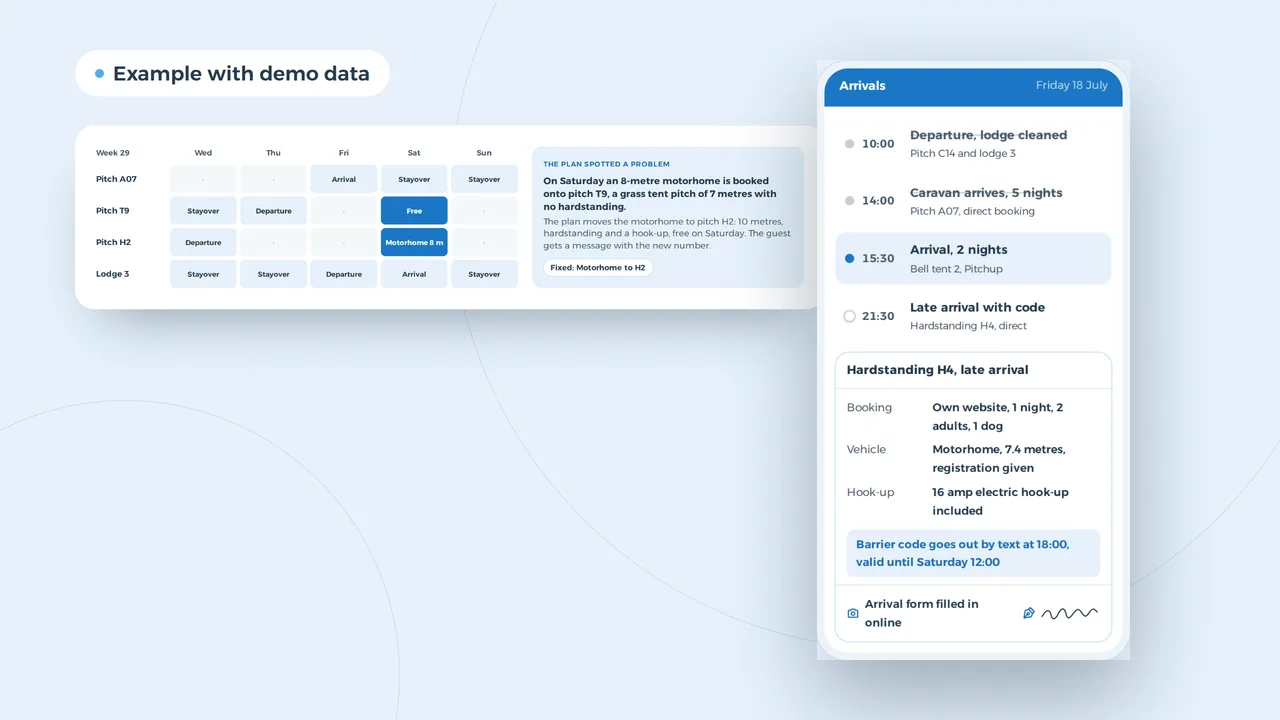
Hardstanding H4 and a gate code at half nine
- One pitch plan for every channelA Pitchup booking for bell tent 2 closes it on your own website straight away. A pitch, a pod or a lodge only sells once.
- The late motorhome does not ringThe barrier code goes out at the time you choose and only works for that night.
- Length and hook-up known in advanceGuests give the length of their motorhome or caravan and say if they want a hook-up. The system only offers pitches that fit.
An example of what we can build, with made-up guests and pitches. You choose which fields a booking has.
Where a busy weekend breaks down
Most of the lost time on a campsite sits in the same five places. They are worth naming before anyone talks about software, because each one asks for a different fix.
| Moment | What goes wrong now | What the system does |
|---|---|---|
| A booking request by email | Someone reads it, checks the plan, writes back, and the pitch is gone by then | The request lands with the dates, the unit length and the hook-up, and a matching pitch is suggested |
| A platform booking | The bell tent is sold on Pitchup and on your own site for the same night | One calendar per pitch and per unit, read by every channel |
| A late arrival | You stay up or leave an envelope at the barrier | The guest gets the gate code, the pitch number and a map before they set off |
| Seasonal pitches | Contracts, payments and meter readings live in a folder | Each seasonal has a page with contract, instalments and electricity readings |
| The pitch plan | Lengths, hook-ups and dogs live in the warden's head | Every pitch carries its size, surface, amps and rules |
None of this needs a big platform on day one. On most parks, the first win is a calendar that knows the difference between a grass pitch with 10 amps and a hardstanding with 16 amps, and that shuts a pitch on every channel the moment it sells.
Hotel calendar or a pitch plan
- What a guest books
- A hotel style booking calendarA room type with a number
- Campsite booking software built on a planA pitch type, or a chosen pitch, sized for the unit
- Unit length and awning
- A hotel style booking calendarNot asked, or a free text field
- Campsite booking software built on a planAsked at booking and checked against the pitch
- Hook-up
- A hotel style booking calendarAn extra on the bill
- Campsite booking software built on a planA property of the pitch, with the amps
- Seasonal pitches
- A hotel style booking calendarA very long booking that blocks the calendar
- Campsite booking software built on a planA contract with instalments and meter readings
- Lodges, pods and bell tents
- A hotel style booking calendarFine on their own
- Campsite booking software built on a planIn the same calendar as the pitches around them
An 8 metre motorhome on a 7 metre pitch
The plan spotted a problem
On Saturday an 8-metre motorhome is booked onto pitch T9, a grass tent pitch of 7 metres with no hardstanding.
The plan moves the motorhome to pitch H2: 10 metres, hardstanding and a hook-up, free on Saturday. The guest gets a message with the new number.
Fixed: Motorhome to H2
An example of what we can build, with made-up pitches and bookings. You choose which sizes and facilities the plan checks.
Pitches, hardstandings and seasonals in one system
A campsite booking system has to know more about the ground than a hotel system knows about a room. For each pitch you store the size, the surface, the hook-up, whether dogs are allowed and which units fit. For each unit type you store the minimum stay and the price per night, per person and per extra, such as an awning, a second car or a dog.
Seasonal pitches are a separate product. A seasonal tourer stays on the same pitch for months, pays in instalments and uses electricity that you meter. In the system, the seasonal gets a contract with dates, instalments and readings, and the pitch is closed for touring bookings for that period. When a seasonal leaves early, you see the free weeks and can sell them.
Lodges, pods and bell tents work more like holiday cottages, with a changeover day and cleaning between guests. They sit in the same calendar, so the warden sees one plan with everything on it. The same reasoning is behind our bed and breakfast booking software and the booking system for a website.
Caravan park software and holiday parks
A holiday park with static caravans that owners buy, and a touring field next to it, needs two things from its software. For the touring field it is the same pitch plan. For the statics it is owner records, pitch fees, the hire fleet and the cleaning rota. Most caravan park software splits those into two tools. Built around your park, it can be one system with two views. Where a holiday park mostly lets its own lodges, its calendar looks more like a hotel than a campsite, and the software should follow that.
A family looks for a campsite near Keswick
New booking
Hardstanding pitch with hook-up, 4 nights, 6-metre caravan, 2 adults and 2 children
Hannah, Manchester, today 20:41
- A page per pitch type and per pod, with photos, sizes and price
- A Google profile with recent photos of the field and the shower block
- A booking module that reads the same calendar as Pitchup
An example of what we can build, with made-up campsites and reviews.
Booking direct instead of through a platform
Platforms bring guests who would never have found you, and they charge commission on every night. The trick is to let them fill gaps and to make your own site the easier place to book for everyone else.
Three things move bookings from the platforms to your site:
- A page per pitch type and per lodgeWith the size, the hook-up, photos of the actual pitch and the price for the chosen dates. A guest who sees that the pitch fits their 7.5 metre caravan books there and then. Read more on a direct booking website.
- A Google Business Profile with the right categorySet it up as in create a Google Business Profile, choose the category from Google Business Profile categories and ask for a review after every stay with the Google review link generator. Why that matters is in get more Google reviews.
- Pages in the languages of your guestsDutch and German touring families plan months ahead and book where they can read the rules. See multilingual website development.
Whether you list lodges on Airbnb, Booking.com or both is a choice of its own, set out in Airbnb vs Booking for hosts. For a campsite that wants to rank for its own area, local SEO does more than a new logo.
Glamping booking software needs a few extras
- A changeover day per unit, so a bell tent is not sold Wednesday to Wednesday when you clean on Fridays
- A minimum stay per season, with two nights in spring and seven in August
- Add-ons per booking, such as a breakfast hamper, firewood or a hot tub
- A deposit at booking and the balance taken automatically before arrival
- House rules on the page and in the confirmation, including fires and dogs
- Photos per unit, not one gallery for the whole field
Four emails in three languages become pitch offers
An example of what we can build, with made-up guests. The AI reads the request and finds a pitch, you decide what goes out.
AI that reads requests, and leaves the decision with you
A good share of the mail a campsite receives is the same question: is there room for a caravan of this length, with power, for these dates. AI can read those requests in English, French or German, pull out the dates and the unit, and suggest a free pitch that fits. The warden reads the offer, changes it if needed and sends it. Nothing goes out unchecked.
The same goes for questions about dogs, late arrival, the shop or the swimming pool. The answers come from your own rules, not from the internet. More on that in AI in hospitality and AI customer service.
Seasonal staff for reception and the facilities
An example of what we can build, with made-up names. You choose what you ask.
Staff rotas for the summer
A park that is quiet in March can need ten people in August. Seasonal staff want to know their shifts weeks ahead, and the warden wants to see who covers reception, the toilet blocks and the shop each day. A vacancy page with a short form, a rota that knows who is available which weeks, and a swap request on the phone take most of the work out of it. See staff scheduling software.
UK rules the system should carry
The rules for a campsite in England and Wales are spread over several acts. Software does not replace your planning consultant or accountant, but it can carry the numbers that affect bookings. These are the ones we build in when they apply.
| Rule | What it says | Where it shows in the system |
|---|---|---|
| Class BC permitted development | A temporary recreational campsite may open up to 60 days a year, with up to 50 pitches, toilets and waste disposal on site, and written notice to the council before you start each year | A counter of opening days and pitches, with a warning before day 60 |
| Class B | The general 28 day right for temporary use of land does not cover camping, except for a festival | Not used for a campsite |
| Site licence for caravans | A caravan site needs a licence from the council, which is only issued with planning permission granted on an application, not with permitted development | Licence conditions, such as the maximum number of units, as limits on the plan |
| Licence for tents | Camping in tents and other moveable dwellings for more than 42 days in a row or 60 days in any twelve months needs a licence | Opening days per field |
| Fire safety | The responsible person keeps a written fire risk assessment; Home Office guidance for England covers pods, lodges, shepherd huts, tents and yurts | Spacing between units on the plan and a record of checks |
| Business rates for lodges | In England a holiday let is rated as a business when available 140 nights and actually let 70 nights in a year; in Wales 252 and 182 | Nights available and let per lodge, ready for the annual check |
| VAT | Registration once taxable turnover goes over £90,000; pitches and holiday accommodation are standard rated | Prices with VAT and a turnover view |
One more change affects owners of lodges and pods: the furnished holiday lettings tax regime ended in April 2025. Ask your accountant what that means for you. Small business rate relief takes a property with a rateable value of £12,000 or less out of rates, tapering to £15,000.
Twenty pitches or four hundred
Not every park needs the same system. Size decides more than price.
| Park | What usually fits |
|---|---|
| A small field with 20 to 40 pitches | A site with availability per pitch type, online booking with a deposit, and a simple plan for the warden |
| A touring park with 60 to 150 pitches and some lodges | A pitch plan with sizes and hook-ups, platform sync for the lodges, seasonal contracts and a reception view |
| A holiday park with statics, touring and a shop | Booking software linked to the till, owner records for the statics, staff rotas and reporting per area |
For the small field, a good site with booking often does more than a heavy system. For the large park, the work sits in linking what is there: the till, the barrier, the accounts. That is custom software or a web application, not an off the shelf package with a dozen workarounds.
Overbooking in numbers
Take a park with 120 pitches and four channels: your site, the phone, a pitch platform and a lodge platform. If one booking a week slips through twice in high season, that is a family at the barrier with nowhere to go and a refund, a bad review and an hour of phone calls. A shared calendar closes a pitch on every channel at once. It does not stop every mistake, but it stops the one that costs the most.
Starting with a walk round the park
- A talk about your seasonHow bookings come in now, who keeps the plan, how seasonal contracts run and what happens with a late arrival. We go through a week in August and a week in November.
- A fixed price per projectWe pick where you lose the most and give a fixed price for that part. Websites start from 1,500 euro; a booking system or pitch plan is priced after the talk.
- Built next to the old wayThe plan runs alongside your current system for a few weeks, so nothing is lost before the busy months.
We built the availability calendar and the request form for the holiday house No.4 Lange Ast and the booking form with an admin panel for Villa Lidia in Umbria. If you are starting a site from scratch, read start a glamping business in the UK first, and when the site itself is the question, see glamping website design. Questions about your own park? Get in touch.
Park owners ask us
Does it work with Pitchup, Booking.com and Airbnb?
Yes. The calendar reads bookings from those platforms and closes the pitch or lodge on your own site. What sells on your site closes on the platform too.
Can a guest pick their own pitch?
If you want them to. You can let guests choose on the plan, choose only a pitch type, or assign the pitch yourself after booking. The plan checks length, hook-up and dogs.
What about seasonal pitches?
Each seasonal gets a contract with dates, instalments and meter readings. The pitch is closed for touring bookings for that period and opens again when they leave.
Can it count our Class BC days?
Yes. If you open a field under Class BC, the system counts the opening days and the pitches and warns you before the limit. The notice to the council is still yours to send.
How long does it take?
A site with booking can be live in weeks. A pitch plan linked to the till and the barrier takes longer, and we plan it so it runs before your busy season.
Custom software
How VBS helps you with this
We build the platform your business runs on every day: your spreadsheets, emails and paperwork in one system that does what you do.
- Your workflow mapped first, then a fixed price
- Screens for the office, the client and the road
- Hosting, backups and security managed by us on AWS
How we approach it is on our page about Custom software.
Your pitches and lodges on one plan.
Tell us how many pitches you have and how bookings come in now. We show you where we would start.
Rather get in touch right away?