Industries: bike shops
Bike shop software for the workshop, the stockroom and Cycle to Work
A workshop schedule that knows who can open up an e-bike motor, a job card per frame number on the mechanic's phone, stock by frame size and by part, and Cycle to Work orders that run from certificate to invoice without retyping. Built around how your shop already works.
Spring sells the bikes, the workshop pays the rent
Bike shop software has to cope with a Saturday in April. A family wants three bikes in three frame sizes, eleven bikes in the workshop are promised for today, and a commuter rings about a puncture before the 7.40 train. On Monday a Cycle to Work provider emails two certificates, and on Wednesday someone is at the counter with an e-bike showing an error code and a receipt from last summer.
In many shops that runs through an EPOS for sales, a paper diary for the workshop, cardboard tags on the handlebars and a spreadsheet for scheme orders. Each piece works. None of them talk to each other. A service that slipped off the diary, a size still showing online after the last one sold, or a scheme invoice that never went out costs more than it looks.
Bike shop management software built for your shop puts the workshop, the stock and the customer in one place. Below, need by need, what we build, which UK rules belong in the system, and how much software a shop of your size actually needs.
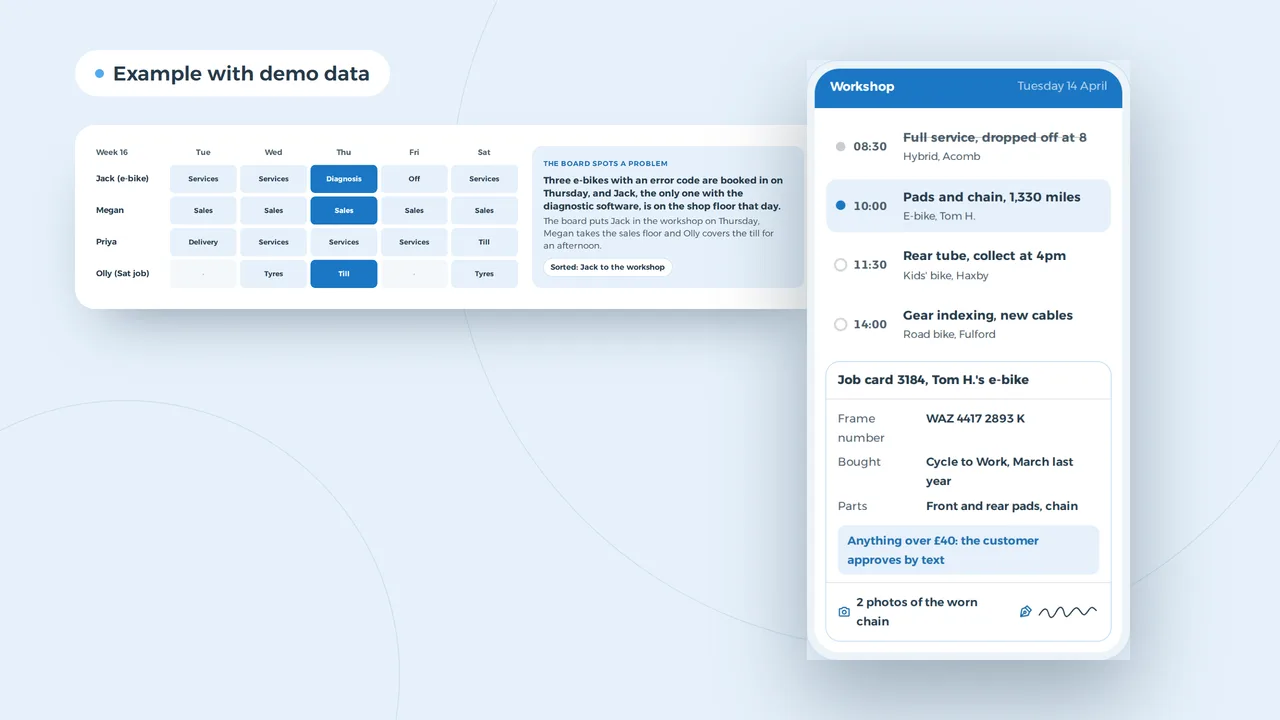
A Cycle to Work bike on the mechanic's phone
- The customer approves extra workIf the chain is worn out, the customer gets a text with the price and a button. No phone call nobody picks up while the bike sits in the stand.
- Every service sits on the frame numberYou see straight away what was done to the bike before, when it was sold and whether it came through a scheme.
- Ready means a text, not a callWhen the job card closes, the customer gets a text with the total and the collection time.
An example of what we can build, with made-up names. You choose what a job card asks for.
Between the counter and the workstand
A bike shop rarely loses money on the bike itself. It loses it on the service written on a scrap of paper, the phone nobody answered and the scheme invoice left in a folder.
| Moment | How it often goes | With your own software |
|---|---|---|
| A customer wants a service | The phone rings while you're indexing gears; the slot goes on a sticky note | The customer books a free slot online and it lands on the schedule |
| A bike comes in | A cardboard tag on the bars with a name and a mobile number | A job card on the frame number, with everything done to that bike before |
| The chain is worn out | You ring, nobody answers, the bike sits on the hook | The customer gets a text with the price and approves with a tap |
| A Cycle to Work bike is ordered | The certificate is retyped into the till and a spreadsheet | The certificate becomes an order, with the invoice to the right party |
| A size sells out | You find out when someone asks for it | Stock by frame size shows in the shop and online at the same time |
| Someone reports a fault | You dig through a box of receipts for the purchase date | Purchase date, frame number and services sit on the customer's record |
None of those moments call for a big package. They call for the workshop, the shop floor and the scheme orders to see the same data. That is where custom software for a bike shop starts: not with a screen full of buttons, but where you are doing the same work twice today.
Three e-bikes with error codes on Thursday
The board spots a problem
Three e-bikes with an error code are booked in on Thursday, and Jack, the only one with the diagnostic software, is on the shop floor that day.
The board puts Jack in the workshop on Thursday, Megan takes the sales floor and Olly covers the till for an afternoon.
Sorted: Jack to the workshop
An example of what we can build, with made-up names. You decide how many services a day can take and who may strip which bike.
Workshop scheduling that knows what a service takes
A service is not just a service. A basic service on a town bike takes half an hour, a full service on an e-bike with a hub gear takes an afternoon, and an error code on a mid-drive motor needs someone with that brand's diagnostic tool. A paper diary doesn't know the difference. Bike shop service software does.
We build the board around your own job types. Each one gets a duration, the people allowed to do it and the parts it usually needs. When a customer books a full service online, the board looks for a day with enough free hours from someone qualified. When three e-bikes with error codes land on the same Thursday, it shows up before the day starts, not at ten o'clock with the first customer already at the counter.
If you schedule in a diary or a spreadsheet today, read Excel scheduling or planning software first. If the main problem is spreading hours across your staff, staff scheduling software may fit better than a full workshop module. Online booking on its own is covered on booking system for your website.
Four habits a workshop board has to learn
- Drop-off daysCustomers pick a day and drop off in the morning. The board caps how many bikes arrive, so the workshop isn't full by nine.
- While-you-wait jobsA free quarter of an hour per half day keeps punctures and brake cables out of the booked services.
- The spring rushFrom March to May the board shows weeks ahead where the hours run out, so you hire a Saturday mechanic in time.
- Who may do whatA trainee fixes punctures, an experienced mechanic opens a motor. Nobody is booked for work they aren't trained for.
The job card is the heart of a bike workshop. On paper it hangs from the bars and gets covered in greasy fingerprints. On a phone or a tablet on the wall it hangs from the bike's frame number. The mechanic sees at once when the bike was bought, which services it has had, whether it is a scheme bike and what that agreement covers.
If they find a worn chain or a split tyre, they add it to the job card with a photo. Above an amount you choose, the customer gets a text with the price and a button to approve. The bike doesn't sit on the hook because nobody picked up the phone, and there's no argument at the counter about a bill that came out higher than expected. When the job card closes, the parts come off stock and the bill is waiting at the till. We build it as a simple app for your workshop that works with oily hands and without Wi-Fi at the back; more on job cards in general on work order app.
Brake pads running low for this week's services
2 sets of disc pads left, and 5 services with disc brakes are booked this week.
Order 20 sets from the distributor, delivered Thursday morning.
An example of what we can build, with made-up numbers. You choose per part when the system warns you.
Bikes by frame size, parts by service
Stock in a bike shop is two kinds of stock. Bikes are counted one by one, by frame size and colour, and each has its own frame number. Parts are counted by the box, and in the workshop they often disappear without anyone booking them out. Generic inventory management software doesn't know the first and sees the second too late.
So we tie each bike to its frame number from the moment it's scanned in, link parts to the services on the board, keep part-exchange bikes as separate second-hand stock with their own price, and let the shop and the website share one count by frame size. When the last 54 cm sells at the counter, it disappears from the site.
Already on a bike shop POS like Lightspeed? Then we build around it, not beside it: an integration that hangs the workshop and scheme orders on your till. What that EPOS costs a year is in Lightspeed pricing, and whether to start from the till or the webshop is in Shopify or Lightspeed. Thinking of moving your online shop? Read switching from Lightspeed to Shopify. A shop without a workshop will find the right overview on our page for retail shops.
Cycle to Work: three parties, one bike
With a Cycle to Work bike, the person at your counter is not the one who pays you. The employer hires the bike to the employee, usually through a salary sacrifice of at least 12 months, and the employee doesn't own it during the hire. You supply the bike and invoice the scheme provider or the employer. Software that keeps that apart per order stops a bike being invoiced twice, or never.
A Cycle to Work certificate becomes an order
An example of what we can build, with made-up names. The AI picks from your own stock, a salesperson decides what goes out.
AI doesn't sell bikes. It takes the retyping away. A certificate from a scheme provider, a customer email with a photo of a snapped spoke, a wholesaler's price list as a PDF: AI reads what's in it and drafts something. For the certificate that's an order with the right bike from stock, the accessories in the agreement and the invoice to the provider. For the photo it's a job card with a suggested list of parts.
A person always checks. Someone at the counter sees whether the size matches what the customer tried, then confirms. You save the retyping without a bike going out in the wrong size. How that works for supplier invoices is on invoice automation, and for customer questions on AI customer service.
UK rules that belong in your till and workshop
A bike shop sells under the ordinary consumer rules, with a few points that matter more for bikes. Some of them touch your software directly, because they decide what you have to be able to find or show.
| Rule | What it says | What the software does |
|---|---|---|
| Short-term right to reject | Under the Consumer Rights Act 2015, a customer can reject faulty goods within 30 days | The purchase date sits on the bike's record, so the counter sees the date at once |
| Faults in the first six months | A fault within 6 months of delivery is taken to have been there at delivery, unless shown otherwise | Every service and repair since the sale is on the frame number, as evidence for you and the customer |
| Electric bikes | An EAPC needs a rider of 14 or over, a motor of at most 250 watts and no assistance above 15.5 mph. Then no licence, registration, tax or insurance is needed | Motor power and assist speed on each e-bike record; anything outside the rules is flagged before it is sold as a bicycle |
| Cycle to Work | The tax exemption has to be open to employees generally, the bike is used mainly for qualifying journeys, and the employee doesn't own it during the hire | Scheme orders carry the provider, the certificate and the hire, apart from ordinary sales |
| Customer data | Bookings and records hold personal data under UK GDPR | Data kept per customer, deleted on request, with access per role |
Anything faster or more powerful than an EAPC is treated as a motorcycle or moped, with registration, tax, a licence and insurance; check with the DVLA before stocking one. Selling online adds the distance selling rules, set out in ecommerce legal requirements. The data side is covered in UK GDPR vs EU GDPR.
Someone looks for a bike shop in York after dinner
Service booked
Full service, e-bike from a Cycle to Work scheme
Sarah, Heworth, today 21:15
- A page per kind of bike, showing what is in the shop now
- A Google profile with workshop and shop hours
- Book a service online, into a free slot in the diary
Example with made-up bike shops and reviews.
Found for a service, not just for a new bike
People buy a new bike every few years and book a service every year. Someone looking for a bike mechanic nearby usually decides on their phone, one evening, between the three names at the top of the map. Those are the customers who fill your workshop, and they come back when they want a new bike.
So the website is built around what they search for: a page per type of bike and per type of service, your shop and workshop hours, a page for Cycle to Work with the providers you accept, and a button to book a service in a free slot. Next to that, a strong Google Business Profile with photos of your workshop, and a fixed way to ask for a review after every service, see get more Google reviews. To rank higher nearby, see local SEO. The site itself is on bike shop website design.
A mechanic on your own, five staff or several branches
A mechanic working alone doesn't need a chain ERP. A shop with three branches needs more than a paper diary. By size, the first build looks different.
| Size | What you need | What you don't need (yet) |
|---|---|---|
| Sole mechanic | A website with online service booking, a Google profile, a job card on your phone | A board for several people, a stock module of your own |
| Shop with 5 staff | Workshop scheduling by skill, job cards per frame number, Cycle to Work from certificate to invoice | A new EPOS if yours works: we connect to it |
| 20 to 50 staff, or several branches | Stock per branch, transfers between shops, a board per workshop, a weekly dashboard | A whole new ERP: we build around what works |
| Larger, or selling across the UK online | Stock shared by shop and webshop, a wholesaler feed, a portal for scheme customers | Everything at once: we build piece by piece, busiest first |
Selling bikes online beyond your own area brings delivery and returns of boxed bikes into play. What a webshop for bikes and parts involves is on webshop development, and what it costs in ecommerce website cost.
A spring of online bookings, in hours
| Item | Sum | Per year |
|---|---|---|
| Services per year | 40 x 13 + 25 x 37 | 1,445 services |
| Phone time for services | 1,445 x 4 minutes | 96 hours |
| Retyping scheme orders | 2 x 50 weeks x 20 minutes | 33 hours |
| Time together | 96 + 33 hours | 129 hours |
| Value of that time | 129 x £15 | £1,935 |
If half your customers book online, and a scheme certificate takes five minutes to check instead of twenty to retype, this example wins back about 73 hours a year (48 plus 25), worth around £1,100, mostly in the weeks the workshop is already full. What it leaves out: the services lost because nobody answered the phone, and the scheme invoice that never went out.
Your week first, then a fixed price
- A conversation about your weekHow does a service come in, who books it, what goes on the job card, how does a scheme bike run? We walk through an ordinary week and a week in April.
- A fixed price per projectTogether we pick where you lose the most and put a fixed price on that piece. A website with online service booking starts from 1,500 euro; software is priced after the conversation.
- A week in the workshopYour mechanics use the first version for a real week. What doesn't fit, we change before the rest follows. You own the code and the data.
A bike shop isn't among our clients yet; what has run every day since July 2026 is the scheduling board with clash warnings and the app per driver for DA Logistics, with about thirty drivers and 34 vehicles.
Bike shop owners ask us
- Do I have to replace my EPOS?
- No. If your till works, we connect the workshop and the scheme orders to it. We only build a till of our own when your current system really holds you back.
- Can customers book a service on my website?
- Yes. They pick their bike, the type of service and a day. Only days with enough free hours show, and the booking goes straight onto the workshop schedule.
- Will it work with the Cycle to Work providers I use?
- We read the certificates as they arrive, by email or from the provider's portal. Where a provider offers an integration, we use it.
- Can it tell a legal e-bike from one that counts as a moped?
- It can flag it. Each e-bike record holds the motor power and the assist speed, so anything above 250 watts or assisting above 15.5 mph is marked before it goes on sale as a bicycle.
- What about my webshop?
- It shares stock with the shop, by frame size. If you don't have one yet, read ecommerce website cost before you decide.
- I'd rather talk first. How does that work?
- Through contact. We plan a call about your week and show where we would start.
Custom software
How VBS helps you with this
We build the platform your business runs on every day: your spreadsheets, emails and paperwork in one system that does what you do.
- Your workflow mapped first, then a fixed price
- Screens for the office, the client and the road
- Hosting, backups and security managed by us on AWS
How we approach it is on our page about Custom software.
Workshop, stock and scheme bikes in one place?
Tell us how a week in April runs at your shop. We'll show you where we would start.
Rather get in touch right away?