Websites for farms
Farm website design that sells the week's harvest
1,500
A site for a farm with a shop, a vending hut or veg boxes. It shows what is in this week, takes orders up to a cut-off and sends people to the right collection point or picking slot.
A farm site has one job on a Tuesday evening
Good farm website design starts from the question people actually ask: what have you got this week? A farm's stock changes by the week, sometimes by the day. The shop is not always open, but the vending hut is. People collect somewhere that is not your farm. And what is in the field in June is gone by October.
This page is about the site itself: which pages, what goes on them, what the law asks and what it costs. What sits behind the site (box rounds per collection point, a rota for pickers, stock in three places) is covered on farm software.
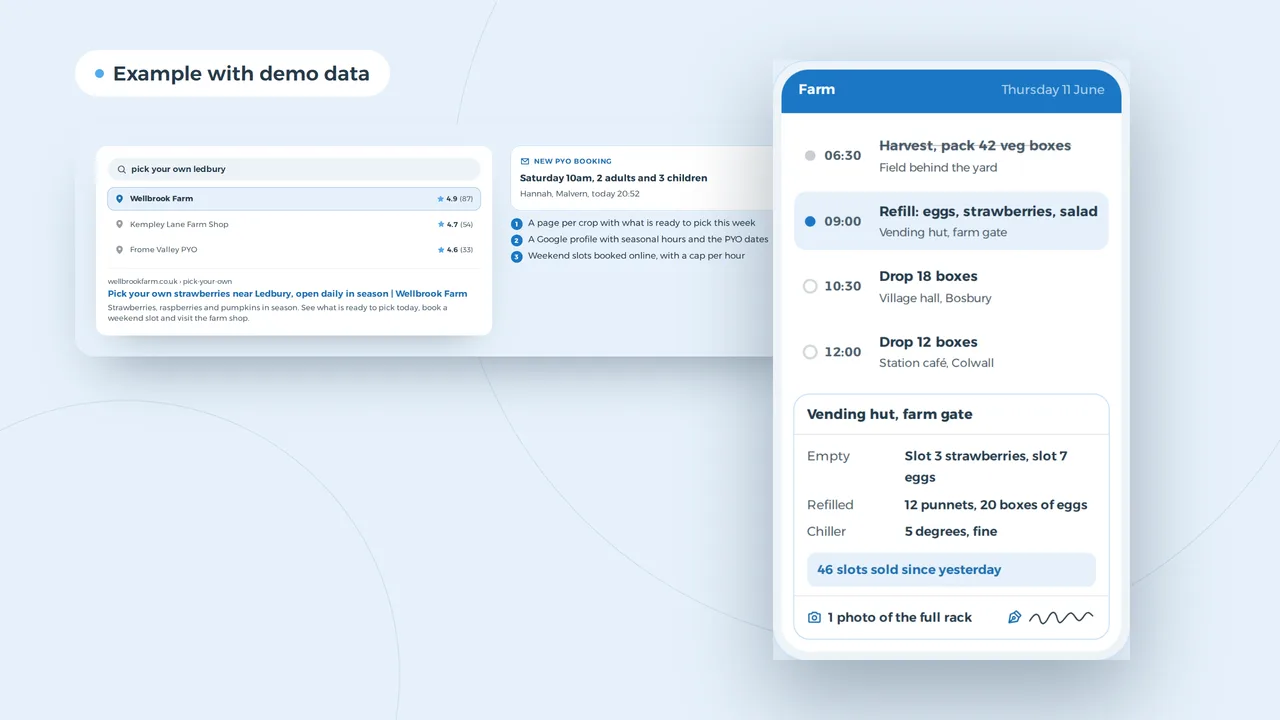
Found near Ledbury, booked for Saturday the same evening
New PYO booking
Saturday 10am, 2 adults and 3 children
Hannah, Malvern, today 20:52
- A page per crop with what is ready to pick this week
- A Google profile with seasonal hours and the PYO dates
- Weekend slots booked online, with a cap per hour
Example with made-up farms and reviews.
Farm website design around what is in this week
A farm site that answers that one question beats a beautiful site that does not. Put a short list of this week's produce at the top of the home page. If your shop has a till, the list can come straight from it; otherwise you update it on your phone in a minute.
Under that come the pages people search for. Not ten pages about your history, but one page for each thing you sell.
| Page | What goes on it | Why |
|---|---|---|
| This week | What is in, with prices | Every visitor's first question |
| Veg boxes | Contents, price, collection points, cut-off | Where subscriptions come in |
| Farm shop and vending hut | Hours, address, what the hut holds | For people who want to call in |
| Pick your own | Season, slots, what to bring | Slots spread the busy days |
| About the farm | Who you are, how you grow | Why someone buys from you |
A page for each village where you run a collection point helps too, as long as it holds something real: the address, the day, what is in the box that week. A page that only swaps the place name helps nobody.
Before a farm site goes live
- This week's list sits at the top of the home page
- Shop, vending hut and pick your own hours are separate, with the closed weeks
- Each collection point has an address, a day and a time
- Orders close at a cut-off you chose
- Photos are your own fields, shop and animals
- The site loads fast on a weak signal at the edge of a field
- Your food business registration is done before the order page opens
A farm shop website template or a site built for your farm
Plenty of farms start with a farm shop website template: a theme from a site builder or a hosted ordering platform. That can be the right call. A template is cheap, quick and good enough when you sell a few things from a table at the gate.
It starts to pinch when your farm does not fit its shape. Templates assume a shop that ships parcels, not a box that is collected on Thursday from a village hall. They rarely know about cut-offs, pauses, collection points or picking slots, and the monthly fee grows with every add-on that patches the gap. What a hosted shop really costs over a few years is worked out in ecommerce website cost; whether a shop pays at all, in is an online store worth it.
A template or a site built around your farm
- Start
- TemplateQuick, a weekend
- Built for your farmA few weeks, built over the winter
- Veg boxes
- TemplateShipping logic, add-ons for subscriptions
- Built for your farmCut-off, pauses and collection points from the start
- Pick your own
- TemplateA separate booking tool
- Built for your farmSlots on the same site
- Cost over time
- TemplateMonthly fee plus add-ons
- Built for your farmA fixed price, then hosting
- Your data
- TemplateOn the platform
- Built for your farmYours, including the code
A template fits a farm that sells a few things. Once boxes, collection points and picking slots meet, a site built around them saves more than it costs.
What the site shows comes from the shop, the vending hut and the cold store
Eggs in the vending hut nearly gone
4 boxes left; 15 sold between 5pm and 9pm yesterday. Proposal: refill 12 boxes before 4pm.
An example of what we can build, with made-up numbers. You choose per product when the system warns you.
Orders with a cut-off, and picking slots that spread the day
The difference between a site that shows and a site that sells is an order page. For a farm it works best with a fixed cut-off: orders close on Tuesday night, you pick on Wednesday what was ordered, boxes are at the collection point on Thursday. You know the evening before what to harvest, and less goes to waste. A subscriber pauses a week or adds eggs without sending you a message.
Pick your own works the same way. Families choose a time online, you set how many people a slot holds, and you close a day when the crop needs to recover. That is a small booking system, the kind a holiday let uses.
Four voice notes in the field become this week's list and the newsletter
An example of what we can build, with a made-up harvest. The AI drafts from your own notes, you decide what goes out.
Something new every week, without the late nights
A farm site lives on what changes: the first asparagus, the last strawberries, the pumpkins coming in. Saying so every week, on the site and in a newsletter, keeps customers coming back. But in season the evenings are short. So we build it to take minutes: record a few notes in the field and AI drafts this week's list, a line for the home page and the newsletter. You check it and put it live. It works only from what you record, so it does not invent a crop. More in AI for business and how to write a newsletter.
Photos matter more on a farm site than almost anywhere. People buy from a farm because they know where the food comes from, so show your own fields, shop and animals, never stock photos. Give each one a short description, the alt text. Most visitors arrive on a phone, often at the vending hut itself, so check the site with the speed test. A QR code on the hut that opens this week's page turns an empty slot into a box order.
What the law asks of UK farm websites
A farm that sells food online follows the same rules as any online shop, plus food business registration. These are the points we build into the site.
| On the site | What the rule asks | How it shows |
|---|---|---|
| Food business | Register with the council 28 days before trading, online selling included | Done before the order page opens |
| Online orders | Cancel within 14 days of delivery; deliver within 30 days unless agreed | Cancellation info in every confirmation |
| Not telling customers | The cancellation period stretches by up to 12 months | Clear terms at checkout |
| Plants by post | Plant passport, registered professional operator | Only plants that may ship are orderable |
| Subscriber data | UK GDPR | Privacy notice and a short form |
Each site you sell food from is registered separately; in Scotland, through Food Standards Scotland. Read how to register a food business first. The cancel button is covered in the withdrawal button in Shopify and WooCommerce, cookies in UK cookie law and data in UK GDPR versus EU GDPR.
Being found in your own area
People search for a farm shop in their village, strawberries to pick, a veg box nearby. Google shows the map first. A complete Google Business Profile with the shop and vending hut hours, the right categories and photos of what is ripe does more there than the site itself. Reviews that keep coming in do the rest, and our local SEO tips go further.
What a farm site costs
A site that shows what is in, with the pages above, your Google profile and a contact form, starts at a website from 1,500 euros. See website design. An order page with subscriptions, collection points and a cut-off is custom work, with a fixed price per project after a conversation. If you want a full online shop, we first talk about whether it fits your farm. UK prices in general are covered in website cost UK.
Live for the first boxes of the season
- A conversation about how you sellWhat you sell, where people collect, how many subscribers you have. We look at an ordinary week, not a list of features.
- A fixed priceA website starts from 1,500 euros. An order page or shop gets a fixed price after the conversation.
- Live before the seasonWe build over the winter, so the site is up for the first boxes and the first picking slots. You own the site and the data.
A farm is not on our client list yet; a site in two languages with a booking form and an availability calendar is what we built for Villa Lidia.
Website design
How VBS helps you with this
We build your site from design to copy, imagery and code, in one team, so that Google and your buyers find it and get in touch.
- Design and copy built on your buyers' questions
- Fast, multilingual when you need it, at a fixed price
- Forms, cookieless analytics and hosting on AWS
How we approach it is on our page about Website design.
Your farm online before the season starts
Tell us what you sell and where your customers collect. We will show you what the site would look like.
Rather get in touch right away?