Industries: groundworks
Groundworks software for gangs, plant, muck away and tenders
Day sheets with plant hours, a board that spots a double-booked 360, and a first bill of quantities from drawings.
Groundworks software starts at the gate at half seven
Groundworks software has to fit a day that starts at the site gate at half seven. One gang is laying a drainage run in Knaresborough, the 21 tonne 360 is digging footings for an extension in Harrogate, a muck away lorry is due in Ripon at ten, and the main contractor on the housing site wants the day sheets by Friday. In the office, two phones are ringing and a tender is due on Monday.
Most firms run this on a whiteboard, a WhatsApp group and paper day sheets. That works until a machine is booked twice or a developer asks for photos of a pipe already under half a metre of type 1. Below is what we would build for a groundworks firm: the day on a phone, the week on a board, enquiries from Google, operators who apply, and estimates that start from the drawings.
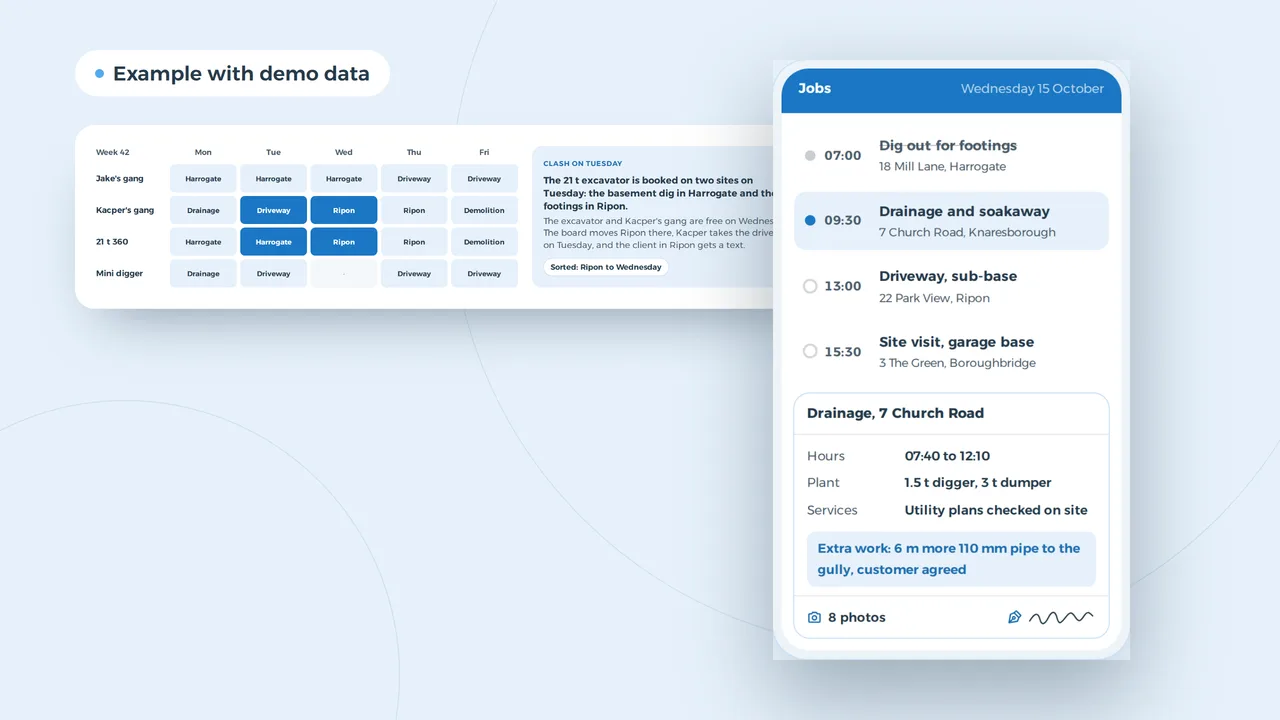
The day sheet in the cab, with the service drawings attached
- Service plans travel with the jobThe operator opens the utility drawings on the phone before breaking ground, with the date they were requested.
- The office sees hours and plantMachine hours for the digger and the dumper are ready for the invoice and the job costing. Nobody types up paper sheets.
- Photos before backfillThe pipe in the trench is on record before it disappears. If a question comes up later, you can show what is down there.
An example with made-up sites and addresses; you choose what a groundworks job sheet asks for, from utility plans to plant hours.
Hours, plant and muck away on one job sheet
A paper day sheet records who turned up. A digital one records what the office needs to invoice and cost the job. The gang leader fills it in on the phone in the cab, and the office sees it the same evening. That is the base of a work order app and of time tracking built for a gang, not for a desk.
| Line on the sheet | Who fills it in | What the office does with it |
|---|---|---|
| Hours per person | Gang leader, at the end of the day | Payroll, and the CIS deduction for subcontracted labour |
| Machine hours per item of plant | Operator | Job costing, and hire invoices checked against real use |
| Loads off site | Gang leader, with a photo of the ticket | Muck away cost per job, and the waste paperwork per load |
| Materials delivered | Whoever signs the docket | Checked against the supplier's invoice |
| Photos before backfill | Pipe layer | Proof for the client, the inspector or a later dispute |
| Variations | Gang leader, with the client's signature | Extra work invoiced, not forgotten |
A variation signed on site, with a photo and a time stamp, gets paid. One agreed by phone is easy to dispute. If you price variations by hand today, an AI quote generator can draft them from the gang leader's photo and three lines of text, for you to check and send.
Two gangs, a 21 tonne 360 and a clash on Tuesday
Clash on Tuesday
The 21 t excavator is booked on two sites on Tuesday: the basement dig in Harrogate and the footings in Ripon.
The excavator and Kacper's gang are free on Wednesday. The board moves Ripon there, Kacper takes the driveway on Tuesday, and the client in Ripon gets a text.
Sorted: Ripon to Wednesday
An example of what we can build, with made-up names and sites. You choose which rules the board checks.
Plant, gangs, wet ground and off-hire dates
- Plant is the bottleneckA 360, a dumper and a roller rarely sit on one site all week. The board gives every machine its own row, so a double booking shows before the low loader leaves the yard.
- Planned per gangGroundworks is planned per gang. Who leads, who drives and who holds which card sits on the gang, and a sick day moves the gang, not just a name.
- Rain moves the digWet ground stops excavation and spoils a sub-base. When a day is lost, the board shows what moves with it: the machine, the muck away and the concrete order.
- Off-hire on timeHired plant that stands idle still costs money. The off-hire date sits next to the job, so the office calls the hire firm when the work is done, not a week later.
Main contractors search before they ring
Groundworks enquiries come from two directions. Homeowners search for a driveway, a drainage repair or footings in their own town. Developers and main contractors search for a groundworker they have not used before, then check the website and the jobs you show before they send a tender pack.
For the first group, the map in Google decides. A complete Google Business Profile, photos of finished drives and steady Google reviews get you into the results under the map. Local SEO does the rest for the towns you actually work in.
For the second group, the website has to answer what a buyer asks before a call: which work, which plant, which cards and accreditations, and which jobs of a similar size. What such a site needs is on groundworks website design, and the wider picture for building firms is on marketing for construction companies.
A driveway in Harrogate that turns into an enquiry
New request
Block paved driveway, 60 m2, old concrete out, sketch attached
Paul, Harrogate, today 20:47
- A page per job type: driveways, drainage, footings, demolition
- A Google profile with photos of your sites
- A form that asks for size, access and a sketch
An example with made-up groundworks firms and reviews.
A plant operator who applies from the cab
An example with made-up names; you choose what the form asks an operator, from machine type to CPCS or NPORS card.
Plant operators read the advert for the machines
A good 360 operator has a choice of firms. Before applying, they want to know what they will drive, how far the sites are and whether the gang is fixed. An advert on your own site that answers that, with an application in three taps, reaches operators who are not scrolling job boards. The thinking behind it is employer branding: showing what working for you is like, in your own words.
The office then sees every applicant in one list, books a chat or a trial day, and keeps the cards on file. That matters more since 1 October 2026: right to work checks now also reach individual subcontractors, not only employees, and the civil penalty is up to £60,000 per illegal worker. Once someone is hired, the same record feeds the board and staff scheduling, so their name, cards and gang are never typed twice.
An architect's drawing as a first bill of quantities
An example: the AI works from your own rates per m3 and per machine, you decide.
Drawings in, quantities out, prices yours
Pricing a tender from drawings eats evenings. Dig volumes, muck away loads, sub-base, drainage runs, manholes: most of it is the same counting on every job. AI can do that first pass. It reads the drawings and the specification, sets out the items with quantities, and marks what it could not read, such as a level that is missing or a drain run that leaves the sheet.
The estimator then does what an estimator is for: checking the quantities, adding what the drawings do not show, such as soft spots, dewatering or a tight access, and setting the prices from the firm's own rates. Nothing goes to a client without that check. More on what AI can and cannot do on a building site is on AI for construction.
For small domestic work, a quote template is often enough. For tenders, the draft saves hours, and the margin calculator helps you see what a price leaves after plant, labour and tipping.
One digger or six gangs
A sole trader with a mini digger does not need a planning system. A firm with six gangs, a plant yard and three developers as clients needs more than a diary. This is what we would build at each size.
| Size | What you need | What we would build |
|---|---|---|
| Sole trader with a mini digger | Quotes, day sheets, invoices, quarterly updates for MTD | A phone app for day sheets and quotes, with invoices from the same record |
| Two or three gangs, own plant | A board for gangs and machines, CIS for subbies, cost per job | Board, day sheets and CIS statements, linked to your accounts package |
| Six gangs or more, tendering for developers | Tenders, a plant register, RAMS per site, documents for main contractors | Tender register, plant and service dates, a document store per site and a portal for clients |
For a larger fleet, fleet management software keeps services, inspections and fuel per machine. A client portal lets a main contractor download RAMS, photos and day sheets without ringing your office. Whether you build any of this or buy a package is a real choice; we set out both sides on build versus buy.
CIS, Party Wall and CDM: the rules under the ground
The rules that most often end up in a groundworker's paperwork, as they stand on 31 October 2026, for England.
| Rule | What it asks | What the software does |
|---|---|---|
| CIS | 20 percent off registered subcontractors, 30 percent off unregistered ones; return by the 19th, payment by the 22nd, £100 penalty from one day late; nil returns back since 6 April 2026 | Prepares the return and statements from the day sheets, a nil return included |
| Gross payment status | Turnover test of £30,000 for a sole trader; since 6 April 2026 HMRC can cancel it at once where a firm knew or should have known of fraud | Keeps each subcontractor's verification on file |
| Making Tax Digital | Income over £50,000 from 6 April 2026, over £30,000 from April 2027, over £20,000 from April 2028; quarterly updates by 7 August, November, February and May | Keeps income and costs per job ready for your MTD software |
| Party Wall etc. Act, section 6 | A month's notice before digging within 3 metres of a neighbour's building and below its foundations, or within 6 metres and through a 45 degree line | Flags jobs near a boundary and stores the notice |
| CDM 2015 | A construction phase plan on every job, domestic ones too; an F10 above 30 working days with more than 20 workers at once, or 500 person days | Starts the plan from your template, with inductions per worker |
| Building Safety Act, Part 2A | Since 1 October 2023 for all building work: competence per contractor, a principal designer and principal contractor where more than one contractor works | Keeps appointments and cards per site |
| Waste carrier registration | Upper tier £191.02, renewal every 3 years at £130.25; numbers start with CB | Stores the number, the renewal date and the paperwork per load |
| Asbestos, regulation 5 | Assume asbestos in buildings from before 2000 unless a survey shows otherwise | Asks for the survey before a break-out job is planned |
| Right to work | Up to £60,000 per illegal worker; since 1 October 2026 also for individual subcontractors | Stores the share code check per person |
Two tenders a week, counted in hours
| Task | Now, per week | With the system | Saved per week |
|---|---|---|---|
| Take-off from drawings, two tenders | 12 hours | 7 hours, checking a first draft | 5 hours |
| Day sheets typed up and chased, 15 gang days | 3.5 hours | 0.5 hours | 3 hours |
| Hire and muck away invoices matched to jobs | 2.5 hours | 0.5 hours | 2 hours |
| CIS return and subcontractor statements | 1 hour | 0.5 hours | 0.5 hours |
| Total | 19 hours | 8.5 hours | 10.5 hours |
Over 46 weeks that is 483 hours, worth £21,735 at the assumed £45 an hour. It leaves out the variation that now gets invoiced and the idle hire days you no longer pay. What a system like this costs to build depends on how many of these parts you need; our guide to custom software development cost explains what drives the price.
Groundworkers start with an ordinary week
- A conversation about your weekHow do enquiries arrive, who prices, where are the day sheets on Friday, which machines are yours and which are hired? We look at an ordinary week, a wet one too.
- One part first, at a fixed priceUsually the day sheets or the board, because everything else feeds from them. You get a fixed price per project before we build.
- One gang uses it firstOne gang works with it for a few weeks. What the operators skip or find slow, we change before the next gang starts.
- Then tenders, CIS and the websiteOnce the day sheets run, the next parts plug into the same data: quantities from drawings, CIS statements and enquiries from your own site.
Groundworks touch almost every other trade on site. The roofers arrive once the frame is up, landscapers finish the garden on ground you levelled, and in renovation a main contractor plans all trades together. What we build for building firms in general is on software for construction companies; how we build is on custom software, and a first conversation starts on contact. For a construction company in Ghent we built a site where clients cost their own project step by step: SN Group.
Groundworkers ask us
Can groundworks software price a job from drawings?
It can draft the quantities: dig volumes, muck away loads, sub-base, drainage runs and manholes. You check them and set the prices from your own rates. Nothing goes to a client unchecked.
Does it handle CIS for my subcontractors?
It can prepare the monthly return and the statements from the payments on the day sheets, with the right deduction per subcontractor. Filing stays with you or your accountant.
We hire most of our plant. Does that fit?
Yes. A hired machine gets a row on the board like your own, with on-hire and off-hire dates, so hire invoices can be checked against the days it actually worked.
Will operators use it on site?
Only if it is quicker than paper. That is why we design the day sheet for a phone in a cab: large buttons, few fields, and saving without signal until the phone is back in range.
Can it link to our accounts package?
Where the package allows it, yes, so invoices and costs are not typed twice. Which link works for your package, we check in the first conversation.
What does groundworks software cost?
We start with a conversation about your week and then give a fixed price per project. A sole trader with a mini digger and a firm with six gangs need very different systems, so there is no list price.
Custom software
How VBS helps you with this
We build the platform your business runs on every day: your spreadsheets, emails and paperwork in one system that does what you do.
- Your workflow mapped first, then a fixed price
- Screens for the office, the client and the road
- Hosting, backups and security managed by us on AWS
How we approach it is on our page about Custom software.
Your gangs, plant and muck away in one place?
Tell us how a week runs in your firm, a wet one included. We show where we would start and what it would save you.
Rather get in touch right away?