Industries: landscapers
Software for landscapers, built round one firm and its seasons
£50,000
Maintenance rounds that plan themselves, a job sheet with hours, plants and waste, and a quote ready the evening after the site visit.
Patios in March, hedges in July, quotes all winter
Software for landscapers has to cope with two businesses under one roof. Hard landscaping is project work: a site visit, a quote, a planting list, a dig, a handover. Maintenance is a subscription: the same gardens every year, each on its own rhythm. Both pull on the same people, the same tipper and the same mini digger, and the weather has a vote.
Most firms run that on a diary, a spreadsheet of maintenance customers and a phone full of photos. Quotes get typed at night, the planting list is copied out of the designer's drawing, and only the owner knows which hedges are still due in September. That is what we build custom software for: round the way your firm builds, maintains and quotes, not round a package built for every landscaping firm at once.
The landscaping year and where it pinches
Every season puts pressure on a different part of the business. This is how it tends to run for a UK firm that does both builds and maintenance.
| Months | Builds | Maintenance | Where it pinches |
|---|---|---|---|
| November to February | Bare-root hedging and trees, groundwork when it is not frozen | Pruning, leaf clearance, winter tidy-ups | Spring quotes pile up while the crews are out in the cold |
| March to May | Patios, driveways, turf and new gardens | First cuts, weeding hard surfaces | Everyone wants their garden done before summer, the board fills up |
| June to August | Planting, finishing, watering in a dry spell | Hedge cutting, mowing every week or two | Rounds and builds fight over the same people and the tipper |
| September and October | Seeding lawns, builds before winter | Second hedge cut, leaves | Rounds get longer while spring enquiries already arrive |
Those four rows hold four places where software wins time back: quotes done sooner, rounds generated from the contract, a board that spots the double-booked tipper, and a job sheet that becomes the invoice. If you plan in a spreadsheet today, Excel scheduling or planning software shows where that stops working.
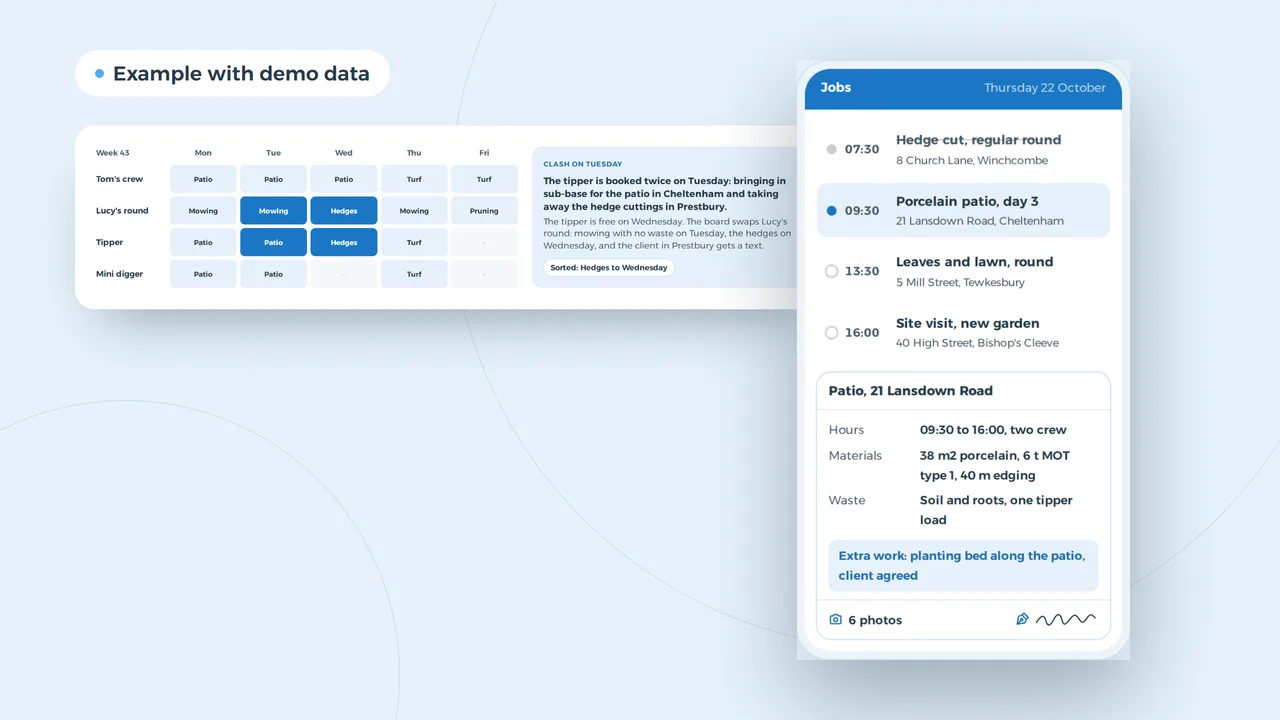
Tom's crew, Lucy's round and a tipper booked twice
Clash on Tuesday
The tipper is booked twice on Tuesday: bringing in sub-base for the patio in Cheltenham and taking away the hedge cuttings in Prestbury.
The tipper is free on Wednesday. The board swaps Lucy's round: mowing with no waste on Tuesday, the hedges on Wednesday, and the client in Prestbury gets a text.
Sorted: Hedges to Wednesday
An example of what we can build, with made-up names and gardens. You choose which rules the board checks.
The job sheet of a porcelain patio in Cheltenham
- Every client has a roundHedges in June and September, lawns every fortnight: the round comes from the contract, not from memory.
- Hours and loads are readyThe office sees hours, materials and waste as soon as the crew signs off, and turns them into the invoice.
- Extra work is signedAn extra bed or a tree that has to come out: the client signs on the phone before you start.
An example with made-up gardens and addresses; you choose what a landscaping job sheet asks for.
Maintenance contracts that fill the round by themselves
Most landscapers have dozens of regular customers, each with their own arrangement: hedges twice a year, lawn every fortnight from April to October, leaves in November. In your own system each arrangement is a contract per garden, and the round follows from it. The board lays out the week's visits per crew, grouped by area, so nobody drives to Winchcombe three times.
If it rains on Tuesday, the board pushes the cuts on and shows which customers get a message. If a build needs the tipper on the same day as a round, you see the clash before the crews leave, not at eight in the morning on a driveway. You decide; the board suggests.
The job sheet is where the money is. Hours, yes, but also tonnes of sub-base, cubic metres of topsoil, plants per variety and what left site: green waste, soil, roots, old paving. Those lines decide your margin and they are the first to vanish when someone retypes notes at night. More on the sheet itself in the work order app; planning people round holidays and seasonal staff is staff scheduling software; and your customer file with contracts, prices per visit and the history of each garden is a custom CRM in all but name.
Jobber, Aspire, LMN or a system shaped round you
Packages such as Jobber, Aspire, LMN and Yardbook were built in North America for thousands of landscaping firms at once. That is their strength and their limit.
- Who it fits
- A landscaping packageThe average firm the package was designed for
- Software built round your firmYour mix of builds and maintenance, your areas, your crews
- Your way of quoting
- A landscaping packageYou adapt to its line items and templates
- Software built round your firmYour own build-ups: sub-base depth, plants per metre, waste per load
- UK rules
- A landscaping packageDepends on the package and the add-ons you connect
- Software built round your firmCIS, MTD, waste carrier and certificates where you need them
- What you pay for
- A landscaping packageA subscription, usually with features you never open
- Software built round your firmA fixed price per project for what you actually use
- When it is the right choice
- A landscaping packageYou are happy to work the way the package works
- Software built round your firmThe package keeps forcing workarounds into a spreadsheet
Try a package first if it fits. When the workarounds start living in Excel again, a system built round your firm pays back.
Ellie's enquiry from Prestbury, with the plan attached
New enquiry
New garden for a new build, 320 m2, architect's plan attached
Ellie, Prestbury, today 20:47
- A page per job: patios, planting, maintenance
- A Google profile with photos of your own gardens
- A form that asks for a plan, photos and the size
An example with made-up landscapers and reviews.
Found when new-build owners search in January
A new garden nearly always starts with a local search, often in winter, when a family sees their house finished and knows the garden has to be done by spring. Whoever ranks then gets the season's enquiries. Build your site round that:
- One page per type of workGarden design and build, maintenance, patios and driveways, hedges and trees. With your own gardens as photos and the towns you cover. Everything about such a site is on landscaping website design; a website starts at EUR 1,500 with us.
- A form that describes the gardenSize, new build or existing, a drawing if there is one, and photos. You know before the visit whether it is a front garden or half an acre.
- A Google profile full of gardensBefore and after photos, recent reviews, the right category. See create a Google Business Profile and get more Google reviews.
To rank in the towns round your yard, look at local SEO.
Three photos of a front garden, turned into line items
An example: the AI works from your own price list and plant list, you decide.
Planting lists and quantities from a drawing
A garden quote is a lot of arithmetic: square metres of paving with the right sub-base, linear metres of hedge with plants per metre, topsoil by the cubic metre, perennials per square metre, and the skips or tipper loads to take it all away. AI can draft those lines from photos, a sketch or a designer's drawing, with your prices and your plant list. After the site visit you adjust the quantities and send.
How that works in detail, with unit rates, waste allowances and a planting list that goes straight to the nursery, is on quoting software for landscapers. How AI prepares quotes in other trades is on AI quote generator and AI for construction.
Hiring a landscaper before the spring rush
An example with made-up names; you choose what the form asks a landscaper, from build or maintenance to a trailer licence.
Crews, seasonal staff and the right to work
Good landscapers are scarce, and in March everyone is hiring at once. An advert on your own site says what they want to know: builds or maintenance or both, which machines, a firm's van, who pays for the pesticide certificate and the tickets. Applying takes three taps on a phone, and the office sees each candidate and where they stand. What you show as an employer is called employer branding.
Everyone who starts brings papers that expire or that you must be able to show: a right to work check, a pesticide certificate if they spray, a licence for the trailer. A staff file per person keeps track and warns you in time. Since 1 October 2026 the right to work scheme also reaches businesses that use individual subcontractors, which can include extra hands taken on for the season.
Sole trader, crew of five or fifty on the books
A sole trader does not need an ERP. A firm with three build crews, two maintenance rounds and its own yard needs more than a diary. This is what we would build at each size.
| Size | What you need | What you do not need (yet) |
|---|---|---|
| Sole trader | A site with an enquiry form and photos of your gardens, a Google profile, a job sheet on the phone that becomes an invoice and feeds MTD records | A planning board, roles and permissions |
| Crew of five | Maintenance contracts with rounds, quotes from a drawing or photos, job sheets with materials and waste | A stock module of its own |
| Firm of 20 to 50 | A board with crews, rounds, tipper and digger, job costing per garden, a staff file with certificates and right to work | An ERP the crews will not use |
| Larger firm | Links to accounts and nurseries, reports per crew and type of work, access for managing agents and councils | A second system next to the one you have |
If you hold plants, stone and materials in a yard, also look at inventory management software.
Waste carrier, CIS and pesticide certificates
These are the UK rules that most often belong in a landscaper's files, as they stand on 31 October 2026. The waste rules below apply in England.
| Rule | What it asks | What the software does |
|---|---|---|
| Waste carrier registration | Register before you carry waste. Lower tier only covers your own waste that is not construction or demolition waste; carrying construction or demolition waste, even your own, needs upper tier. Upper tier costs £191.02 to register and £130.25 to renew every three years. Report changes within 28 days. Not registering can mean an unlimited fine | Your CB number sits on every waste transfer note, with a reminder before renewal |
| Pesticide certificates | Under the Sustainable Use Regulations 2012, grandfather rights ended on 25 November 2015. Contractors who apply professional products need a certificate such as the Level 2 Safe Use of Pesticides award. Sprayers need a test within five years of purchase, then every three or six years | The staff file shows who holds which certificate; a spraying job only goes to someone qualified; the sprayer has a test date |
| CIS | Contractors deduct 20% from registered subcontractors and 30% from unregistered ones. Gross payment status for a sole trader needs £30,000 net construction turnover. Monthly returns by the 19th, payment by the 22nd, a £100 penalty for a late return, and nil returns are back from 6 April 2026 | Check with the contractor whether your work falls under CIS; if it does, deductions show per payment and statements are filed per job |
| Making Tax Digital | Sole traders with qualifying income over £50,000 keep digital records and send quarterly updates from 6 April 2026; over £30,000 from 2027 and over £20,000 from 2028. Updates are due 7 August 2026, 7 November 2026, 7 February 2027 and 7 May 2027. Late updates earn no penalty points in 2026 to 2027 | Job sheets and invoices are the digital records; the quarterly figures come out of them |
| Right to work | Up to £60,000 per illegal worker. Checks with a share code. Since 1 October 2026 the duty extends to individual subcontractors | A check per person, with the date and the outcome stored |
| Work at height | There is no minimum height. A ladder against a tall hedge counts | The job sheet for a hedge or tree job carries the method you chose |
More on invoicing in the UK in e-invoicing in the UK.
Forty maintenance customers and a build crew, in hours
| Task per week | Diary, spreadsheet and typing at night | Your own system |
|---|---|---|
| Quotes from a drawing or photos, an hour each | 6 hours | 2.5 hours |
| Planning rounds and re-planning after rain | 3 hours | 1 hour |
| Retyping job sheets, hours and waste, 6 minutes each | 3 hours | 0.5 hours |
| Ordering plants and checking deliveries | 1.5 hours | 0.5 hours |
| Total | 13.5 hours | 4.5 hours |
That is 9 hours a week, or 360 hours a year: £16,200 of the owner's time in this example. An example, not a promise. What it comes to for you depends on how many quotes you write, how many you win and how long your round is. The margin calculator shows what an hour more or less per garden does to your profit.
The first season on your own system
- NovemberA conversation about your yearHow enquiries arrive, how you quote, how rounds are planned, where the photos live. We look at a week in May and a week in November.
- DecemberA fixed price per projectWe pick the part where you lose most time and put a fixed price on it. A website with an enquiry form starts at EUR 1,500; software is priced after the conversation.
- FebruaryOne crew works with it firstOne crew and whoever plans use the first version on real gardens. What does not work on site, we change before March.
- MarchEveryone on it before the rushThe other crews and the round move over, and the spreadsheet goes into the archive.
Next to the groundworker and the tiler
A new garden is rarely one trade's job. The groundworks crew may have been in before you with the drainage, tilers sometimes lay the terrace by the house, and in renovation a main contractor plans every trade together. What we build for building firms in general is on software for construction companies, and you can get in touch for a first conversation. For a construction company in Ghent we built a site where clients cost their own project step by step: SN Group.
Questions landscapers put to us
- Can I bring my maintenance customers over from a spreadsheet?
- Yes. We import your list with addresses, arrangements and prices per visit and turn it into a contract per garden. Whatever is missing you fill in once.
- Can it draft a quote from a garden designer's drawing?
- A first version, yes. AI drafts the lines and quantities from the drawing or from photos, with your prices and plant list. After your site visit you decide what goes out.
- How does the board deal with rain?
- It shows which rounds and builds that day touches, suggests what moves and which customers get a message. You decide.
- Does it handle builds and maintenance at the same time?
- Yes. A build is a project with a quote, a planting list and a handover; maintenance is a contract with a rhythm. Both sit on the same board with the same people and machines.
- Do I have to replace my accounting software?
- No. We connect to what you use. The job sheet becomes the invoice, your accountant gets it as today, and the records count towards Making Tax Digital.
- Why not just use Jobber or Aspire?
- If a package fits the way you work, use it. We build for firms where it does not: a mix of builds and rounds the package cannot model, UK rules it leaves to add-ons, or quotes that still end up in Excel.
Custom software
How VBS helps you with this
We build the platform your business runs on every day: your spreadsheets, emails and paperwork in one system that does what you do.
- Your workflow mapped first, then a fixed price
- Screens for the office, the client and the road
- Hosting, backups and security managed by us on AWS
How we approach it is on our page about Custom software.
Show us a week in May and one in November
Tell us how both weeks run. We will show where we would start and what it would save you.
Rather get in touch right away?