Industries: metal fabrication
Metal fabrication software that prices from your own cut times
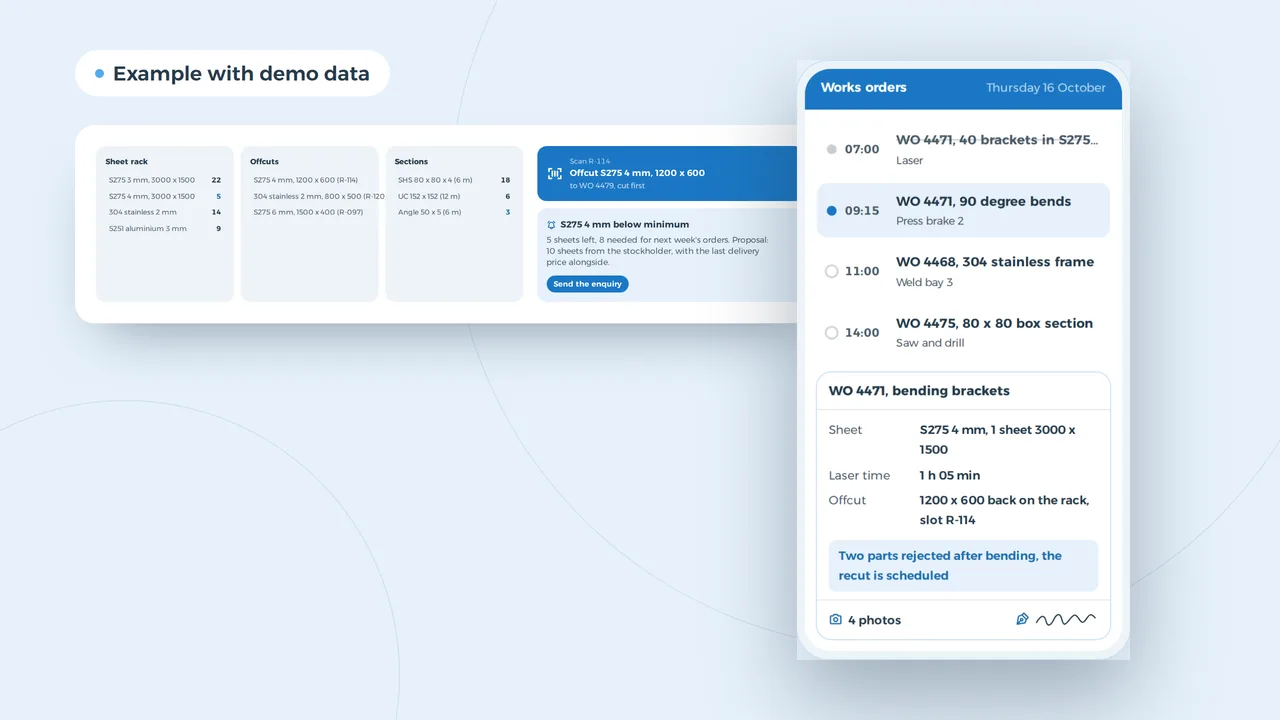
Works orders per machine on the phone, sheet and offcuts with a slot in the rack, and an estimate that starts from the customer's drawing. Built around your laser, press brake and weld bays.
Fabrication shops price in minutes and millimetres
Metal fabrication software does not start in the accounts. It starts at seven in the morning at the laser, with the first sheet of 4 mm S275 on the bed for forty brackets. The workshop manager knows they go to press brake 2 next, that weld bay 3 is waiting on a stainless frame, and that somewhere in the rack an offcut is just big enough for tomorrow's job. Exactly where, only they know.
In many shops the schedule lives on a whiteboard, the estimate in the owner's spreadsheet and the job costing nowhere. A DXF enquiry gets priced in the evening on experience. Whether the price held only shows at the year end, when the margin is thin and nobody can say which jobs ate it.
Software built for your shop puts the works order, the sheet, the hours and the estimate in one place. What happens at the machine flows back to estimating, so the next quote rests on real cut and bend times. Your accounts stay where they are.
Workshop managers see every machine on one phone
- Job costing runs alongsideCut time, bend time and sheet use sit on each order, so you see whether the price held.
- Offcuts get a slotAn offcut with its size and rack slot is offered first, before anyone cuts into a new sheet.
- Rejects become a taskWhat needs redoing goes onto the machine's schedule with the reason attached.
An example of what we can build, with made-up orders and customers. You choose the fields on a works order.
Laser, brake and weld bay: where the hours slip
A fabrication shop rarely loses money at the machine. It loses it in estimates done on feel, offcuts nobody can find and hours that never land on a job.
| Moment | How it often goes | With a system of your own |
|---|---|---|
| A DXF enquiry arrives | The owner prices it in the evening | A first estimate from the drawing, using times from your own jobs |
| The job starts | A printed job card travels with the sheet | The works order sits per machine on a phone or tablet |
| Cutting a sheet | A fresh sheet, because the offcut cannot be found | The system offers a matching offcut with its rack slot first |
| A reject after bending | Passed on by word of mouth, recut later | Logged with a reason, the recut goes straight onto the schedule |
| The job is done | Nobody counts the real hours | Cut, bend and weld time sit next to the estimate |
| Invoicing | From the quote, whatever happened | From the finished order, extras included |
A work order app at the machine is often the first piece. Add time tracking and the hours on each job arrive without the welder filling in a form.
Offcuts with a size and a rack slot
S275 4 mm below minimum
5 sheets left, 8 needed for next week's orders. Proposal: 10 sheets from the stockholder, with the last delivery price alongside.
Example with made-up grades, sizes and rack slots. You set the minimum per material.
Job costing that closes when the order closes
A fabricator's best estimator is the previous job. If you know how long forty brackets really sat on the laser and how many bends an operator made per hour, the next price beats any table. That only works when those times arrive on their own.
The system takes cut time from the laser, time at the brake and weld hours per order, and sets them against the estimate. A custom dashboard shows per customer and per kind of work where the margin is made and where it leaks. The break-even calculator shows how low a price can go before a job costs you money.
Offcuts get a size and a slot. Whoever starts a job sees the offcuts that fit before reaching for a new sheet. Inventory management software explains how that count works for sections and box section too.
Machine builders search with a drawing in hand
Anyone outsourcing laser cutting or folding searches by process and distance: "laser cutting walsall", "stainless folding", "bespoke welding". They want to see which materials and thicknesses you handle, and they want to send the drawing straight away.
A site with a page per process, photos from the shop floor and a form that asks for a DXF or STEP file, the material and the quantity brings enquiries you can price at once. A Google profile in the right categories helps with nearby searches; local SEO tips covers the basics. Selling into Europe as well? Read website for an export business. We handle the website design with that form built in.
DXF enquiries through your own site
New enquiry
DXF of a guard in 2 mm stainless, 60 off, folded and welded
Machine builder, Dudley, today 16:40
- A page per process: cutting, folding, welding, finishing
- A Google profile with photos from the shop floor
- A form that asks for a drawing, material and quantity
Example with made-up shops and reviews.
Coded welders choose who they work for
A TIG welder who lays a neat bead on stainless always finds work. They pick the employer with its own orders, a steady crew and tests renewed on time. A job on your own site, with photos of the shop and three questions, beats an advert lost among hundreds: which processes they weld in, whether they hold a current certificate, and when they can come in for a test piece.
Everyone who applies sits in a list with their status. Showing yourself as an employer is called employer branding; once people start, staff scheduling software plans them per machine. Pay rates follow the National Living Wage of £12.71 from 1 April 2026, so rosters should match the real workload.
Welder applications with the certificate attached
Example with made-up applicants. You pick the questions on the form.
Estimating starts from the customer's drawing
A DXF enquiry asks for the same work every time: measure the profile and holes, estimate sheet use, count bends, look at the welds and look up times. AI can do that first pass, provided the times come from your own job costing rather than a generic table.
The assistant reads the drawing and the email, drafts an estimate with sheet, cut time, bend time and weld time, and shows which past job looked most alike. The estimator sets the margin, changes what needs changing and sends the quote. A person sets the price, every time. More on the approach in AI quote generator. Want customers to build standard parts themselves? A product configurator is the next step.
Drawing in, first estimate out
Made-up jobs to show the idea. Times come from your own job costing, a person sets the price.
Fabricator size sets the first build
A blacksmith with one brake and a welder needs no ERP. A shop with three lasers and twenty staff does need something that spreads orders across machines. What to build depends on where you stand today.
| Size | What you need | What can wait |
|---|---|---|
| Sole trader with a brake or a welder | A site listing your processes with an upload form, invoices from your current package | Scheduling per machine, an ERP |
| Crew of 5 | Works orders on phone or tablet, offcuts with a slot, welder qualifications with a date | Full materials planning |
| Business of 20 to 50 | Scheduling per machine, estimates from drawings, job costing per order, a link to the accounts | A new ERP, while the current one still copes |
| Larger firm | A custom ERP or a standard package with integrations, a client portal for drawings and order status | Nothing: here the whole picture pays to review |
Unsure? Read build vs buy software and what an ERP costs. Still scheduling on a whiteboard or a sheet? Excel scheduling or planning software helps with the first step.
CBAM, welding fume and coded welders on the works order
A fabricator works under rules about material, about people and about the air in the shop. These come back most often.
| Situation | What the rule or standard asks | What the software does |
|---|---|---|
| You import steel structures (7308) or screws and bolts (7318) | UK CBAM applies from 1 January 2027 above £50,000 of such imports in 12 months | Adds up imports per commodity code over a rolling 12 months |
| You weld | HSE treats welding fume as a carcinogen and expects LEV and suitable RPE | Keeps the LEV inspection date and the RPE issued per welder where the manager sees it |
| Your welders work to ISO 9606-1 | A welder qualification needs confirming every six months | Tracks the date per welder and flags who is due |
| You make structural parts to BS EN 1090 | Factory production control with traceable material | Links mill certificate, weld procedure and welder to each order |
| You are VAT registered | Making Tax Digital for VAT, and Peppol e-invoicing between businesses from 1 April 2029 | Builds invoices from finished orders, ready for your accounts package |
BS EN 1090 and ISO 9606-1 are industry standards that customers and certification bodies ask for, not law. The software files no CBAM return and signs no certificate. It keeps the figures, dates and documents ready for you or your customs agent. How the coming e-invoicing works is set out in e-invoicing in the UK.
Cut times and bend times in a worked example
| Task per week | Spreadsheet and experience | A system of your own |
|---|---|---|
| Estimating, 45 minutes against 15 per enquiry | 18 hours | 6 hours |
| Job costing, 15 minutes against 3 per order | 7.5 hours | 1.5 hours |
| Total | 25.5 hours | 7.5 hours |
That is 18 hours a week, 828 hours over 46 weeks. At £40: 828 x 40 = £33,120 a year. Say on top of that a fresh sheet gets cut twice a week while an offcut would have done, at £75 a sheet: 2 x 75 x 46 = £6,900. Set the project price against that, and run it with your own times.
Fabricators start on the shop floor
- A conversation in the shopWe follow one job from enquiry to invoice: who prices, who schedules, what the welder writes down and where the time goes.
- A fixed price per projectWe pick the piece that gives back the most and fix a price for it. A website with an enquiry form starts at 1,500 euro; software is priced after the conversation.
- One machine firstThe first version runs at the laser or the brake on real jobs. What slows the workshop manager down comes out before the rest follows.
We have not built for a fabrication shop yet; the nearest match is the platform that has carried the daily planning at DA Logistics since July 2026.
Questions fabricators ask before switching
- Does this replace our nesting software?
- No. Nesting stays where it is. We read the cut times and sheet use it produces and put them on the order. How such a link works is covered in API integration services.
- Can it work with Xero or Sage?
- Yes. Invoices and job costs go to the accounts package you already use, so your bookkeeper keeps working the same way.
- Will it read STEP files as well as DXF?
- It can, if we build it that way. We decide at the start which formats come in most, because that shapes what the estimate can read.
- What does it cost?
- A fixed price per project, set after the conversation. Only a website has a starting price, from 1,500 euro. What drives the cost of software is explained in custom software development cost.
Custom software
How VBS helps you with this
We build the platform your business runs on every day: your spreadsheets, emails and paperwork in one system that does what you do.
- Your workflow mapped first, then a fixed price
- Screens for the office, the client and the road
- Hosting, backups and security managed by us on AWS
How we approach it is on our page about Custom software.
Orders, sheet and estimates in one place?
Tell us how a job moves through your shop. We will show you where we would start with custom software and what it could give back.
Rather get in touch right away?