Engineering marketing
Marketing for civil engineering firms that wins shortlists and graduates
Clients, architects and contractors check your projects long before they call. Project pages built from your own site records, local pages for domestic work, a recruitment page that graduates read to the end, and a way to see which of it brings enquiries.
Civil engineering work is won before the tender opens
Marketing for civil engineering firms looks nothing like marketing for a shop. Few clients search for a consultancy and buy on the spot. A developer asks an architect who they use, a contractor remembers who answered quickly on the last job, a council officer checks three websites before a shortlist goes out. By the time an enquiry arrives, the choice is half made.
This page covers the parts of that choice you can influence: project pages that prove what you have done, the searches that bring domestic structural work, how shortlists and frameworks find you, and hiring, which for many UK consultancies is now the harder sale. Every example is made up.
Who buys civil and structural engineering, and where they look
Each buyer finds a consultancy in a different way, and each one needs a different page.
| Buyer | How they find a consultancy | What your site must show them |
|---|---|---|
| Architect | Past jobs together, a colleague's tip, your site before a fee proposal | Projects by building type and stage, who leads them, how quickly you turn comments round |
| Developer or housebuilder | The architect's recommendation, a shortlist from the project manager | Similar schemes, sites with difficult ground, experience with higher-risk buildings where you have it |
| Main contractor | Design and build jobs, temporary works, earlier work on site | Temporary works and design and build experience, response times, the regions you cover |
| Council or public body | Contracts Finder, Find a Tender and frameworks | Policies, accreditations and case studies that answer the questions in a tender |
| Homeowner | Search: a structural engineer for a wall removal or a loft conversion near them | Local pages, what a visit involves, how calculations reach building control, how to book |
The first four rarely type your name into a search box and buy. They read your site to check what they heard. The homeowner does search, and that work is won with local SEO, the same way a builder wins it on marketing for construction companies.
The site visit record is where a project page starts
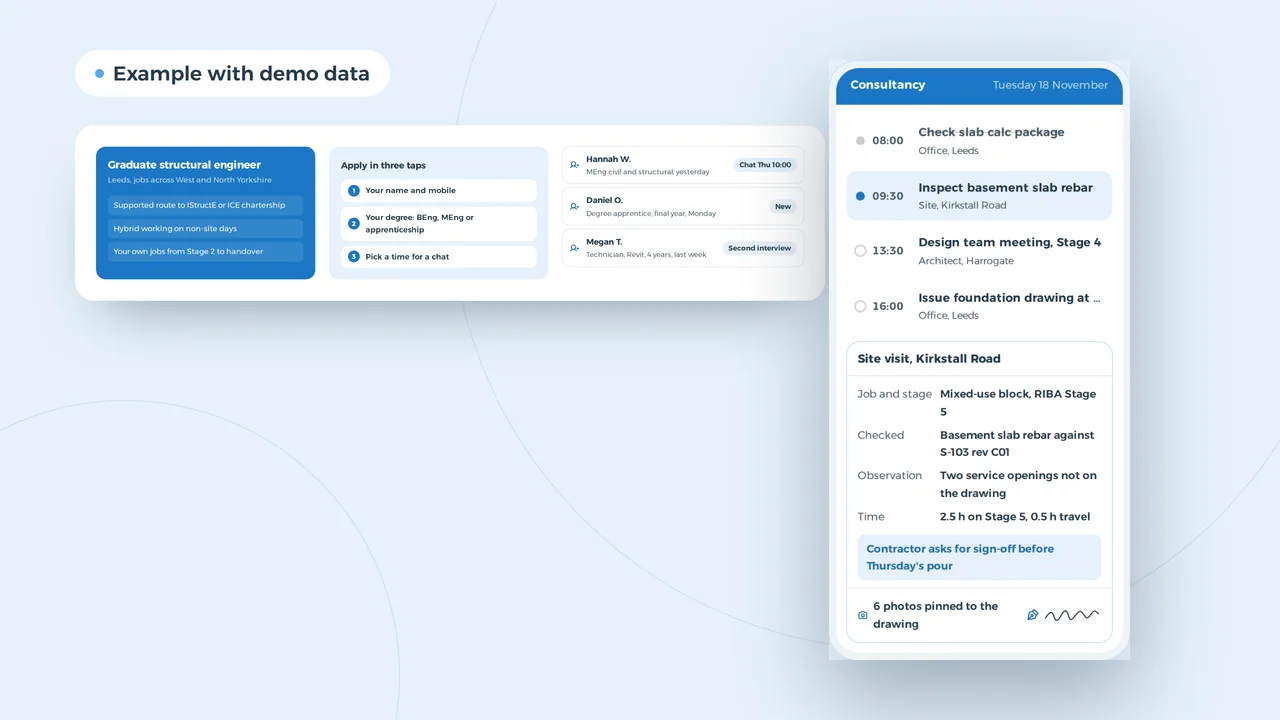
- Hours land on the job and the stageTime logged on site counts against the Stage 5 fee. The office sees how much of each stage is already used.
- The drawing on site is the current revisionThe phone opens the drawing that is current. Superseded revisions stay in the register, clearly marked.
- The record goes out from sitePhotos, observations and the contractor's question go to the right people at once, with a copy in the project file.
An example of what we can build, with made-up names and jobs. You choose what the site visit record asks.
Project pages built from records you already keep
Most consultancy websites have a projects page with a photo and three lines per job. An architect deciding between two practices learns nothing from it. A project page that wins work answers the questions they would ask on the phone: what the building is, what made the structure hard, which stages you covered, how you dealt with the ground, the programme or a late design change.
You already record most of that. Site visit photos, the drawing register, the comments you closed at each revision, the date you signed off a pour. If those records sit in a job file of your own, a project page after handover is an afternoon of writing, not a week of digging. We turn them into pages with SEO copywriting that reads well for an architect and for search engines alike.
Two rules keep this honest. Ask the client before you publish a project, and name only what your practice did. If you were the civils engineer on a scheme where someone else did the frame, say so.
Searches that bring domestic structural work
Homeowners are the one group that searches the way shoppers do. They need calculations to take out a wall, a loft conversion signed off, a crack looked at before they buy. They search with a task and a place, and they book whoever explains it clearly.
| The homeowner's task | The page that answers it | What the page needs |
|---|---|---|
| Removing a load-bearing wall | A page on beam calculations for building control | What the visit involves, what you send to building control, how long it takes |
| A loft conversion or extension | A page per type of job | Drawings you provide, how you work with the architect or builder, a booking link |
| Cracks or movement | A page on structural surveys | When a survey makes sense, what the report covers, what it does not |
| A town or area | A local page with jobs done there | Real jobs in that area, not a page that swaps only the town name |
A local page that only swaps the town name is what Google calls a doorway page, and it can pull the rest of the site down. It works when it carries something of its own: jobs in that area, the soil you often meet there, the councils you deal with. Local SEO and a sound SEO base do the rest. We do not promise positions; we build the pages that deserve them.
Shortlists, frameworks and the tender question
Public work in the UK is advertised on Contracts Finder and Find a Tender, and a lot of it runs through frameworks. Marketing does not win a tender. It does decide whether a project manager adds you to a shortlist, and it makes tender writing faster.
A site that answers the standard questions helps on both counts: the sectors you work in, your quality and health and safety approach, your CDM experience as a designer, how many chartered engineers you have and with which institution. Keep those answers on the site and in one place internally, and a tender response starts from a draft instead of a blank page. AI can draft that response from your own past answers; an engineer still checks every line.
For private clients the shortlist comes from people. An architect who has worked with you sends your site to the developer. That page needs to look like the practice they described: current projects, real names, a way to reach the director.
A graduate job page that is read to the end
An example of what we can build, with made-up names. You choose which questions the form asks.
Recruitment is the other half of the marketing
Many consultancies have enough enquiries and too few engineers. The graduate choosing between three offers reads your site the way a client does, looking for proof: which projects they would work on, who would mentor them, how you support the route to chartership with ICE or IStructE, whether site days and office days are balanced.
A job page that answers those questions, and lets someone apply in three taps from their phone, does more than a job board advert. It also tells clients that the practice is growing. We build those pages as part of a website, with an application form that lands straight in a list the office can work through. If you already use a recruitment tool, we connect to it instead.
Career fairs and university links still matter. The job page is where a student goes afterwards, so make sure it says what you said at the stand.
LinkedIn, CPD talks and what the institutions see
Engineers trust engineers. A director explaining how a basement was designed next to a listed wall gets read by architects, contractors and graduates alike. That works on a LinkedIn company page and in CPD talks for architects, and it works better when the same story is on your site as a full project page.
Keep it to work you can show and claims you can back. Use CEng or IEng only for engineers who hold the registration: both are protected titles. Mention awards and accreditations with the year. A case study with a client's name needs their permission.
One post a fortnight from someone who did the work beats a weekly post written by nobody in particular.
Marketing for civil engineering firms, measured in enquiries
Without measurement, marketing for a consultancy becomes a feeling. Keep it small and count what leads to work.
| Channel | What to count | Where it shows |
|---|---|---|
| Project pages | Visits from architects and developers, enquiries that name a project | Search Console, the enquiry form with a field for how they found you |
| Local pages | Calls and bookings for domestic work per area | Call tracking or a booking form per page |
| Job page | Applications and how many reach interview | The application list on your own site |
| LinkedIn and CPD talks | Profile visits, follow-up conversations, invitations to bid | A simple log kept by the directors |
| Shortlists and tenders | Invitations to bid, tenders won and lost with the reason | A tender register in your own system |
A form that asks how someone found you is old-fashioned and still the most reliable answer. If cookies are involved, the UK GDPR and PECR rules apply; our guide on UK GDPR vs EU GDPR sets out the difference. What a new site costs is in website cost in the UK.
Where the software and the marketing meet
The practices that market well are rarely the ones with the biggest budget. They are the ones whose records are in order: projects with photos and dates, comments closed per revision, a list of who did what. That is why this page sits next to our page on engineering firm software. The same records that keep a job on fee become the project page after handover.
The chain around you runs the same way. Architects and land surveyors choose partners from what they can see. A surveying practice faces the same question from the other side of the table; its version is marketing for land surveyors. A custom piece of software that keeps your records tidy is also the start of your marketing. Or get in touch and tell us which kind of work you want more of.
SEO
How VBS helps you with this
We find the questions your buyers ask Google, write the pages that answer them in full and measure every week what climbs.
- A term map: every search term with proof on its own page
- Guides, tools and comparisons with tables and sourced figures
- Rankings and impressions from Search Console every week
How we approach it is on our page about SEO.
More architects and graduates finding your practice?
Tell us which work you want more of and who you need to hire. We say which pages to build first, starting from the records you already keep.
Rather get in touch right away?