Websites: food trucks
Food truck website design that shows today's pitch and books private hire
1,500
Regulars want to know where you are tomorrow. Someone planning a wedding wants to know if you are free on the 14th and what it costs per head. A site that answers both before anyone has to message you, and that you do not update by hand every morning.
Regulars, passers-by and party planners
Three kinds of visitor land on a food truck website. The regular from the Tuesday lunch pitch, checking you are back on Thursday. The passer-by who saw the van at the market and looks up the menu at home. And the person planning a wedding or a staff party, comparing three traders and picking the first one that shows the date is free.
Many vans run on Instagram alone. The week sits in a story that disappears after a day, the menu is a photo of the board and the prices are nowhere. A party planner sends a DM and waits. Your own site fixes that without giving up Instagram.
Today's pitch, straight from your diary
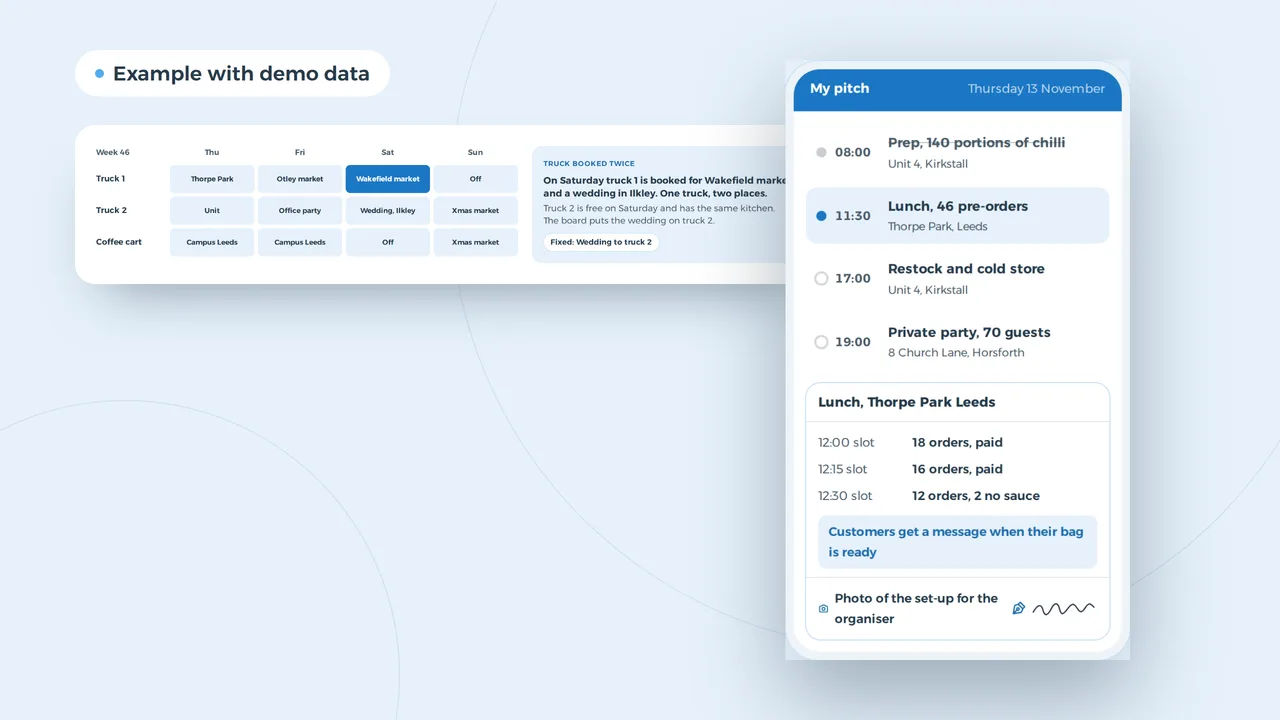
The question you get most is: where are you today? The answer changes daily, and a page someone updates by hand falls behind within a fortnight. So the list of pitches on the site comes from the diary or board you already keep. Add a pitch there and it appears online, with the address, the hours and a map.
| What the visitor wants | Where it comes from | What they see |
|---|---|---|
| Where are you today | Your diary or weekly board | Today's pitch at the top, with hours and a map |
| Where are you this week | The same diary | A list per day: lunch spots, markets, festivals |
| Are you at that festival | Your events list | Public events only, never private parties |
| Are you closed today | A note you set on your phone | A banner: no pitch today because of the wind |
Private parties never show on the site; only you and the crew see them. The full weekly board with vans, crew and stock is on the page about food truck software. A site that only needs the diary starts with plain website design.
Lunch at Thorpe Park with 46 pre-orders
- Order before you arriveOffice workers order at 10am, pick a slot and pay there and then. At noon the bag is ready.
- Every pitch with its own rulesAddress, times, power, what the organiser asks and what the council allows, on one sheet per pitch.
- What is left on the truckAfter lunch you see how many portions remain and what to restock for tonight.
An example of what we can build, with made-up names. You choose what a pitch records.
A menu written as text, not a photo of the board
A photo of your menu board is quick, but Google cannot read it, someone on a small phone has to pinch and zoom, and a customer with an allergy finds nothing. A menu written as text loads fast, fits every screen and can show what is in each dish.
For food that is not prepacked, you have to give allergen information, and you can tell customers where to ask for it. If you take orders online, allergen information has to be available before the order is completed and again when the food is handed over. Food you make and pack in your own unit before it is ordered falls under the labelling rules explained in Natasha's Law. On the site, allergens sit with each dish, from the same list the crew uses.
Your food hygiene rating belongs on the site too. Where you show it online, it should be easy to see before someone orders, for example in the header or on the menu, and it has to be your current rating. In Wales and Northern Ireland, displaying the sticker at your premises is the law. How you get rated in the first place is in register a food business.
If you change the menu by season or run a dish of the week, you change it in one place and it shows on the site, the pre-order page and the receipt. A restaurant with a fixed dining room needs more than that, with table bookings and a set opening time; that is a different site, described in restaurant website.
On the site before it goes live
- This week's pitches, pulled from your diary
- The menu as text, with prices
- Allergens per dish, or clearly where to ask
- Your current food hygiene rating, near the menu
- A page per kind of event: weddings, staff parties, birthdays, festivals
- Free dates and a hire form asking date, guests, venue and power
- Photos of the van, the food and a set-up at an event
- Your business details and a privacy notice for enquiries
- A Google Business Profile with the same name, area and photos
Found for food truck hire in Leeds
New enquiry
30th birthday, 80 guests, Sat 14 June
Sophie, Headingley, today 21:08
- A page per type of event, with menu and price per head
- A Google profile with reviews and your regular pitches
- Free dates on show and an enquiry sent in one go
An example of what we can build, with made-up names. The trucks and reviews above are fictional.
Found on Google next to your Instagram
People who want a van for a party type food truck hire and their town. First they see the map. That is your Google Business Profile, set up with a service area instead of a fixed address: see create a Google Business Profile, pick the right category with Google Business Profile categories, and after each event send a direct review link from the Google review link generator.
Below the map come the websites. A page per kind of event and per area you cover ranks better than a home page with a slider. If you want someone to keep that moving, that is local SEO.
Instagram stays important: it is where people see your food and your week. The site links to it and your bio links back to the site. If you want help with what to post and when, look at social media management.
A food truck website builder or a site built around your week
Builders give you a template in an afternoon. The question is what happens on the third Tuesday, when the pitch changes and an enquiry comes in at night.
- Where you are today
- Website builder with a templateYou edit a page by hand, or link to Instagram
- Site built around your weekPulled from your diary, always current
- Menu and allergens
- Website builder with a templateA text block or an image
- Site built around your weekDishes with prices and allergens from one list
- Private hire
- Website builder with a templateA contact form that sends an email
- Site built around your weekFree dates, a form with guests, venue and power, and a draft quote
- Pre-orders
- Website builder with a templateAn add-on, or a separate app
- Site built around your weekCollection slots on your own site
- Speed on a phone
- Website builder with a templateDepends on the theme and its plug-ins
- Site built around your weekBuilt to load quickly on a weak signal
A builder is fine for a first summer. Once the hire enquiries and the pitch questions take your evenings, a site built around your week pays for itself.
Private hire pages that answer the three questions
The money of the season is often in private hire. A planner searches, opens three sites and picks the trader that answers fastest: are you free, what does it cost, what do you need from us.
Each kind of event gets its own page. A wedding asks for something different from a staff party: other numbers, other hours, sometimes a vegetarian menu for half the guests. Each page shows a package with a price per head from, what is in it, and what the venue needs: flat ground, power, access for the van. Caterers use the same approach for menus without a van; see catering website design.
The hire form asks what you need to quote: date, hours, guests, address, power, vegetarians and allergies. A calendar shows which dates are full, so nobody enquires for a day when both vans are out. How such a calendar talks to your diary is in booking system for your website. A chat window that answers the usual questions at night is AI chatbot development.
Fast on a phone in the queue
Whoever opens your site is often standing at the van or in the queue next to it, with a phone and patchy signal. The site has to load in seconds. That means images sized for the screen, no video that starts by itself and a menu that is there before the photos arrive.
| Part | What we do | Why |
|---|---|---|
| Images | Sized per screen, loaded as you scroll | The menu appears at once, even on a weak signal |
| QR code on the van | Goes straight to the menu or the pre-order page | No detour through the home page |
| Type size | Readable without zooming | People read in the sun |
| Pre-ordering | Three steps: choose, slot, pay | Done before the queue moves |
To see how your current site does, run it through the website speed test.
Events, pre-orders and languages set the price
From1,500 euro
A food truck website starts from 1,500 euro: your pitches from your diary, the menu with prices and allergens, a page per kind of event, a hire form and the basics for Google. Pre-orders with payment, a quote tool or a link to your till are software; they get a fixed price after a conversation. We always start with a conversation, then a fixed price per project.
- Kinds of eventHow many kinds of event get their own page with a package and price.
- LanguagesEnglish only, or also Welsh for traders in Wales.
- After the enquiryA plain form, or a calendar with free dates, pre-orders and a quote that is ready to send.
What a site costs up front in the UK is in website cost UK, and what it costs per year in hosting, domain and upkeep in website cost per year. Still getting licensed? Read the food van licence UK guide first. Your footer needs your business details; whether a company number belongs there is answered in company number on a website, and what your privacy notice has to say about hire enquiries in do I need a privacy policy. Rather not touch the site yourself after launch? See website maintenance. Want to talk about your site? Book a conversation through contact.
Website design
How VBS helps you with this
We build your site from design to copy, imagery and code, in one team, so that Google and your buyers find it and get in touch.
- Design and copy built on your buyers' questions
- Fast, multilingual when you need it, at a fixed price
- Forms, cookieless analytics and hosting on AWS
How we approach it is on our page about Website design.
A site that says where you are and whether you are free?
Tell us how your week runs and which events you want. We show you what your site would look like.
Rather get in touch right away?