Industries: food trucks
Food truck software for pitches, pre-orders, POS and private hire
A board that knows which van stands where this week, customers who order ahead and pick a collection slot, a till that keeps up with the lunch queue and stock you can see per van and per day. Built around how your trading week runs, with one van or five.
Lunch on Tuesday, a market on Saturday, a wedding on Sunday
A food truck changes address every day. Tuesday is a business park, Thursday a street pitch the council gave you for the year, Saturday a farmers' market and Sunday a wedding forty minutes away. Every day needs the right van, the right crew, enough stock and a till that works in a field.
Most traders hold all that together with a paper diary, a WhatsApp group and a spreadsheet of private hire enquiries. It works until two bookings land on the same van, or the burger buns for the wedding are still in the unit on Monday. Software built around your week takes those slips out.
Pre-orders per collection slot on the phone
- Order before you arriveOffice workers order at 10am, pick a slot and pay there and then. At noon the bag is ready.
- Every pitch with its own rulesAddress, times, power, what the organiser asks and what the council allows, on one sheet per pitch.
- What is left on the truckAfter lunch you see how many portions remain and what to restock for tonight.
An example of what we can build, with made-up names. You choose what a pitch records.
The jobs that eat a trader's evenings
Ask a food truck owner where the hours go and the answer is rarely cooking. It is the work around it: answering where you are tomorrow, quoting for parties, counting stock, sorting out who works Saturday. Most of it happens after a long day on the pitch.
| Job | How it usually runs | What software takes over |
|---|---|---|
| Telling customers where you are | An Instagram story each morning | Today's pitch on your site and profile, straight from the board |
| Private hire enquiries | Emails and DMs, answered at night | A form that asks date, guests, venue and power, and a draft quote |
| Lunch rush | A queue that walks away after ten minutes | Pre-orders with a collection slot, paid in advance |
| Stock | A count in the unit and a guess for the weekend | Stock per van and per day, with a warning before you run short |
| Crew | A group chat on Thursday night | Shifts per van and per pitch, visible on each phone |
None of this needs a big system. It needs one place where the week lives, so that every other screen reads from it.
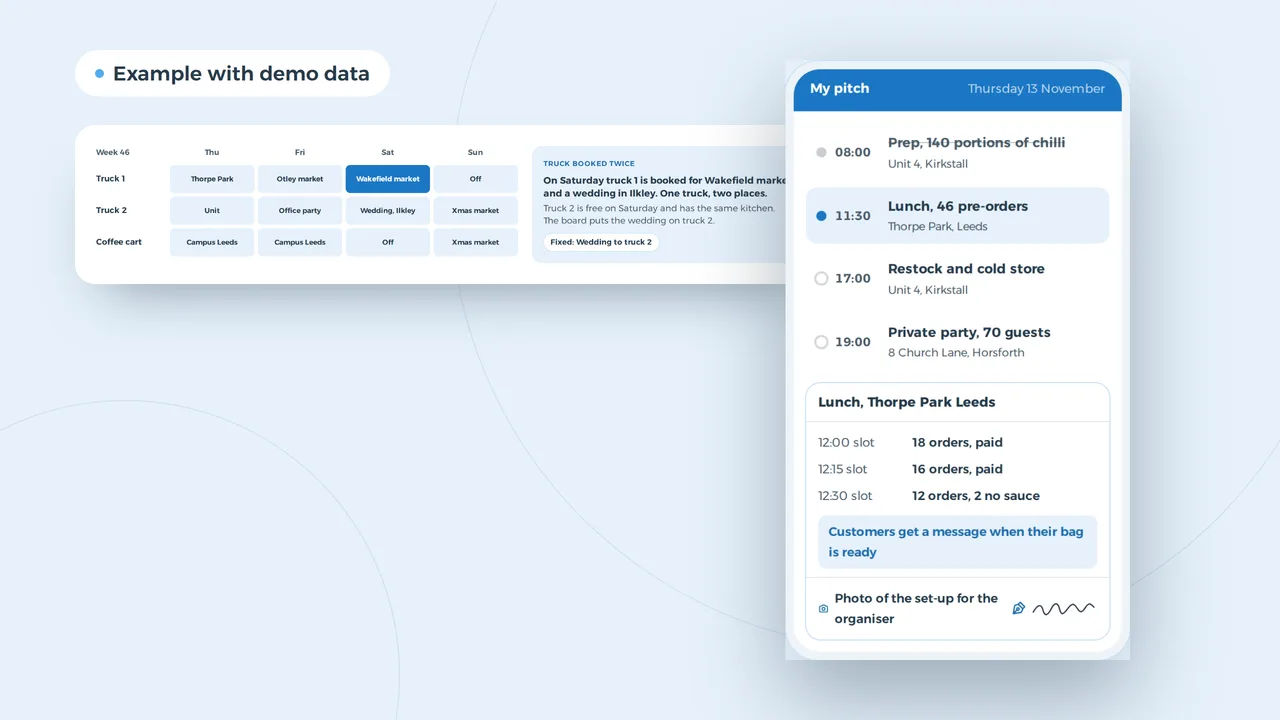
A week of pitches on one board
Truck booked twice
On Saturday truck 1 is booked for Wakefield market and a wedding in Ilkley. One truck, two places.
Truck 2 is free on Saturday and has the same kitchen. The board puts the wedding on truck 2.
Fixed: Wedding to truck 2
An example of what we can build, with made-up names. You decide which rules the board checks.
Pitches, vans and crew on one weekly board
The board is the heart of it. Each row is a van or trailer, each column a day, and each slot a pitch: a lunch spot, a market, a festival, a private party. When you add a wedding on a Saturday that already has a market, the board shows the clash before you confirm, and suggests the van that is free.
From that board everything else follows. Your website and Google profile show the public pitches of the day. Private parties stay off the public page. The crew sees which van and which pitch they are on, with the start time and the address. If you also plan casual staff, the same board feeds staff scheduling software, so that nobody gets a shift on a van that is in the workshop.
Work a lot for festival organisers and wedding venues? Then the board also holds the documents each organiser asks for, so you are not searching your inbox the night before. Event businesses with the same problem at a larger scale will recognise it from software for event companies.
Pre-orders by time slot, and a POS that keeps up
The lunch pitch makes or breaks the week. Office workers have half an hour. If the queue is twelve deep at 12:20, some of them buy a meal deal instead. Pre-orders fix part of that: a customer orders on their phone at ten, picks a collection slot, pays, and walks past the queue at 12:15. You see the orders per slot and cook in batches.
The till is the other half. Food truck POS software has to take cards quickly, work when the signal drops, and send each sale to the same stock and reports as your pre-orders. Many traders already use a card reader or a till app; we connect to what you have where we can, rather than replacing it. If you are comparing tills, our breakdown of Lightspeed pricing shows what a full hospitality POS costs per month.
A pre-order app for one van does not need to be a separate app in the store. A page on your own site that works like an app is often enough. When it does need to be a real app, with loyalty stamps or push messages, that is app development.
Stock per van and per day
Saturday: Wakefield market and a wedding, 260 portions
You have 90 buns and need 260. Suggestion: order 180 from your baker for Friday 4pm delivery.
An example of what we can build, with made-up numbers. You choose which products and thresholds to track.
Stock counted per van, per day and per batch
A food truck runs out at the worst moment: in the middle of a festival, an hour from the unit. Stock software for a truck is simple. It knows what is in the unit and in each van, what each pitch usually sells, and what is booked for private hire. On Thursday it tells you that the buns for Saturday will not stretch, while you can still order.
It also keeps the batch and the use-by date of what you prepare in the unit, which helps when an environmental health officer asks, and when a supplier recalls a product. The same logic sits behind inventory management software for shops and kitchens.
Allergens belong in the same place. Each dish carries the allergens of its ingredients, so the menu board, the pre-order page and the till all show the same thing. The rules for food made and packed on your own premises before it is ordered are in our guide to Natasha's Law.
An enquiry becomes a quote
An example of what we can build, with made-up names and prices. AI reads the email and proposes; you decide and send.
Private hire quotes before the next trader replies
Weddings, birthdays and staff parties pay the best per day, and they are won by the trader who replies first with a clear price. The enquiry often arrives at nine in the evening while you are cleaning down.
AI reads the enquiry from your form or email, fills in your menu, price per head, travel and minimum spend, and leaves a draft quote on your phone. If something is missing, such as whether there is power or flat ground for the van, it asks the customer. You check the price and press send. How this works in a wider hospitality business is on AI in hospitality; a tool that only drafts quotes is described under AI quote generator.
Caterers who cook for events without a van face the same quoting work, with more courses and more staff. If that is closer to your business, look at software for caterers.
Found for food truck hire in your town
New enquiry
30th birthday, 80 guests, Sat 14 June
Sophie, Headingley, today 21:08
- A page per type of event, with menu and price per head
- A Google profile with reviews and your regular pitches
- Free dates on show and an enquiry sent in one go
An example of what we can build, with made-up names. The trucks and reviews above are fictional.
Showing up when someone searches for food truck hire
People who want a van for a party search Google with the town in the query. First comes the map. That is your Google Business Profile, set up with a service area rather than a fixed address; see create a Google Business Profile, and after each event ask for a review as described in get more Google reviews.
Under the map come the websites. A page per kind of event and per area you cover does better than a home page with a slider. What belongs on such a site, from today's pitch to the hire form, is on food truck website design. If you want someone to keep your local ranking moving, that is local SEO. We build websites from 1,500 euro.
UK rules a food truck system has to carry
Software does not make you compliant, but it can hold the dates, documents and settings the rules ask for. These are the ones a UK food truck meets most often.
| Rule | What it asks | What the system holds |
|---|---|---|
| Food business registration | Register with the local authority at least 28 days before you trade; free, and it can't be refused | The registration date and the authority, per van or unit |
| Food hygiene rating | Rated 0 to 5 after an unannounced inspection; display is the law in Wales and Northern Ireland | Your current rating, shown on the site and the pre-order page |
| Street trading | Many councils require a licence or consent per street; a licence runs up to 12 months; trading without one can mean a fine up to £1,000 | Each pitch with its licence, its days and its end date |
| Allergens | Allergen information for food that is not prepacked, and full labels for food prepacked for direct sale | Allergens per dish, the same on the board, the page and the till |
| VAT | Register once taxable turnover passes £90,000 in 12 months; hot and cold takeaway are taxed differently | The VAT rate per menu item and turnover over a rolling 12 months |
| Gas | HSE says work on gas fittings in workplaces such as restaurants must be done by a Gas Safe registered engineer, and the rules cover LPG | The date of the last check per van and a reminder before the next |
The full steps to get licensed are in our guide on the food van licence in the UK; the registration itself is covered in register a food business.
One van, three vans or a fleet with its own unit
| Your setup | What you really need | What can wait |
|---|---|---|
| One van, owner on the pitch | A weekly board, today's pitch on the site, a hire form | Stock per van, crew scheduling |
| Two or three vans and a coffee trailer | The board with clashes, crew per van, stock per van | A full app with loyalty |
| A fleet with a commissary unit | Stock from unit to van, batches, pre-orders per pitch, quotes | Little: this is where custom software pays back |
A sole trader does not need a fleet system, and a fleet does not run well on a single trader's tools. We start with what costs you the most hours now. If your setup does not fit a product off the shelf, custom software is built around the way your vans already run.
Worked example: three lunch pitches and a season of parties
Take a trader with three weekly lunch pitches and a season of private hire. Assume 30 customers a week walk away from a long queue. With pre-orders and collection slots, say half of them come back. At an assumed margin of £6 per meal, that is £90 a week, or £3,600 over a 40-week season.
Now the quotes. Assume four private hire enquiries a week over that season.
| By hand | With a draft quote | |
|---|---|---|
| Time per enquiry | 30 minutes | 10 minutes to check and send |
| Per week, four enquiries | 2 hours | 40 minutes |
| Over a 40-week season | 80 hours | 27 hours |
The hours matter less than the speed: a quote that goes out the same evening wins more parties than one that goes out two days later. Run your own figures through the margin calculator and the break-even calculator.
A first version before the summer season
- A conversation about your weekWhich pitches, which vans, where the hours go, and what you already use for the till.
- A fixed priceAfter the conversation you get a fixed price per project, with what is in it and what is not.
- The board firstPitches, vans and crew on one board, fed to your site and profile.
- Then the restPre-orders, stock or quotes, in the order that saves you the most time.
Questions food truck traders ask
- Can it work with the card reader I already have?
- Often, yes. We connect to the till or card reader you use where it allows that, so sales flow into the same stock and reports as your pre-orders.
- Does it work when the signal drops on a field?
- The till and the crew screens keep working offline and sync when the connection comes back. Pre-orders need a connection on the customer's side, which they have at their desk.
- Do I need an app in the App Store for pre-orders?
- Not always. A pre-order page on your own site that works like an app is often enough for one or two vans. A store app makes sense for loyalty and push messages.
- Can private parties stay off my public page?
- Yes. Private hire stays on your board and the crew's phones. Only the pitches you mark as public appear on your site and profile.
- I trade in Scotland. Does that change anything?
- The licence does. Scotland has its own street trader's licence, and a food van needs a certificate from the food authority before the licence is granted. The software holds the same dates and documents.
- What does a website cost?
- Websites start from 1,500 euro. Software for pitches, pre-orders or quotes gets a fixed price after a conversation about your week.
Custom software
How VBS helps you with this
We build the platform your business runs on every day: your spreadsheets, emails and paperwork in one system that does what you do.
- Your workflow mapped first, then a fixed price
- Screens for the office, the client and the road
- Hosting, backups and security managed by us on AWS
How we approach it is on our page about Custom software.
Pitches, pre-orders and quotes in one place?
Tell us how your trading week runs. We show you what the board would look like for your vans.
Rather get in touch right away?