Industries: yoga studios
Yoga studio software for classes, passes and retreats
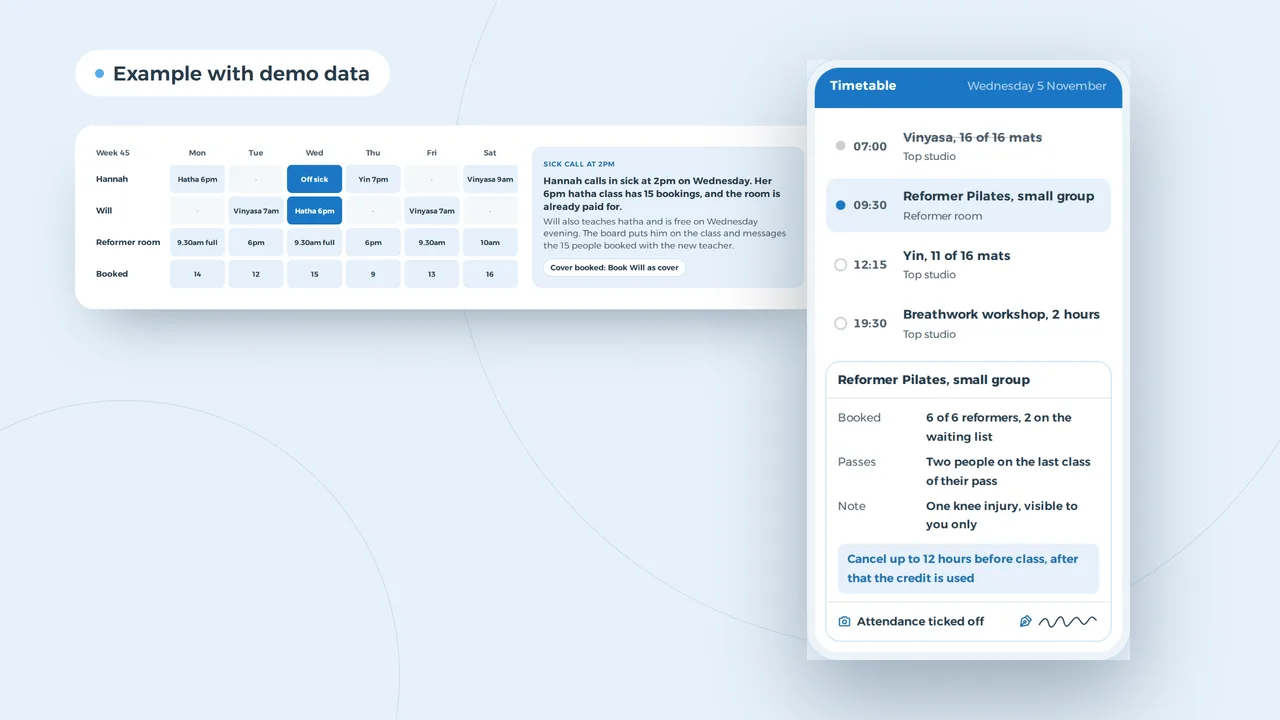
A timetable that knows how many mats and reformers you have, class passes and memberships that count down on their own, a waiting list that moves up, and workshops and retreats with deposits. On your own site, built around how your studio works.
A room of sixteen mats and a week of moving parts
Yoga studio software has one job before any other: sharing out a fixed number of places. A studio holds sixteen mats or six reformers, and every class has a teacher, a style and a cap. The 7am vinyasa is full by Sunday night, Thursday's yin still has five spaces, and Friday's breathwork workshop needs eight people to run at all.
Most independent studios sell a mix of drop-in classes, a 10-class pass, a monthly membership and the odd private session. On top of that come workshops at their own price, a retreat with a deposit, and freelance teachers who each take a few classes a week. A studio with two rooms and five teachers handles hundreds of bookings a month, with late cancellations, taster classes and renewals on top.
Software built for your studio puts the timetable, passes, memberships, waiting list, teachers and payments in one place. Below you will find what we build for each need, the UK rules your system has to respect, how much system suits your size, and a worked example with empty mats. A gym with kit and key fobs is a different business; that is on our page for gyms.
A sick call at 2pm for a full 6pm class
Sick call at 2pm
Hannah calls in sick at 2pm on Wednesday. Her 6pm hatha class has 15 bookings, and the room is already paid for.
Will also teaches hatha and is free on Wednesday evening. The board puts him on the class and messages the 15 people booked with the new teacher.
Cover booked: Book Will as cover
An example of what we can build, with made-up names. You decide who may cover which styles.
Drop-in, class pass, membership or retreat
A yoga studio does not sell access to a room. It sells a place in a class. That makes booking different from a gym: each class has a cap, a teacher and a style, and every mat left empty is income you will not see again. Your booking software has to know what each client holds and what that product allows.
| Product | How it usually works | What the system has to do |
|---|---|---|
| Drop-in class | Pay when you book, one place in one class | Take payment, hold the place, enforce the cancellation window |
| Class pass | 5 or 10 classes, valid for a set period | Count credits down, show the expiry date, prompt a renewal |
| Membership | A monthly fee, one or more classes a week | Collect monthly, cap classes per week, pause for illness or pregnancy |
| Intro offer | A first class or first fortnight at a lower price | Once per person, then an offer for a pass |
| Private session | One teacher, one or two clients, by appointment | Show the teacher's free slots, price it separately |
| Workshop | A fixed date, its own price, a minimum number | Decide to run or cancel, refund if it does not run |
| Retreat | Several days with accommodation, deposit and balance | Deposit, balance reminder, kit list and directions |
You set the rules per product: how long a pass lasts, until when someone can cancel without losing a credit, whether a membership can pause. The system applies them to everyone in the same way. That ends the debates at the front desk, because the rule is on screen at the moment of booking.
Where an ordinary week pinches
Most studio owners teach as well. Between two classes they answer emails about a missing credit, move someone off the waiting list, and message a teacher because the room has to be clear by 6pm. In the evening comes the admin: who paid by bank transfer, who has not, which pass expired. Teaching, the actual work, gets whatever is left of the day.
The 9.30am class on the teacher's phone
- The waiting list moves up on its ownWhen someone cancels in time, the first person on the waiting list gets the spot and a message. Nobody has to ring round.
- Passes and memberships count alongEvery class comes off the class pass. Whoever is on their last credit gets a link to renew after class.
- Health notes stay with the teacherAn injury or a pregnancy sits on the client's record, but only the teacher of that class can see it.
An example of what we can build, with made-up clients. You choose which fields a class has.
Many teachers are self-employed and teach at two or three studios. They want their classes on their own phone, the chance to swap a class with a colleague, and a count of how many classes they taught this month. That count is also the basis for their invoice to you. With a timetable that tracks classes per teacher, month-end payments run without anyone adding up a spreadsheet. More on rotas for a team is on staff scheduling software, and if you are torn between a spreadsheet and a system, read Excel scheduling or planning software.
Health notes need care. A client tells you about a knee injury or a pregnancy so the teacher can adapt the class. That note belongs on the client's record, visible to the teacher of that class and nobody else, with the client's consent recorded alongside it.
What yoga studio booking software has to handle
- Caps per class and per kitA cap per class, per room and per piece of kit: mats, reformers, chairs.
- A waiting list that movesWhen someone cancels in time, the first person waiting gets the place and a message.
- Your cancellation windowTwelve hours, say, after which the credit is used. You pick the number.
- Passes and membershipsCredits that count down, monthly payments, a pause for illness or pregnancy.
- Workshops and retreatsTheir own price, a deposit, a minimum number and a date to decide.
- Health notes kept closeVisible to the teacher of the class only, with consent on record.
Four notes become a retreat page
An example of what we can build, with a made-up retreat. The AI drafts from your own notes, you decide what goes live.
Workshops, teacher trainings and retreats
Workshops and retreats earn more per booking than a regular class, but they take more work up front: a page with the programme, bookings with a deposit, a reminder for the balance, a kit list and directions. A residential retreat adds room allocation and a question about dietary needs.
AI helps here in a practical way. You dictate what the retreat involves after a planning chat; the AI drafts the programme per day, the price, the terms and the emails that go out at set moments. You check it and publish. The same works for the monthly newsletter with next month's timetable, or a reply to a question that comes in every week. More on that in AI for sole traders and AI automation; how to build that monthly email is in how to write a newsletter.
If you host retreats at your own venue with rooms, booking starts to look like a holiday let: availability per weekend, an enquiry or a booking with a deposit. That is what a direct booking website covers.
A freelance teacher for mornings and weekends
An example of what we can build, with made-up names. You choose what you ask.
Finding cover and new teachers
A studio grows as fast as it finds teachers. Whoever needs a vinyasa teacher for Sunday morning asks around their own training group or posts on Instagram, and usually hears the same three names. A standing page on your site with the classes you need covered, the hours and what you offer gets found by teachers who live nearby and have just finished their training.
Replying takes three taps: name, styles and training, and the hours that suit. You see the replies in one list and book a trial class. Once a teacher starts, they sit on the same timetable as everyone else, with their classes on their phone. How a small employer stands out to candidates is covered under employer branding and AI for HR.
Someone searches for yoga in York
New booking
Taster yin class on Thursday, asks about the 10-class pass
Ellie, Fulford, today 21:12
- A page per style, with the level and who teaches it
- A Google profile with photos of the studio and the timetable
- A taster class booked in three taps, paid on the spot
Example with made-up studios and reviews.
A website that fills classes
A new client searches "yoga" and the name of their town, looks at the map and clicks through to two or three studios. They want to see three things: which styles you teach and for whom, when the classes are, and what a first class costs. If the timetable is hard to find or booking means sending an email, they go back.
That is why we build the website and the booking system as one. The timetable on your site is the real timetable, with the places still free. Each style gets its own page: vinyasa, yin, hatha, reformer Pilates, pregnancy yoga, with the level and who teaches it. Booking a taster class takes three taps on a phone, with payment built in. We build websites from 1,500 euro; a booking system on top is priced after our conversation, as a fixed price. What goes into the site itself is on yoga studio website design.
Being found in your own town comes down to your Google profile and your reviews. A profile with the right category, photos of the room and the timetable in the description does more than an advert. See create a Google Business Profile and get more Google reviews; with local SEO we strengthen the pages per style and per area.
Software that fits the size of your studio
A teacher running three classes a week in a hired hall needs something else than a studio with two rooms, reformers and ten teachers. Per size, this is what we usually suggest.
| Size | Typical set-up | What we build |
|---|---|---|
| Sole trader teacher | 3 to 8 classes a week, hired hall | A site with timetable, online booking and payment, class passes |
| Studio with a team of 5 | Own room, 20 to 30 classes, freelance teachers | Timetable per teacher, waiting list, memberships, pay per teacher |
| Studio of 20 to 50 people | Two rooms or sites, reformers, workshops | Timetable per room and kit, retreats with deposits, reports per style |
| Larger or several sites | Own teacher training, corporate classes, retreats | A platform with its own app, linked to your accounts package |
Selling classes to companies, such as lunchtime yoga at an office, means invoices to businesses; an integration with your accounts package removes the retyping. If clients should be able to put the timetable on their home screen without an app store, a PWA often does the job; a full app pays off once you have a large group of regulars.
UK rules your system should respect
A studio handles payments, contact details and sometimes health information. These rules shape how your system deals with them.
| Topic | What applies | What the system does |
|---|---|---|
| VAT registration | You must register when your taxable turnover for the last 12 months goes over 90,000 pounds | Show turnover over a rolling 12 months, so you see the threshold coming |
| VAT on classes | Whether your classes carry VAT depends on your situation. Check with your accountant before you set prices | Show prices with or without VAT, as you set them |
| Health notes | Data concerning health is special category data under UK GDPR: processing is prohibited unless a condition applies, such as explicit consent for a specified purpose | Ask for explicit consent, show the note to the class teacher only |
| Data protection fee | Most organisations pay the ICO 52 or 78 pounds a year unless exempt | A record of what you keep and who sees it |
| Children's classes | Checks through the Disclosure and Barring Service cost 20 pounds for a basic or standard check and 41 pounds for an enhanced one. Ask whether a check applies to your role | A record per teacher of which check they hold |
More on privacy for your site is in UK GDPR vs EU GDPR, UK cookie law and do I need a privacy policy. A data processing agreement covers the software supplier who stores your client data.
A worked example with empty mats
| Item | Without waiting list | With waiting list and reminders |
|---|---|---|
| Mats taken per class | 11 | 13 |
| Mats taken per week | 220 | 260 |
| Extra mats per week | 40 | |
| Extra income per week at 14 pounds | 560 pounds | |
| Extra income per year (46 weeks) | 25,760 pounds |
The two extra mats come from three places: a waiting list that moves up when someone cancels, a reminder the evening before so fewer people forget, and a nudge on the last credit of a pass so people renew instead of drifting off. Run it with your own numbers; on a 10-class pass the price per class is lower, and not every class is full enough to have a waiting list.
Booking platform or software of your own
An off-the-shelf platform works well when your studio fits the way it was built. If you want your own rules for passes, retreats or teachers, or would rather not send clients into a third-party app, software of your own pays off. A wider view of the trade-off is on custom software for small business and booking system for your website.
One conversation, then a fixed price
- A conversation about your weekWhich classes you run, how people book now, which passes and memberships you sell, who teaches. We go through an ordinary week and a week with a workshop.
- A proposal at a fixed priceYou get a proposal per project, with what we build and what we leave out. Websites start from 1,500 euro; the booking system is priced from the conversation.
- Built with your own timetableWe load your real classes, rooms and teachers, so you test with what you know. Clients notice nothing until the day we go live.
- Live, then tunedAfter the first weeks we look together at what works: where people drop out of a booking, which reminders help, what the teachers miss.
A yoga studio is not yet among our clients. Bookings and availability are: for No.4 Lange Ast we built an availability calendar from the Airbnb and Booking iCal feeds with an enquiry form, and for Villa Lidia a booking form, an availability calendar and a small admin panel. Teaching dance rather than yoga? See dance schools; for appointment-based practices see physiotherapists. Want to talk first? Get in touch.
Questions studio owners ask us
Is yoga studio software from you different from a booking app?
A booking app gives you its own rules and sends your clients into its own app. We build around your passes, your cancellation window and your teachers, on your own site. If an existing package suits you better, we will say so in the first conversation.
Can I move my current clients and passes across?
Yes. We move your client list, the open class passes with their remaining credits and the memberships, so nobody starts again.
Does it work for reformer Pilates?
Yes. For Pilates the system counts reformers instead of mats. You set how many machines each class has, and the waiting list works per machine.
Do I have to charge VAT on my classes?
You must register once your taxable turnover for the last 12 months goes over 90,000 pounds. Whether your classes are standard-rated or exempt depends on your situation, so ask your accountant.
Can teachers see and swap their own classes?
Yes. Each teacher sees their classes on their phone, can ask for cover and sees how many classes they taught this month, as a basis for their invoice.
Does the scheduling side handle more than one room?
Yes. Yoga studio scheduling software from us keeps a timetable per room and per teacher, and warns you before two classes land in the same room.
Custom software
How VBS helps you with this
We build the platform your business runs on every day: your spreadsheets, emails and paperwork in one system that does what you do.
- Your workflow mapped first, then a fixed price
- Screens for the office, the client and the road
- Hosting, backups and security managed by us on AWS
How we approach it is on our page about Custom software.
Full classes without the inbox?
Tell us how a week at your studio runs, with the classes, the passes and the teachers. We will show you where we would start.
Rather get in touch right away?