Industries: retail shops
An EPOS system for a small shop, with the website on the same stock
The last vase sold at the counter disappears from the website within seconds. Last night's online order sits in a numbered tray by the till. A loyalty card counts in the shop and online. We help you pick the EPOS that fits and build what it leaves out.
One shelf, two shopfronts
A shop with a website sells through two doors. The till knows what goes over the counter, the website knows what is ordered online, and every evening someone checks whether the two still agree. Usually they don't. A customer orders the last vase online an hour after it left the shop, and the next morning starts with an apology.
An EPOS system for a small shop is no longer a box that prints receipts. It is where your stock, prices and customers live, and the website should read from it directly. This page covers how that works, what a small shop actually needs, which UK rules apply to pricing, payments and returns, and where we come in.
Shop floor, stockroom and reserved online, in one count
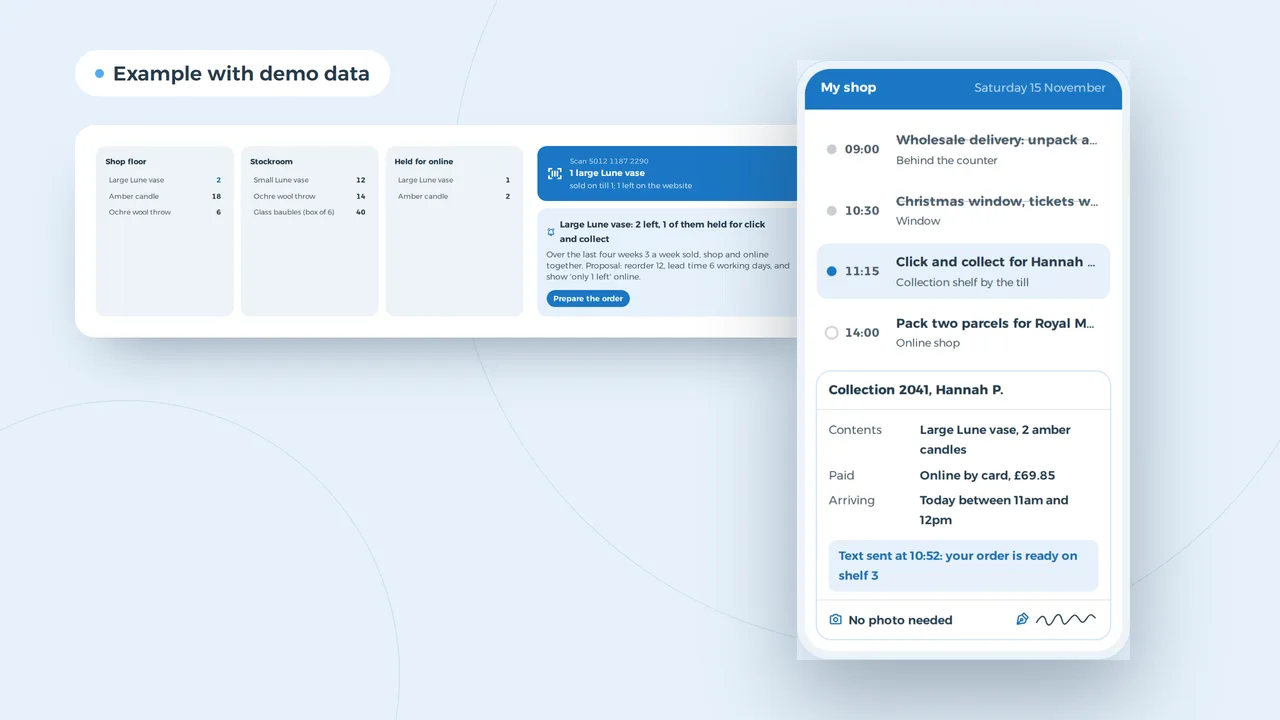
Large Lune vase: 2 left, 1 of them held for click and collect
Over the last four weeks 3 a week sold, shop and online together. Proposal: reorder 12, lead time 6 working days, and show 'only 1 left' online.
An example of what we can build, with made-up names. You choose the level at which the system warns you.
Stock that knows about the website
Retail EPOS systems in the UK all promise stock control. The question is whether that stock is shared with your website, or copied to it every few hours. Shared stock means each product exists once, with a barcode, a quantity per location and a status: on the shop floor, in the stockroom, reserved for an online order. A sale at the till comes off at once. An online order is reserved at once and drops out of what the shop can still sell.
| What happens | Two separate stock counts | One shared stock count |
|---|---|---|
| The last item sells at the till | The website shows it in stock for hours | It shows sold out online within seconds |
| Someone orders online at 9pm | Staff check the shelves next morning | The item is reserved and moved to a collection tray |
| A delivery arrives | Booked in twice, till and website | One scan, both channels see the new numbers |
| The January stocktake | Two lists with their own mistakes | One list, with differences per location |
Most EPOS packages now come with their own online shop or a link to Shopify or WooCommerce. If you are starting out, a package where till and shop already share a database is often the simplest route. We compare the two best-known in Shopify or Lightspeed, with monthly costs in Lightspeed pricing and Shopify cost. Already on Lightspeed and thinking of moving? Read switching from Lightspeed to Shopify.
If your till and website already exist but don't talk, an API integration is usually cheaper than replacing both. If stock itself is the headache, with several stockrooms, suppliers and reorders, look at inventory management software that sits above the till.
Saturday, with collections between customers
- One stock count for shop and websiteWhat leaves through the till comes off the website at once. You never sell the last vase twice.
- Collections without a huntEvery click and collect order gets a shelf and a code. Whoever is on the till sees which shelf and whether it is paid.
- One loyalty card for bothPoints from a purchase in the shop count online too, and the other way round.
An example of what we can build, with made-up names. You choose which tasks go on the list.
Click and collect at the counter
Click and collect software sounds simple: order online, pick up in store. It goes wrong at the counter. The order is somewhere in the back, nobody knows if it was paid, and the customer waits while two people search.
The parts that make it work:
- A reservation in the stockWhatever is ordered online can no longer be sold in the shop.
- A tray and a codeEach order gets a fixed place and a QR code sent by email or text.
- Paid or notThe till shows straight away if anything is still owed.
- A message when it's readyThe customer comes in when the order is on the shelf, not before.
- Orders nobody collectsAfter a period you set, a reminder goes out, and then the item goes back on sale.
We build that as part of a custom webshop or a Shopify store through our Shopify agency, with collection as a proper delivery option. Not sure a website pays for a shop your size? Read is an online store worth it first.
Loyalty that counts in both channels
A loyalty card only works when customers can use it everywhere: at the till, online and in every branch.
One customer, one balance
Points land on the same account whether the customer pays at the till or online. An email address or phone number is the key, not a plastic card in a wallet.
Your rules
Points per pound, a reward after ten purchases or something on a birthday. You decide, the system does the sums.
Messages that fit the customer
Someone who bought candles twice hears when the new scents arrive. Not a newsletter for everyone, a note for the people who care, with their consent.
Data kept in order
A loyalty scheme holds personal data. Keep only what you use and let customers see or delete it. The differences with the EU rules are in UK GDPR vs EU GDPR.
UK rules your till and website have to follow
The law doesn't tell a shop which till to buy. It does say a lot about prices, payments and returns, and a good system takes care of most of it.
| Rule | Where it comes from | What it means for till and website |
|---|---|---|
| Show the selling price, including VAT | Price Marking Order 2004 | Every price a customer sees is what they pay |
| Show the unit price on many goods | Price Marking Order 2004 | Price per kg or litre on the label and the product page; some shops up to 280 square metres are exempt for certain goods |
| No fee for paying by card | Consumer Rights (Payment Surcharges) Regulations, since January 2018 | No card surcharge on the till or at the website checkout |
| No legal duty to refund non-faulty goods bought in the shop | gov.uk guidance on returns | Your own returns policy applies in the shop, so print it on the receipt |
| 14 days to cancel an online order, then 14 days to send it back | Consumer Contracts Regulations 2013 | The website needs a cancellation route and refunds within 14 days of getting the goods back |
| Personalised and perishable goods are exceptions | Consumer Contracts Regulations 2013, regulation 28 | Mark engraved or made-to-order items so the website shows the exception |
The tricky case is click and collect. An order paid online and collected in the shop was still placed at a distance, so treat it as an online sale for cancellations unless your adviser tells you otherwise. Your till should know which sales came through the website.
Shipping to customers in Ireland or the EU adds customs and VAT questions, covered in selling to the EU from the UK. What else a website has to show is in ecommerce legal requirements.
Making Tax Digital reaches sole traders
Every VAT-registered business already keeps digital records under Making Tax Digital for VAT, and registration starts at 90,000 pounds of taxable turnover. From 6 April 2026, sole traders with qualifying income over 50,000 pounds also send quarterly updates for Income Tax; the threshold drops to 30,000 pounds in April 2027 and 20,000 pounds in April 2028. A till that exports clean daily totals makes that much lighter.
Off-the-shelf EPOS or EPOS with a layer on top
For most shops a standard EPOS package is the right start. Custom work pays only where the package makes you do things twice.
- Setup
- EPOS package with online shopA few days, with a monthly subscription
- Package plus integration or custom layerA few weeks, a fixed price per project on top of the subscription
- Stock
- EPOS package with online shopShared when till and shop are the same brand
- Package plus integration or custom layerShared across your existing till, website and stockroom
- Click and collect
- EPOS package with online shopUsually a tick box for store pickup
- Package plus integration or custom layerTrays, time slots, a text when ready and a QR code at the till
- Loyalty
- EPOS package with online shopPoints or discounts inside the package
- Package plus integration or custom layerYour own rules, across branches or with a partner
- Accounts
- EPOS package with online shopExport or link to the usual accounting packages
- Package plus integration or custom layerPlus your own reports per branch and per channel
- Fits
- EPOS package with online shopOne shop, one till, one website
- Package plus integration or custom layerSeveral branches, a trade counter or many house rules
Start from what you have. We build only what the package can't do, and say so when a standard EPOS is enough.
Someone in Knaresborough wants a gift they can collect today
New click and collect
Ochre wool throw, collect tomorrow after 10am
Laura, Knaresborough, today 8:15pm
- A page per range showing what is in the shop now
- A Google profile with opening hours, Sundays in December included
- Order online and collect at the till, or have it delivered
An example of what we can build, with made-up names. The shops and reviews above are fictional.
Found by people a short drive away
People looking for a gift type the kind of shop and the town into Google. The map pack with three shops and their reviews comes first. A complete Google Business Profile with the right category, December Sunday hours and real photos of the shop is the base, and getting more Google reviews without buying them is the next step.
After that, the website. A page per product range, showing what's in the shop now and whether it can be collected today, draws searchers who want to buy rather than browse. Shared stock fills those pages for you. For your own area we work on local SEO; for a larger catalogue on ecommerce SEO.
A delivery note that books itself in
An example of what we can build, with made-up names. AI reads and proposes, you decide the prices.
A shop with a few hundred lines gets deliveries every week, and every delivery note is typed in twice: name, quantity, cost price and barcode in the till, then again on the website with a photo and a description. AI can take the typing away. It reads the note, matches lines that already exist, suggests a selling price for new ones from your margin, and drafts a product description. You check it and put it live. How we set that up safely is under AI for business; test your margins with our margin calculator.
Which setup fits your shop
A small shop needs its till to be simple: a card reader that's quick, a barcode scanner and stock you can see on your phone. Often that's all.
| Situation | Enough on its own | Where custom work pays |
|---|---|---|
| One shop, no website | A till app with a card reader | Rarely; at most a small business website with hours and ranges |
| One shop and a small online shop | A package where till and shop share stock | Click and collect with trays, your own loyalty rules |
| Two or three branches | A multi-location package | Transfers between branches, reports per shop |
| Shop plus trade customers | Till plus separate invoicing | One stock for both, invoices from the same data, see e-invoicing in the UK |
Planning for the busy weeks? Our piece on Black Friday 2026 in Europe has the dates.
Weekend help for December
An example of what we can build, with made-up names. You choose what you ask.
Saturday staff and the Christmas rush
The busiest days are the ones the regular team can't cover: Saturdays, the Sundays before Christmas, the first week of the January sale. A short job post on your own website finds students and weekend staff better than a card in the window. Replies land in one list, and new starters go straight onto the rota on their phone. We handle the rota with staff scheduling software and hours with a time tracking app.
Sold twice: the numbers
This is an example, not a measurement. Run your own numbers in our break-even calculator.
Getting your shop set up
- A callWe look at your till, your website and how a Saturday and a sale week run. What gets typed twice, and where do mistakes creep in?
- What we leave aloneIf a standard EPOS is enough, we say so. We build only what's missing: an integration, click and collect, a loyalty scheme.
- A fixed price per projectYou get a proposal with a fixed price, not an hourly rate that keeps running.
- Live in a quiet monthWe test with your real products and go live outside the rush, not in December and not in sale week.
We don't have a shop on our client list yet. What we have built is close: the website for No.4 Lange Ast reads the Airbnb and Booking calendars so a room is never sold twice, the same idea as one stock for till and website. Websites start from 1,500 euro; anything larger gets a fixed price after a call. Run a specialist shop? See bike shops, garden centres, bakeries, butchers or our page on florist website design. For something fully bespoke, start with custom software.
Shopkeepers ask us
- Can my current till talk to my website?
- Often, yes. Most EPOS systems have an API or a ready link to Shopify or WooCommerce. If not, we build one, so you don't have to replace what works.
- Can I charge a different price online than in the shop?
- Yes, as long as each price is clear in its own channel and includes VAT.
- Do I have to give refunds in my shop?
- Not for items that aren't faulty, unless your own policy promises it. Online orders are different: customers can cancel within 14 days of delivery, with some exceptions such as personalised goods.
- Can I add a fee when customers pay by card?
- No. Card surcharges for consumers have been banned in the UK since January 2018.
- What does it cost?
- Websites start from 1,500 euro. An integration or custom system gets a fixed price per project after a call.
Custom software
How VBS helps you with this
We build the platform your business runs on every day: your spreadsheets, emails and paperwork in one system that does what you do.
- Your workflow mapped first, then a fixed price
- Screens for the office, the client and the road
- Hosting, backups and security managed by us on AWS
How we approach it is on our page about Custom software.
Till and website on one stock?
Tell us which EPOS and website you use and what you type in twice each week. Book a call and we'll show where we'd start.
Rather get in touch right away?