On this page
- 01What the rule asks of an online shop
- 02Paper forms and inboxes still carry most withdrawals
- 03From the terms page to a confirm button
- 04Behind the login and inside JavaScript
- 05Shopify stores show it more often than WordPress stores
- 06Retail leads, pharmacies lean on the form
- 07Provinces sit close together
- 08A link to a platform that no longer exists
- 09What the home page already showed
- 10Three checks for your own webshop
Of 2,824 Belgian webshops outside hospitality, 112 showed an online withdrawal function without login on the pages we read in November 2026: 4.0 percent. Another 548 (19.4 percent) offer only the model withdrawal form, and 236 (8.4 percent) only an email address. On 1,421 shops, none of the pages we read mentioned the right of withdrawal at all.
One in twenty-five webshops shows a withdrawal function without login
Withdrawal function without logina form or button on the site itself
4.0%Only inside the customer accountthe site says you have to log in
0.4%Model withdrawal formto print, or fill in and email
19.4%Only an email addressno form, an address to write to
8.4%Mentions the right, no routeno form, model or email address with it
17.6%Nothing found on withdrawalon the pages we looked at
50.3%
Percent of the webshops outside hospitality. Each shop sits in one group: the strongest route we found. Measured in November 2026.
What the rule asks of an online shop
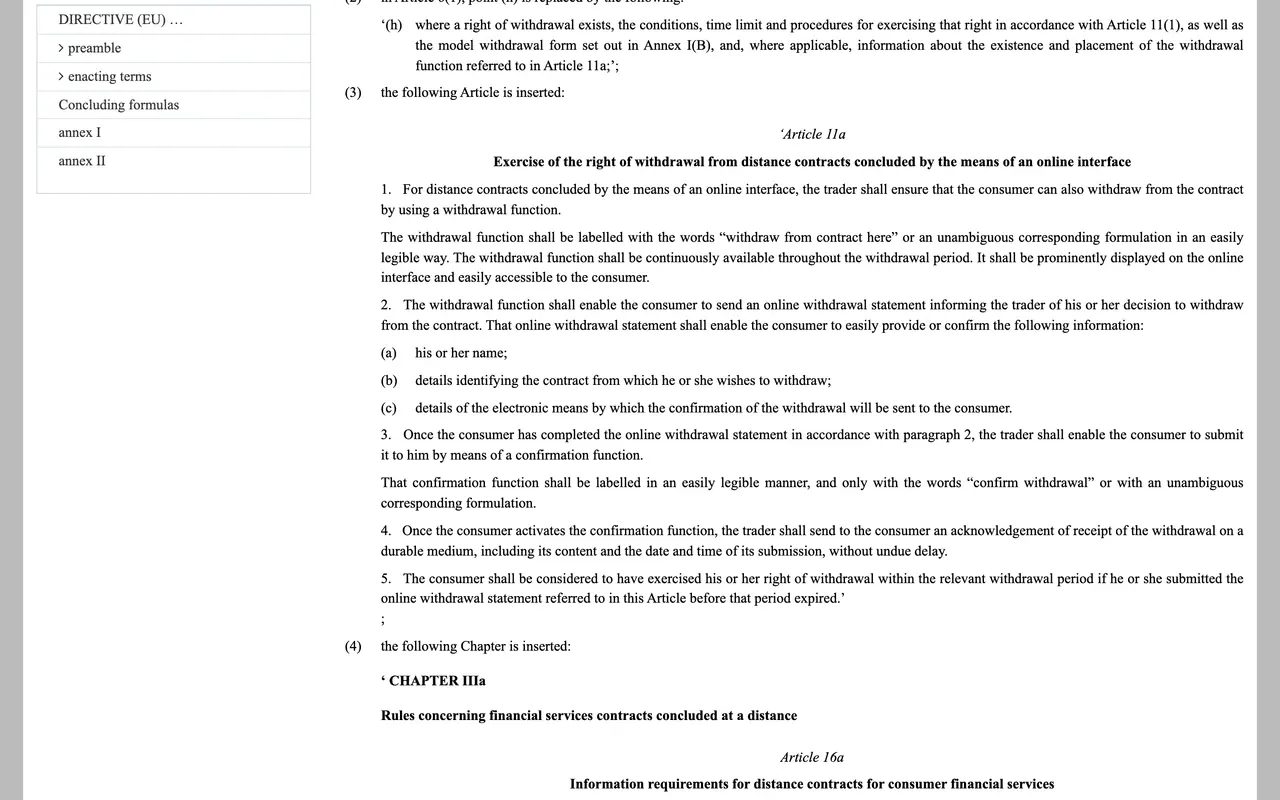
Directive (EU) 2023/2673 of 22 November 2023 adds Article 11a to the Consumer Rights Directive 2011/83. A trader who sells at a distance through an online interface, such as a webshop or an app, has to let the consumer withdraw through a withdrawal function as well. That function is labelled 'withdraw from contract here' or an unambiguous equivalent, stays available for the whole withdrawal period and is displayed prominently. The Dutch text uses 'hier de overeenkomst herroepen', the French text of the Belgian law 'renoncer au contrat ici'. A second step reads 'confirm withdrawal', and the shop then sends an acknowledgement on a durable medium with the content, date and time of the statement.
Member States had to transpose the rule by 19 December 2025 and apply it from 19 June 2026. Belgium did so with the law of 19 July 2026, published in the Belgian Official Gazette on 4 August 2026. Article 23 of that law inserts Article VI.61/2 into the Code of Economic Law. The law sets no start date of its own, so it has applied since 14 August 2026. Our news item on the EU withdrawal button covers what the button does and what you refund.
The function sits next to the model form; it does not replace it. The recital also says that a consumer who is already logged in should not have to identify again. Whether a function that exists only after login is enough, the text does not spell out. That is why our headline measure is narrow: an online withdrawal function visible without login, on the pages we looked at.
Paper forms and inboxes still carry most withdrawals
Every shop sits in one group, the strongest form we found on its pages. The second column keeps only the 1,995 shops where we read a terms, returns or withdrawal page. There, the share with a function rises to 5.6 percent and the share with no mention drops from 50.3 to 30.2 percent. Much of the silence in the first column comes from shops where we found no policy page, not from policy pages that said nothing.
| What we saw on the pages | All 2,824 webshops | 1,995 shops with a policy page read |
|---|---|---|
| Online withdrawal function without login | 112 (4.0%) | 112 (5.6%) |
| Function inside the customer account only, per the text | 11 (0.4%) | 11 (0.6%) |
| Model form only | 548 (19.4%) | 546 (27.4%) |
| Email address only | 236 (8.4%) | 235 (11.8%) |
| Right of withdrawal mentioned, no channel found | 496 (17.6%) | 488 (24.5%) |
| Not mentioned on the pages read | 1,421 (50.3%) | 603 (30.2%) |
| 14-day period mentioned | 1,376 (48.7%) | 1,370 (68.7%) |
| Link to the ODR platform | 298 (10.6%) | 297 (14.9%) |
Among the 907 shops that offer some channel, 784 use a model form or an email address: 86.4 percent. The model form is still valid. What differs is the effort: download a PDF, fill it in and email it, against a field for your order number and a button. Our guide to ecommerce legal requirements places the withdrawal rules among the other duties of a shop.
Where webshops drop out on the way to the withdrawal button
Webshops readoutside hospitality, up to four pages each
2,824With a terms or returns pagethat we could open
1,995 · 70.6%Mentions the right of withdrawal
1,403 · 49.7%Gives a route to withdrawfunction, account, model form or email
907 · 32.1%Withdrawal function without login
112 · 4.0%With a separate confirmation stepa second button to confirm the withdrawal
66 · 2.3%
Number of webshops, with the share of all shops read. Measured in November 2026.
From the terms page to a confirm button
The funnel follows the route a customer would take. 1,995 of the 2,824 shops link a terms, returns or withdrawal page we could read. 1,403 mention the right of withdrawal somewhere. 907 give a channel, 112 a function without login, and 66 of those 112 show a button to confirm or send the withdrawal in their HTML. For the other 46, that step may appear after the form is filled in; we never filled one in, so we did not see it.
The exact label is rare. Only 9 shops in the frame use 'withdraw from contract' or its Dutch, French or German counterpart word for word. The rest choose wording such as 'withdrawal form', 'cancel order' or 'herroepingsformulier'. Whether such a variant counts as an unambiguous equivalent is for a regulator or court to say, not for our count. If you want to build the function into your store, the options are in our guide to the withdrawal button in Shopify and WooCommerce.
A third of the 112 functions belong to one shared storefront platform run by a network: 38 businesses, nearly all in retail, with the same form and the same confirm button. Leave them out and the share falls to 74 of 2,786 shops, or 2.7 percent, with 28 shops keeping a visible confirm button. One choice made at network level outweighs hundreds of separate decisions.
Behind the login and inside JavaScript
We saw only what a visitor without an account sees. 11 shops write that you withdraw through your customer account, and 10 of them run on Shopify. That matches what Shopify announced: since 18 June 2026 its self-serve returns also take cancellation requests, and since 16 July 2026 EU buyers can file them through Shopify Managed Markets too. Shopify's help page says the customer requests it from their account, the merchant turns the feature on, and the return window must be at least 14 days. The same page adds that using these tools does not make a store compliant by itself. How many shops offer the function behind a login without saying so on a public page is beyond what we can measure.
A static read also misses whatever appears only through JavaScript, so we opened two groups in a browser without clicking or typing. In the first pass of 84 shops, the browser found 2 functions among 50 random shops where the HTML had shown 1. Of 17 shops with a known withdrawal widget, 14 displayed a form or an embedded frame. The 17 shops that build their whole page with JavaScript showed no withdrawal text on the home page in the browser either.
The second pass took 75 shops with a withdrawal link on the home page that we had not counted as a function. 66 pages opened, and on 10 of them (15.2 percent) a form appeared once the scripts had run. The true share with a function is therefore higher than 4.0 percent, though not by enough to change the picture. If 15.2 percent of the 784 shops with a model form or email address had a hidden function, the frame would land at about 8 percent.
Shopify stores show the function more often than WordPress stores
Custom or not recognised38 shops on one shared network platform, 367 shops
13.4%Shopify525 shops
7.6%Magento127 shops
3.9%Odoo178 shops
2.2%PrestaShop133 shops
1.5%WordPress / WooCommerce880 shops
0.8%Wix170 shops
0.6%JouwWeb65 shops
0.0%one.com Builder62 shops
0.0%Squarespace58 shops
0.0%Ecwid50 shops
0.0%Drupal44 shops
0.0%
Percent of the webshops outside hospitality per platform, only platforms with at least 30 shops. Measured in November 2026.
Shopify stores show it more often than WordPress stores
| Platform | Webshops | Function without login | Model form | Email only | Not mentioned | ODR link |
|---|---|---|---|---|---|---|
| WordPress and WooCommerce | 880 | 7 (0.8%) | 15.2% | 8.1% | 58.4% | 6.6% |
| Shopify | 525 | 40 (7.6%) | 21.3% | 13.7% | 30.7% | 8.4% |
| Custom or not recognised | 367 | 49 (13.4%) | 21.3% | 6.3% | 42.5% | 20.7% |
| Odoo | 178 | 4 (2.2%) | 15.2% | 7.9% | 62.4% | 2.8% |
| Wix | 170 | 1 (0.6%) | 5.3% | 4.7% | 81.2% | 2.4% |
| PrestaShop | 133 | 2 (1.5%) | 30.8% | 12.0% | 25.6% | 12.0% |
| Magento | 127 | 5 (3.9%) | 71.7% | 4.7% | 12.6% | 59.1% |
| JouwWeb | 65 | 0 (0.0%) | 15.4% | 0.0% | 72.3% | 4.6% |
| one.com Builder | 62 | 0 (0.0%) | 9.7% | 0.0% | 77.4% | 6.5% |
| Squarespace | 58 | 0 (0.0%) | 3.4% | 1.7% | 84.5% | 0.0% |
| Ecwid | 50 | 0 (0.0%) | 6.0% | 20.0% | 66.0% | 0.0% |
| Drupal | 44 | 0 (0.0%) | 13.6% | 6.8% | 56.8% | 11.4% |
The top score, for custom or unrecognised systems, comes mostly from the network platform: 37 of the 49 functions in that row. Without that group, custom systems reach 12 of 330, or 3.6 percent. Shopify stands at 7.6 percent, WordPress and WooCommerce at 0.8 percent. Shopify stores also more often carry a separate withdrawal policy: 75.2 percent mention the 14-day period, against 38.9 percent on WordPress. If you are weighing the two, see Shopify or WooCommerce.
Magento stands out for the model form: 71.7 percent of its 127 shops offer it, and 59.1 percent still link to the ODR platform. On Wix and Squarespace, more than 80 percent do not mention the right of withdrawal on the pages we read. A platform does not decide what a shop does; the same Shopify store can hold a function in the account and no public link at all. Our comparison of Wix vs Shopify covers the wider trade-offs.
Retail leads, pharmacies lean on the form
| Sector | Webshops | Function without login | Model form | Email only | Not mentioned | ODR link |
|---|---|---|---|---|---|---|
| Retail | 2,123 | 98 (4.6%) | 19.3% | 8.9% | 47.8% | 9.3% |
| Hospitality (separate) | 643 | 4 (0.6%) | 3.3% | 4.0% | 75.4% | 2.3% |
| Personal care and leisure | 198 | 1 (0.5%) | 13.6% | 6.6% | 65.2% | 6.1% |
| Health, many pharmacies | 190 | 3 (1.6%) | 41.6% | 6.3% | 40.0% | 36.8% |
| Construction and trades | 141 | 4 (2.8%) | 11.3% | 6.4% | 66.0% | 6.4% |
| Business services | 131 | 5 (3.8%) | 10.7% | 6.9% | 62.6% | 4.6% |
| Cars and transport | 41 | 1 (2.4%) | 4.9% | 9.8% | 65.9% | 7.3% |
Retail is the big group with 2,123 shops and supplies 98 of the 112 functions. In health, 41.6 percent offer the model form alone, the highest share of any sector, and more than one in three still link to the ODR platform. 89 of the 190 health webshops carry 'apotheek' or 'pharma' in their domain name. Our page on websites for pharmacies covers what else such a shop needs.
Hospitality counts apart because much of what people order online there falls outside the right of withdrawal. Article 16 of Directive 2011/83 excludes, among others, goods that deteriorate quickly and catering or leisure services tied to a specific date or period. That 75.4 percent of hospitality businesses do not mention the right of withdrawal therefore says little about the rule. Which orders fall under an exception depends on what each business sells, and we did not read that shop by shop.
Provinces sit close together
| Province | Webshops | Function without login | Model form | Email only | Not mentioned | ODR link |
|---|---|---|---|---|---|---|
| Antwerp | 567 | 31 (5.5%) | 18.7% | 7.9% | 49.6% | 10.9% |
| East Flanders | 532 | 20 (3.8%) | 22.0% | 7.3% | 49.8% | 11.3% |
| Brussels | 347 | 11 (3.2%) | 19.0% | 9.2% | 46.7% | 7.5% |
| West Flanders | 346 | 12 (3.5%) | 22.3% | 8.7% | 49.7% | 11.0% |
| Flemish Brabant | 307 | 14 (4.6%) | 16.3% | 8.1% | 57.0% | 12.4% |
| Limburg | 184 | 8 (4.3%) | 16.8% | 7.6% | 53.3% | 13.0% |
| Liège | 148 | 4 (2.7%) | 25.7% | 12.8% | 47.3% | 8.8% |
| Hainaut | 133 | 5 (3.8%) | 20.3% | 6.8% | 46.6% | 9.0% |
| Walloon Brabant | 126 | 3 (2.4%) | 12.7% | 7.9% | 54.0% | 9.5% |
| Namur | 80 | 1 (1.2%) | 15.0% | 8.8% | 46.2% | 10.0% |
| Luxembourg | 54 | 3 (5.6%) | 14.8% | 11.1% | 57.4% | 9.3% |
Among provinces with at least 100 shops, the share with a function runs from 2.4 percent in Walloon Brabant to 5.5 percent in Antwerp. That gap is below our threshold of five points, so we treat the provinces as roughly equal. Namur and Luxembourg have fewer than 100 shops. Site language makes little difference too: 4.1 percent on Dutch-language shops, 2.9 percent on French-language shops and 5.9 percent on English-language shops.
Healthcare webshops link to the ODR platform most often
Healthcaremany pharmacies, 190 shops
36.8%Retail and trade2,123 shops
9.3%Automotive41 shops
7.3%Construction and trades141 shops
6.4%Beauty and leisure198 shops
6.1%Business services131 shops
4.6%Hospitality643 shops
2.3%
Percent of all readable webshops per sector, hospitality included. Measured in November 2026.
A link to a platform that no longer exists
The second finding concerns a link that is no longer required. Regulation 524/2013 required webshops to link to the European online dispute resolution platform, the ODR platform. Regulation (EU) 2024/3228 repealed it with effect from 20 July 2025, and complaints could no longer be filed from 20 March 2025. Yet 10.6 percent of the 2,824 shops still link to it, 298 in all. Among shops with a policy page we read, the figure is 14.9 percent.
The link often sits where the withdrawal information sits: in the terms, in the footer or next to the model form. Of the 112 shops with a function, 49 still carry an ODR link, including all 38 on the network platform. In health it is 36.8 percent, on Magento 59.1 percent. The link sends customers to an address that no longer does anything, and anyone rewriting their terms for the withdrawal button can delete that line in the same pass. Our study of legal requirements on business websites measures the other details a company site has to show.
What the home page already showed
In our study of ecommerce accessibility in Belgium, we read only the home pages of the same list on 5 November. That pass found 40 withdrawal functions and 117 ODR links. Reading up to four pages further, the same list with hospitality included now gives 116 functions across 3,467 shops (3.3 percent) and 313 ODR links. The gap comes from the extra pages, not from new shops, because both measurements fall in the same week.
The pattern is familiar. The accessibility law has applied to most webshops since 28 June 2025, as our guide to the European Accessibility Act explains, yet only 2.8 percent of the same shops linked a statement from their home page. In our state of Belgian business websites, more than half of working sites lacked basics such as a description or a heading. The withdrawal button follows the same line: the rule applies, and on most pages we read we did not see the function yet.
Three checks for your own webshop
If you sell online to consumers, your shop falls under Article VI.61/2 of the Code of Economic Law for every sale that carries a right of withdrawal. Start with three checks. Is there a prominently displayed link, for instance in the footer, reading 'withdraw from contract here' or clearly similar wording? Can the customer enter or confirm their name, their order and the email address for the acknowledgement there, followed by a 'confirm withdrawal' button? And do they get an acknowledgement without undue delay with what they sent, the date and the time?
On Shopify, check that self-serve returns are switched on and that a visitor without an account can still find the way. On WordPress and WooCommerce, where 0.8 percent show a function, you need a plugin or a form of your own. Give your terms the same pass: remove the ODR link and keep the model form next to the button rather than in its place. The form handles personal data, so review your privacy notice with our guide to a GDPR-compliant website.
If you are building or rebuilding a shop, design the function in from the start instead of squeezing it into a footer later. In a webshop we build, the withdrawal flow is part of the order and account structure. For budgets, read what an ecommerce website costs, and if you are tempted to do it yourself, see can I build my own online store.
What shop owners ask before adding the button
Is the withdrawal button mandatory for a Belgian webshop?
Yes, for a shop that sells to consumers at a distance through an online interface, for every sale that carries a right of withdrawal. Article VI.61/2 of the Code of Economic Law, inserted by the law of 19 July 2026, has applied since 14 August 2026. Member states had to apply the EU rule from 19 June 2026. In November 2026, 4.0 percent of 2,824 Belgian webshops showed such a function without login.
What must the button say?
'Withdraw from contract here' or an unambiguous equivalent. In Dutch the text is 'hier de overeenkomst herroepen', in French 'renoncer au contrat ici'. The second step reads 'confirm withdrawal'. Only 9 of the 2,824 shops used the exact words.
Can I keep using the model withdrawal form?
Yes, the model form stays. The function comes on top of it, not instead of it. Today 548 shops, or 19.4 percent, offer the model form alone.
Is withdrawal through the customer account enough?
The text does not say so in as many words. The directive asks for a function that is displayed prominently and easy to reach, and a consumer who is already logged in should not have to identify again. A guest who ordered without an account has no account to log into. 11 shops point to the account only.
Should the ODR link come out of my terms?
The duty to link to the ODR platform ended on 20 July 2025, when Regulation 2024/3228 repealed the old rule, and the platform is gone. Even so, 10.6 percent of the 2,824 shops still link to it.
Does the button apply to a restaurant taking online orders?
The right of withdrawal has exceptions, among them goods that deteriorate quickly and catering tied to a specific date (Article 16 of Directive 2011/83). A gift voucher or a package without a fixed date does not automatically fall under those exceptions. Where no right of withdrawal exists, no withdrawal function is needed. That is why we counted the 643 hospitality businesses separately.