Meta ads for estate agents
Facebook ads for real estate, inside the housing rules
Ads for homes to buy or rent fall under Meta's housing category: no age, gender or postcode targeting. Here is what still works and how to build it.
Housing ads play by their own rules.
Facebook and Instagram are where people scroll past homes they did not know they wanted. For an estate agent or a letting agent, that makes Meta one of the best places to show listings, open days and valuation offers. It is also one of the most regulated: housing is a special ad category, and UK listings must carry material information.
This page explains both sets of rules and the campaigns that work inside them: listings, valuations and landlord leads.
The housing special ad category
Any ad for a home to buy or rent, for mortgages, home insurance or related services must be declared as a housing ad. Meta then limits the targeting, to stop ads from excluding people by age, gender or where they live.
| Setting | Normal ad | Housing ad in Europe |
|---|---|---|
| Age | any range | 18 to 65+, fixed |
| Gender | choose | all, fixed |
| Location | any area, exclusions allowed | radius of at least 15 km, no exclusions |
| Detailed targeting | interests and behaviours | limited, no exclusions |
| Lookalike audiences | yes | no |
| Custom audiences | yes | yes, with limits |
If you do not declare the category, Meta may reject the ad or restrict your account. The rules apply to the ad's content, so an agency that "just promotes its brand" with a house in every photo still needs the category. Read the full rules in special ad category.
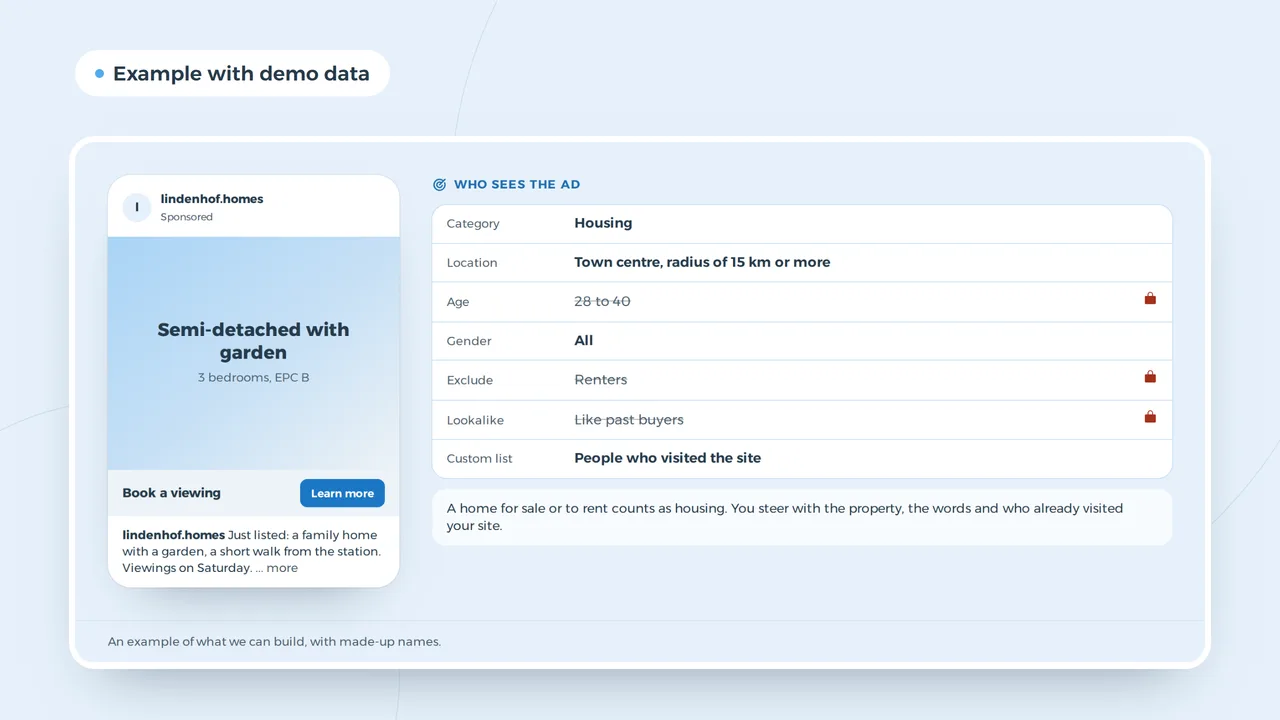
A listing ad with the material information visible
Who sees the ad
- Category
- Housing
- Location
- Town centre, radius of 15 km or more
- Age
- 28 to 40
- Gender
- All
- Exclude
- Renters
- Lookalike
- Like past buyers
- Custom list
- People who visited the site
A home for sale or to rent counts as housing. You steer with the property, the words and who already visited your site.
An example of what we can build, with made-up names.
Material information on UK listings
National Trading Standards expects every property listing to show material information. Part A covers the basics that must be there whatever the property: the price or rent, the council tax band and the tenure. An ad that links to a listing should send people to a page that has them; an ad that shows a single property should not hide the price.
| Part A item | For sale | To let |
|---|---|---|
| Price or rent | asking price | monthly rent and deposit |
| Council tax band | yes | yes |
| Tenure | freehold, leasehold, share of freehold | not required in the same way, but state the landlord type if relevant |
Campaigns that work inside the rules
- ListingsA carousel or a short video tour of new instructions, to everyone in the 15 km radius, linking to the listing page.
- ValuationsThe campaign that brings instructions: "What is your home worth?" with a lead form or a valuation page. It is still a housing ad.
- LandlordsFor letting agents, ads aimed at landlords about management and compliance. These are about a service to landlords, but if they show homes, declare the category.
- Open daysAn event ad for a new development, with the date and the place.
Without age and postcode targeting, the creative and the landing page do the selecting. A video tour of a family home attracts families; a post about buy-to-let yields attracts investors. Meta's delivery learns from who responds.
Measuring valuation leads
Count a valuation request as the result, not a click. A lead form inside Facebook is quick but brings colder leads; a valuation page on your site with the Meta pixel behind consent gives better ones. Feed the leads into your real estate CRM, so you can see which campaign led to an instruction months later. Tag links with the UTM builder so Analytics shows Meta next to Rightmove and Zoopla traffic.
Ad texts that pass review
Write about the home, not about the reader. "Three-bed semi near the station, freehold, band C" passes; "Tired of renting?" points at a personal situation and risks a rejection. Avoid words that suggest who the home is for, such as "perfect for young professionals": it reads as excluding people, which the housing rules are there to prevent. Preview the post in the Facebook ad preview.
Retargeting and your own audiences
Retargeting still works for housing ads, with limits. You can show ads to people who visited your site or engaged with your page, but Meta does not let you build lookalike audiences from them, and you cannot exclude people by age, gender or postcode. In practice:
| Audience | Allowed for housing ads | Notes |
|---|---|---|
| Website visitors | yes, with the pixel behind consent | the most useful audience for agents |
| People who engaged with your page or videos | yes | good for open days and new listings |
| Your customer list | yes, with limits | only with consent to use it for ads |
| Lookalikes of any of these | no | Meta blocks them under the category |
| Exclusions by age or area | no | the category removes them |
A visitor who looked at three-bed homes and a valuation page is worth showing your next new instruction to. Keep the message about the property and the service, never about the visitor. UK GDPR vs EU GDPR explains the consent you need for lists and pixels if you also market to buyers in Ireland or the rest of Europe.
Lead form or valuation page
A Facebook lead form keeps people inside the app and fills in their name and phone for them. That makes it easy, which brings more leads and more weak ones. A valuation page on your site asks a little more effort and gives better leads. Many agents run both and compare the share that becomes a market appraisal before they move budget. Whichever you pick, answer within the hour: a seller who asked three agents usually picks the first one who calls.
Next to Google and SEO
Facebook brings people before they search. Google brings sellers who search "estate agent near me" or "house valuation". For the full channel mix for agents, read real estate marketing. For AI tools that write listing texts and answer enquiries, see AI for real estate.
Seller leads and buyer leads
An estate agent runs two kinds of campaign. Buyer campaigns show a property to people in the area; the housing category limits who you can choose, so the photos and the price do the selecting. Seller campaigns look for owners who might sell: a free valuation, a recent sale in the street, a guide to selling in the town. Seller leads are worth more, take longer and need a page that asks for the address and the timing, not just an email.
Keep the two apart in Ads Manager, with their own budget and their own form. Then you see what a valuation request costs next to what a viewing request costs, and you stop paying for buyers when your stock is low.
Questions from estate agents
Can I target first-time buyers?
Not by age. Housing ads in Europe must reach 18 to 65+. Use the creative and the property to attract first-time buyers.
Does a brand ad need the housing category?
If it shows or promotes homes, yes. A pure recruitment ad for your own staff falls under the employment category instead.
Can I use my email list?
Custom audiences are allowed with limits, as long as you have the right consent under UK GDPR to use the list for ads.
Facebook and Instagram
How VBS builds property campaigns
We declare the category, check each listing ad for price, council tax band and tenure, and measure valuations from the first day. For Les Terrasses de Durbuy we made the reels and carousels that ran as Meta ads; for agents we apply the same craft inside the housing rules. Campaigns run under our Facebook and Instagram ads service. For agents that also manage property, see property management and property management website design.
More valuations from Facebook?
Send us your area and a recent listing. We tell you how the campaign fits the housing rules.
Rather get in touch right away?