Industries: print shops
Web to print software and an MIS built around your UK print shop
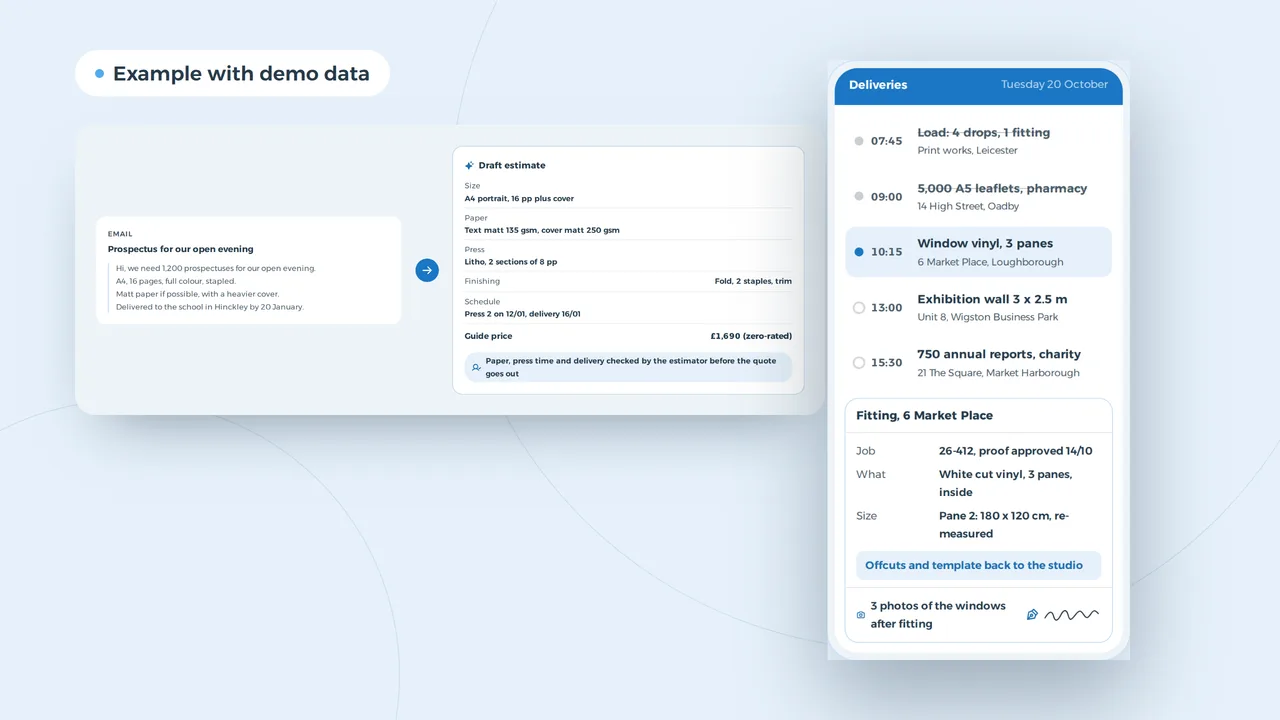
Quotes that price run length, stock and finishing in one go, a job that carries the approved proof from artwork to dispatch, a schedule per press, and VAT that knows a leaflet from a poster. Built around how your print shop works, or around the system you already run.
Most print margin is won or lost before the press runs
A print shop's day starts in the inbox. Fourteen enquiries, a customer at the counter with artwork on a memory stick, a PDF in RGB with no bleed, and a rush job that pushes tomorrow's litho run to Thursday. Every enquiry needs a quote built from run length, stock, sheets, plates or clicks, finishing and delivery, and a slip in that quote costs the margin on the whole job.
In many shops that work lives in the owner's spreadsheet, a mailbox full of proofs, a whiteboard next to the presses and an accounts package that sees nothing until month end. Which proof the customer signed off sits in an email nobody can find when the leaflets come off the press with last year's date on them.
Print management software, often called an MIS in the trade, puts the job at the centre: quote, artwork, proof, press, finishing, dispatch and invoice. Below we cover what we build for each need, which UK rules belong in the system, what fits your size, and a worked example of the time a quote takes today.
A print day in five moments, and where it pinches
Print shops run short jobs with many steps. A run of 2,500 leaflets passes through as many hands as 750 annual reports, only faster. The money leaks at the handovers: between the email and the estimate, between the artwork and the proof, between the proof and the press.
| Time | What happens | Where it pinches |
|---|---|---|
| 08:00 | Enquiries by email, phone and counter | Each estimate rebuilt in a spreadsheet, stock prices out of date |
| 10:00 | Artwork arrives | RGB, no bleed, images under 300 dpi, fonts not embedded |
| 13:00 | Proof out to the customer | Three versions in three emails, nobody sure which was approved |
| 15:00 | Scheduling by press | A rush job shifts everything, the stock turns out to be short |
| 17:00 | Dispatch and invoice | Paper delivery note, invoice days later, VAT rate checked by hand |
A bigger screen in the press hall rarely fixes this. A job that carries every step does, so the printer at the press sees the same spec as the estimator who wrote the quote. You decide which steps your jobs pass through; the software follows that order.
A school's email becomes a draft estimate
An example of what we can build, with made-up names. You set the pricing rules, the AI fills them in.
Estimates built from your own price rules
Most enquiries do not arrive through a form. They arrive as a few lines in an email: 1,200 brochures, A4, sixteen pages, matt, needed by 20 January. AI reads that email and builds a draft estimate with your price rules: size, stock, number of sections, finishing and an indicative price. Your estimator checks it and sends the quote. If something is missing, such as delivery or the cover stock, the AI drafts the question in a reply. The price itself never comes from the AI; it comes from your rules, and a person signs it off. More on what such an assistant does in AI quote generator and AI automation.
Behind that sits the estimating logic: run length converted to sheets, the stock and sheet size that waste least, overs, plates for litho or clicks for digital, then finishing step by step: guillotine, folding, stitching, perfect binding, lamination, packing. Set those rules once and anyone can quote by choosing a product and a quantity. The same rules can drive a product configurator on your website, so customers see a price for standard work like leaflets and business cards; how that looks as a shop is on printing company website design.
An annual report of 64 pages waits for sign-off
The customer follows the job through a link: view the proof, add comments and approve.
An example of what we can build, with made-up names. You choose the stages a job runs through.
Preflight and proofs in the same job
After the quote comes the artwork. A preflight check on upload looks at colour mode, bleed, resolution, embedded fonts and page count, and tells the customer straight away what needs fixing, rather than two days later through your studio. What passes goes back as a proof, with a button to approve or leave a comment on the spot that needs changing. The approved version is locked, with a name and a time, and travels with the job to the press and the delivery note.
Regular customers, such as schools, councils, charities or businesses with brand work, get a client portal where they find their jobs, proofs and invoices and reorder a previous job with a new quantity. If you already use a template for quotes, the quote template is a starting point for the fields a quote should show.
170 gsm silk runs short for next week's jobs
Silk 170 gsm is below 2,000 sheets
Three jobs next week need 5,400 sheets between them; the merchant delivers in two working days. Proposal: order 6,000 sheets today and add the magenta to the same delivery.
An example of what we can build, with made-up names and numbers. You choose the level at which each stock raises an alert.
Stock, ink and a schedule for each press
A print shop schedules machines as much as people. The litho press, the digital press, the guillotine and the folder each have their own queue, and a job can only go on press once the stock is in and the proof approved. A schedule in software shows each press's jobs for the week with proof and stock status beside them. When a rush job comes in, you see which job moves and whether the date you promised that customer still holds. Where a spreadsheet stops and software starts is covered in Excel scheduling or planning software.
Paper is usually the biggest purchase. Stock per grade and sheet size should know what is already allocated to scheduled jobs, not only what sits in the warehouse, so the reorder alert arrives while the merchant can still deliver in time. How scanning and alerts work is set out on inventory management software. Rota planning per shift links in through staff scheduling software, so a press is never booked on a day without a printer.
Window graphics with the approved proof on the job sheet
- The proof travels with the jobThe version the customer approved sits on the job sheet. The fitter sees what was signed, not an older draft.
- Photos close the jobOnce the photos are in, the job is marked delivered and the invoice is ready, with the photos attached.
- A problem reported on the spotIf a size is off, a photo with the real measurement goes to the studio before the vinyl is cut again.
An example of what we can build, with made-up names. You choose what a job sheet asks for.
Delivery and fitting from a phone
Plenty of printers deliver their own work, and those who do signage, banners or exhibition stands also fit it. A work order app on the phone gives the driver the route, the approved proof and the measurements, and asks for photos and a signature on delivery. The photos close the job and queue the invoice. If a measurement is off, a photo reaches the workshop before anything is cut again, not after a second trip.
A pub looks for leaflet printing in Leicester one evening
Quote request: 2,500 A5 leaflets
Double sided, Silk 170 gsm, artwork uploaded, delivery Friday
The Swan, Belgrave, Today, 21:14
- Searches in the evening
- Sees the price per run
- Uploads the artwork
- Gets the proof next morning
An example of what we can build, with made-up names. You choose which products show a price on the site.
Being found for what people want printed
A club, a pub or a small firm does not search for a printer. It searches for leaflets, flyers, business cards or a banner, ideally with a price. Showing up for those searches in your own town brings enquiries that are already half filled in. That takes a page per product with options and a price, your shop on the map with recent reviews, and local SEO for the towns you deliver to. For repeat products, a shop with prices by quantity and an upload is the fastest channel; larger jobs arrive better through a form that asks for the spec and takes the file.
Litho printer wanted for the day shift
An example of what we can build, with made-up names. You choose the questions an applicant answers.
Finding printers, finishers and studio staff
A good litho printer or a designer who understands preflight is rarely found through a general job board alone. A vacancy page on your own site that names your presses, your shifts and what someone will learn draws people from the trade who already know your shop. Applying takes a minute on a phone, with a question about the machines someone has run. You see at once who should come in for a trial day, and who fits better in finishing.
Before an estimate goes out
- Stock prices updated from your merchant's latest list
- Run length, sheet size and imposition checked against the press
- Finishing steps priced, including packing and delivery
- VAT treatment set for the product: zero-rated or standard-rated
- Delivery date checked against the press schedule
- Proof rounds included, and what an extra round costs
- Terms on personalised goods and artwork ownership attached
Copy shop, team of five or a forty-person printer
Not every print shop needs an MIS. A sole trader with one digital press should not buy an ERP, and we would not sell one. What fits depends on job volume, the presses and how many people touch each job.
| Size | How work flows | What fits |
|---|---|---|
| Sole trader, copy shop or one digital press | Counter, email, short runs | A website with a price list and upload, invoices from your accounts package. No ERP. |
| Team of 5 | Litho or digital, finishing in house | An estimating module with price rules, a job list with proof status and an integration with your accounts |
| 20 to 50 staff | Several presses, shifts, own delivery | An MIS package or custom ERP around press scheduling, stock and a client portal |
| Larger, several sites | Web to print, big contract customers | A package with integrations, plus custom work for what the package cannot do |
What a package costs against custom work is in ERP cost. Already on Odoo? Odoo or custom software sets out where a module of your own pays off.
VAT, imprints and personalised goods: the UK rules
Few trades deal with as many VAT rates on one invoice as printing. On top of that come rules that affect your customers but that you, as the printer, often see first.
| Rule | What it asks | What the software does |
|---|---|---|
| Zero-rating printed matter (VAT Notice 701/10) | Books, booklets, brochures, pamphlets, leaflets, newspapers, journals, maps and printed music are zero-rated. Stationery, posters, business cards, letterheads, calendars, forms and tickets are standard-rated. A leaflet is a single sheet no larger than A4 (or up to A2 printed both sides and folded to A4), meant to be held in the hand, in a run of at least 50, on limp paper; a laminated item is not a leaflet. | Each product carries its VAT treatment, and the estimate flags items near the line |
| Making Tax Digital for VAT (Notice 700/22) | VAT-registered businesses keep digital records and file returns through compatible software. Data moving between programs needs a digital link; copying and pasting does not count. | Invoices flow to your accounts package through an API or a file import |
| Imprint on election material (Representation of the People Act 1983, s110) | Printed election material carries the name and address of the printer, the promoter and anyone on whose behalf it is published. | Election jobs ask for the imprint details and block the proof until they are on it |
| Personalised goods (Consumer Contracts Regulations 2013, reg 28) | The 14-day cancellation right does not apply to goods made to the consumer's specifications or clearly personalised. | The shop states it before checkout; have your terms reviewed |
| Mailing lists (UK GDPR, article 28) | Address lists for a mailing are personal data; you process them for your customer under a written contract. | Address files stored apart and deleted after the job |
What is coming for invoices is covered in e-invoicing in the UK, and the differences between the UK and EU data rules in UK GDPR vs EU GDPR. Check borderline VAT cases with your accountant or with HMRC.
Worked figures: twenty quotes a week
| Item | Today | With price rules and a draft estimate |
|---|---|---|
| Minutes per estimate | 20 | 6 |
| Minutes per week | 400 | 120 |
| Hours per year | about 307 | about 92 |
| Difference per year | about 215 hours |
Those hours go back to whoever writes the quotes, often the owner. On top comes what does not show in hours: a quote that leaves the same day rather than two days later, and a stock price that is right because it is kept in one place. Run it with your own numbers; the break-even calculator shows when an investment pays for itself.
A conversation first, then a fixed price
- FirstA conversation about your jobsHow does an enquiry come in, who estimates, how does a proof reach the customer, and what does the printer see at the press? We walk through an ordinary week, rush job included.
- NextA fixed price per projectWe pick where you lose most time or margin and give a fixed price for that part. Websites start from 1,500 euro; software gets its own fixed price after the conversation.
- ThenBuilt on your own prices and jobsWe build with your real stocks, price rules and a few jobs from last month, so you can see whether the estimates match before anyone relies on them. Timings for larger systems are in how long an ERP implementation takes.
We have not yet worked for a print shop; we did build a site with two calculators that visitors fill in themselves for SN Group, and a management platform that replaced the spreadsheets at Business Centrum.
Questions printers put to us
- Will you replace our MIS?
- Usually not. If your package handles estimating and scheduling well, we build what is missing: a web to print shop, a client portal or an integration. If it does not suit your jobs, we look together at whether custom work pays off.
- Can customers approve proofs themselves?
- Yes. The customer gets a link to the proof, leaves comments or approves, and that version is locked. You see who approved it and when.
- Can litho and digital be priced separately?
- Yes. Each press gets its own rules: plates and overs for litho, clicks and stock for digital. The estimate picks the cheaper press for the run length, or you choose.
- Does it work with Xero, Sage or QuickBooks?
- We connect through their APIs, so invoices and VAT reach your accounts digitally, as Making Tax Digital expects. For other systems, see API integration and Exact Online integration.
- We also do signage and large format. Does that fit?
- Yes. Price per square metre, materials and fitting sit in the same job, with a work order for the fitter. Shops that also cut metal or panels will find more under metal fabrication.
Custom software
How VBS helps you with this
We build the platform your business runs on every day: your spreadsheets, emails and paperwork in one system that does what you do.
- Your workflow mapped first, then a fixed price
- Screens for the office, the client and the road
- Hosting, backups and security managed by us on AWS
How we approach it is on our page about Custom software.
Every job from quote to invoice in one place?
Tell us how an enquiry moves through your print shop and we will show where we would start. Or book a conversation straight away.
Rather get in touch right away?