Google Ads for business to business
Google Ads for B2B, measured on deals instead of form fills
A buyer who searches for your product is worth more than a hundred clicks from students and consumers. Here is how to find the first and keep out the rest.
Few searches, high value.
A B2B account rarely has volume. It has a few dozen searches a week from people who could sign an order worth months of revenue. Every setting serves those few.
Why B2B accounts waste money
Most business to business accounts we open have the same three leaks. The keywords are too broad, so a search for "pallet racking" also shows to someone who wants one shelf for the garage. The tracking counts every form as a win, so Google learns to bring in job seekers and price shoppers. And nobody tells Google which of those leads became a customer, so the bidding never learns the difference.
The fixes are not exotic. Tight keywords and a long list of exclusions, a form that asks enough to qualify, and the outcome of each lead sent back from your CRM. The rest of this page goes through them in order.
| Leak | What you see | Fix |
|---|---|---|
| Broad keywords | clicks from consumers and students | phrase and exact match, product names, trade terms |
| No exclusions | searches with free, jobs, DIY, cheap | a negative list from day one |
| Every form counts | many leads, few deals | count qualified leads and deals, not form fills |
| No feedback from sales | bidding chases the cheapest lead | import CRM stages back into Google Ads |
| Home page as landing page | buyers look for specs and leave | a page per product or application |
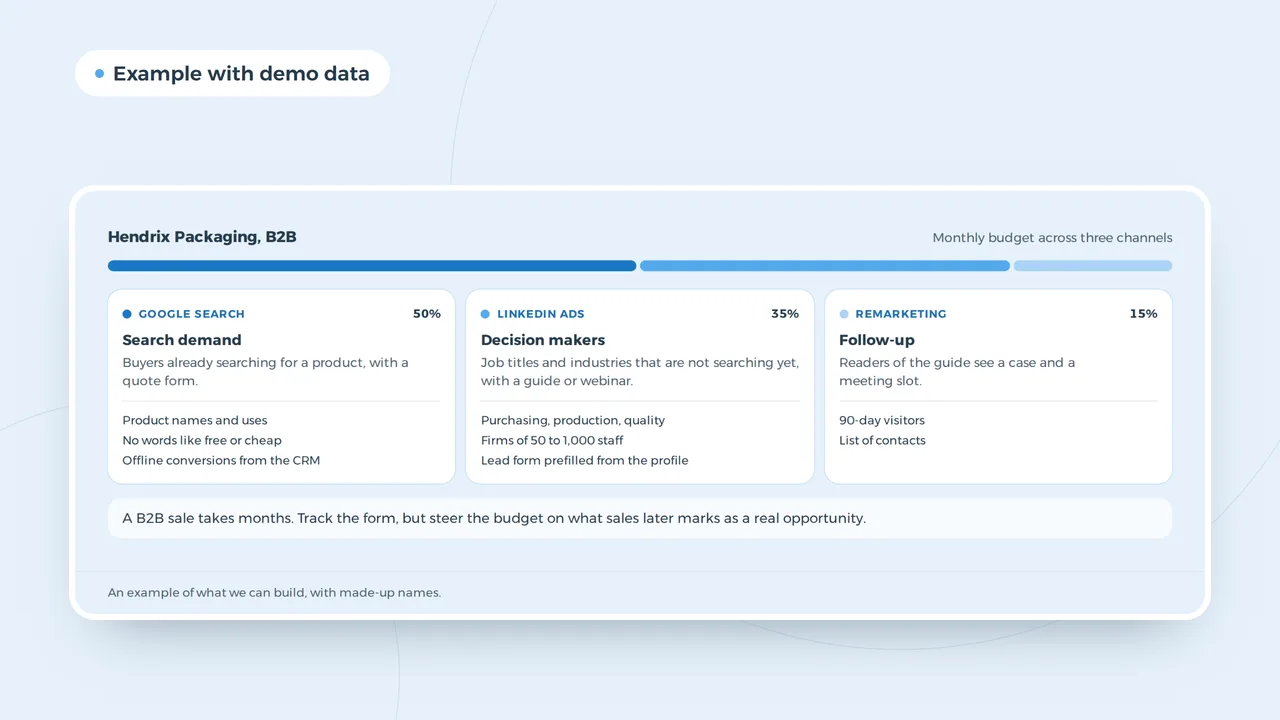
A B2B ad plan across three channels
A B2B sale takes months. Track the form, but steer the budget on what sales later marks as a real opportunity.
An example of what we can build, with made-up names.
Keywords buyers actually type
A purchasing manager does not search like a consumer. They type product codes, materials, norms and applications: "food grade stretch film 23 micron", "ISO 9001 machining subcontractor", "pallet racking inspection SEMA". Those searches are rare, but almost every click is relevant. Start with them, in phrase and exact match, and leave broad match until your conversion data is good.
Write the list from three sources: what your sales team hears on the phone, the search terms report of any account you already run, and your own product sheets. Then add the exclusions. A starting list for most B2B suppliers looks like this.
| Exclude | Why |
|---|---|
| free, cheap, DIY, homemade | consumers and hobbyists |
| job, jobs, vacancy, salary, course | job seekers and students |
| Amazon, eBay, B&Q and other retail names | people who want one unit |
| definition, meaning, pdf, wiki | research without a purchase |
| competitor brand names, unless you choose to bid on them | expensive clicks with low intent |
How negative keywords work, and how to keep them from blocking good searches, is in Google's help on negative keywords. For the wider question of whether a niche even has enough searches, see keyword research and search volume.
A form that qualifies
Ask what sales needs to know: company, role, volume or project size, timing. Every field costs a few enquiries, but the enquiries you keep are worth calling back. A short form that brings in fifty students is not cheaper than a longer form that brings in five buyers. If you sell online to businesses as well, keep the quote form and the checkout apart, so Google learns from both.
Send the outcome back to Google
This is where B2B accounts win or lose. Google only knows that someone filled in a form. Your CRM knows whether that person became an opportunity and a customer. With offline conversion import, or enhanced conversions for leads, you send those stages back. Google then bids more for searches that bring deals and less for searches that only bring forms.
| Stage in your CRM | Send to Google Ads as | Value |
|---|---|---|
| Lead | primary conversion at first | a small fixed value |
| Qualified lead | primary conversion once you have volume | a higher value |
| Opportunity | secondary, to watch | estimated deal value |
| Deal won | primary when there are enough per month | the real deal value |
You need a CRM that stores the click ID or the email address of the form, and someone who updates the stages. Without that, Google keeps optimising for the cheapest form. If you work with Google Tag Manager, the click ID is easy to pass into a hidden field.
LinkedIn for people who are not searching yet
Google reaches buyers with a need today. Most of your future customers do not have that need this month. On LinkedIn you reach them by job title, industry and company size, with a guide, a case or an invitation instead of a quote form. A click is more expensive than on Google, so use it for a narrow list of roles and companies. What that costs is in LinkedIn ads cost; how B2B and B2C buying differ is in B2B and B2C.
Remarketing ties the two together
A buyer visits your site three or four times before they ask for a quote, often over weeks. Remarketing shows them a case, a spec sheet or a demo invitation on Google and LinkedIn in between. Keep the frequency low and exclude existing customers. The setup, and the consent it needs in the UK and the EU, is in Google Ads remarketing.
The page after the click
A buyer who searched for a product code wants that product: specs, sizes, certifications, lead time, and a way to ask for a price without phoning. Send each ad group to the page for that product or application, not to the home page. A landing page per product line is usually the best investment in a B2B account. If your site cannot do that, look at a B2B website first.
Budget and patience
A small B2B account might see ten or twenty relevant clicks a day. That is too few for automated bidding to learn quickly, so start with manual or enhanced bidding on a narrow set of keywords and switch to target CPA once you have a steady flow of qualified leads. Work out what your budget buys with the Google Ads budget calculator, and read the typical click prices in Google Ads cost. A click in a B2B niche costs more than in retail, because one customer is worth more.
Mistakes we see in B2B accounts
Bidding on the company name of a large competitor without a plan, sending every click to a contact form with one field, measuring a download of a brochure as a lead, and running Display to cold audiences on a small budget. Each of these makes the reports look busy while sales sees nothing. Cut them first, before you add anything new.
Questions about Google Ads for B2B
Is Google Ads good for B2B?
Yes, when people search for what you sell. If your product is new or your buyers do not search for it, start with LinkedIn and content, and use Google for the brand and product searches that follow.
Should I use Performance Max for B2B?
Rarely at the start. Without CRM data it finds cheap forms, not buyers. A search campaign with exact keywords gives you control until the lead data is good.
How long before a B2B campaign shows results?
The clicks start on day one. Whether they bring deals takes as long as your sales cycle, often two to six months. Judge the first weeks on lead quality, not on deals.
Google Ads
How VBS runs B2B campaigns
We start with the keywords your sales team recognises and a negative list, build or improve the product pages that the ads point to, and connect the form to your CRM so qualified leads flow back into Google Ads. For Park & Wash we built the tracking so that a fleet request from a company counts separately from a contact from a private customer, through a Meta pixel that loads only after consent. That split is what a B2B account needs: a business lead and a consumer question are not the same result.
Fewer leads, more buyers?
Tell us what you sell and to whom. We tell you which searches are worth paying for.
Rather get in touch right away?