On this page
Responsive search ads replaced the old expanded text ads, which can no longer be created. Instead of one fixed ad, you supply the building blocks. Google tests which combinations get clicks for which searches, and shows the winner more often. That makes writing them a different job: every headline has to work next to any other.
The limits
| Part | Number | Characters | Shown per ad |
|---|---|---|---|
| Headlines | at least 3, up to 15 | 30 each | up to 3 |
| Descriptions | at least 2, up to 4 | 90 each | up to 2 |
| Display path | 2 fields | 15 each | both |
| Final URL | 1 | the domain shows |
On mobile Google often shows only two headlines and one description. Put what matters most in the headlines, not at the end of the second description. You can see how your texts fall with the responsive search ad preview.
Writing headlines that mix
Because any headline can stand next to any other, each one has to make sense alone. Write them in groups: a few with the service and the place, a few with a reason to choose you, a few with the next step. Avoid three headlines that say the same thing in different words; Google then has nothing to test.
| Group | Example for an accountant |
|---|---|
| Service and place | Accountant for Startups, Leeds |
| Reason | Fixed Monthly Fee, No Surprises |
| Proof | Xero and QuickBooks Certified |
| Next step | Book a Free Intro Call |
Claims like "certified" or a price must be true and on the landing page. Google's editorial rules also forbid excessive capitals, repeated punctuation and gimmicky symbols.
Pinning
You can pin a headline to position 1, 2 or 3. That is useful when one line must always show, such as a regulated disclaimer or your brand. Every pin cuts the number of combinations, so pin as little as possible. Pinning two or three headlines to the same position keeps some variety.
Ad strength
Google rates each ad from poor to excellent, based on how many unique headlines and descriptions you wrote and whether they contain your keywords. Ad strength is advice, not a result: an ad rated average can bring more customers than one rated excellent. Judge on CTR and conversions, and read what a good CTR is for a benchmark.
Where they fit
Every search campaign uses responsive search ads, and Performance Max builds its search ads from the same kind of parts; see Performance Max. Examples by trade are in Google Ads examples, and the account setup around them in how to set up Google Ads. What a click costs is in Google Ads cost and in the CPC entry.
Measuring and rewriting
After a few weeks Google shows per headline and description how often each was shown and in which combinations. Replace the headlines that almost never show with a new angle, and leave the rest. Do not change everything at once, or the learning starts over. Tag links outside Google Ads with the UTM builder, so Analytics shows what the ad adds next to your other channels.
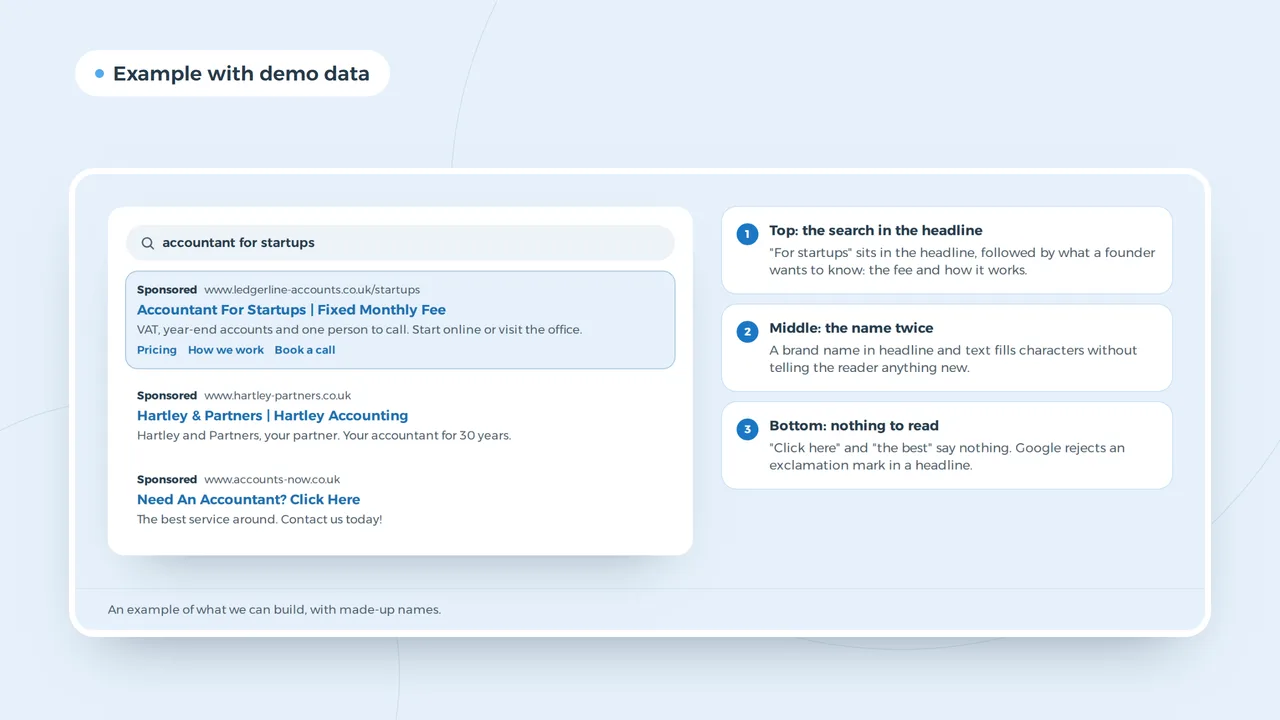
Three headlines and two descriptions in one search ad
- Top: the search in the headline"For startups" sits in the headline, followed by what a founder wants to know: the fee and how it works.
- Middle: the name twiceA brand name in headline and text fills characters without telling the reader anything new.
- Bottom: nothing to read"Click here" and "the best" say nothing. Google rejects an exclamation mark in a headline.
An example of what we can build, with made-up names.
Questions about responsive search ads
How many headlines should I write?
Aim for at least ten unique ones. Fewer gives Google little to test; fifteen near copies give it nothing.
Can I still create expanded text ads?
No. Old ones can keep running, but new search ads are responsive search ads.